
3 Reasons Why Employers Should Stop Using Indeed in 2026: Part One
 Happy Friday, Job Board Doctor friends!
For the last few weeks, I’ve been writing primarily with agencies in mind. This week, I want to talk to the TA leaders who are faithful readers of the Job Board Doctor and tell you all why I think employers should stop using Indeed in 2026.
Reality Check
Now that your TA teams are hooked on a decade of free job ads, free organic traffic, and massive applicant inflow, Indeed is changing the game.

Talroo brings clarity to improve new-hire retention
You filled the seat, but not with someone who plans to stay. The candidate made it through your entire interview process while quietly interviewing with other companies that pay 25% more.
When expectations aren't clear up front, retention suffers.
Get clarity up front with Talroo's SmartQualify.
Healthy budgets. Indeed Connect. Forced integrations. Just to start. I believe the new rules dictated by Indeed come with far greater downside and much greater risk – at a higher price tag.
Why is Indeed doing this to you? Because they THINK they can. This is how monopolies monopoly. They think they own you. You won’t say no. You can’t say no.
Indeed believes you will give them the lifeblood of your talent pool – all the data in your ATS, including demographic data and disposition data. In return, if you promise to comply with all components of Indeed Apply, you can pay for the privilege of sponsoring your jobs at higher prices, with no promise of better candidates.
As we look toward 2026, I’m challenging you to change the stakes of the game in your favor. Will it be easy? Breaking an addiction never is.
Is it worth it? For a healthier pipeline, greater innovation, more control over your spend, and minimized legal exposure? One hundred percent.
The Three Reasons:
- Indeed wants to dictate your hiring process and tools
- Indeed is using your brand as bait
- Indeed’s big data play is your potential legal risk
So let’s walk through this in what I hope is a logical order and dissect the truth, the consequences of submission, and the potential risk your company may be looking directly at you for.
And as always, if I have something wrong, show me. I will share and update. We are all in this together.
Reason #1: Indeed Wants to Dictate Your Hiring Process and Tools
Why? If they can do this, they can own your spend now and continue to push further down the hiring funnel.
Job Delivery
If your company uses any one of the 350 ATS’s already integrated with Indeed, Indeed now dictates the delivery and quantity of jobs your ATS vendor will send to them.
Indeed’s own words:
“Indeed REQUIRES (emphasis added) the JobSync API to be a comprehensive integration. You MUST (emphasis added) send all publicly available jobs, or every job that appears on the client’s career page, to Indeed for each one of your clients. Clients can opt out, but if they do so, you must expire the client and stop sending EVERY (emphasis added) job from this opted-out client.”
“All job data in the ATS file must match the job data on the client’s career site.”
Do you want to opt out of sending all your jobs to Indeed? Do you want to control which jobs your ATS sends to Indeed?
Indeed’s response: No problem—post all of your jobs manually. Oh, and by the way, you can only post three free jobs a month.
Non-Indeed Tech Integrations
Indeed wants control over the tech you choose to integrate with your ATS.
Why? Because Indeed wants you and your teams fully dependent on them as the sole source of candidates. As they work their way down the hiring funnel, Indeed will continue to attempt to push out vendors you are able to use while still leveraging Indeed for advertising.
Will Indeed “allow” you to use innovative engagement and recruitment tech like Vonq, JobPixel, Paradox, Phenom People, and countless others?
According to the Indeed Apply T&Cs, that decision is entirely up to Indeed: “All third parties must be vetted and approved by Indeed before building integrations on behalf of the direct employer.”
ATS Coercion
Indeed is using your ATS vendor to push you toward full integration. You may have noticed the flowery, overtly positive guidance your ATS uses when sharing information about Indeed integrations.
A few examples: HigherMe | Workday | Apploi
Apploi even goes so far as to explain why their Platinum tier status is beneficial to customers, leading with, wait for it, sharing hiring data.
From those I’ve reviewed, ATS vendors provide little to no public pushback to the Indeed supplied narrative. Why? Because Indeed incentivizes ATSs through “tiered status” programs. These aren’t monetary, but they do provide greater exposure, higher service levels, and other benefits—especially for small- and mid-tier ATSs.
To be eligible for tiered status in 2025, ATSs were required to build integrations for EEO data collection and the sharing of disposition data by April 2025.
Indeed even goes as far as to share talking points to “push” ATS clients into disposition sharing. Noting the ATS must achieve an 85% adoption rate and providing Indeed 55% minimum quality signal data.
Indeed also advises ATS vendors who may opt to send less data, may lose access to the Indeed Apply integration altogether.
Sources: Indeed Support | Disposition Sync Guide
Reason #2: Indeed Is Using Your Brand as Bait
In an excellent piece on the “enshittification” of TA, Marc Drees does a compelling job explaining Indeed’s movement through the three stages of enshittification.
The oldest job board play in the book is forced registration. I’ve never been a fan and have never implemented it on a job board I own or lead. One of Indeed’s historic values to employers and job seekers alike has been the open marketplace of jobs.
Indeed has added new features for employers—some paid, some positioned as added value through programs like Indeed Connect. These include better employer branding, logos on job postings (seriously?), more comprehensive employer pages, and even hiding competitor jobs when a job seeker views yours.
But with these changes, Indeed has shifted toward extracting value from job seekers—using your brand as the bait.
- Want to learn more about Acme, Inc.? A couple of clicks – Forced registration.
- Interested in a job on Acme’s company page? Forced registration.
- Want job alerts for Acme, Inc.? No alerts without – say it with me – Forced registration.
Have you taken a look at your brand’s experience on Indeed, lately? Something you may want to keep an eye on and ask yourself who is getting the value?
By restricting access to relevant company and job content, Indeed is using your brand to ensnare job seekers into sharing more data than they may want to, but feel forced to provide.
Which brings us to the last, and in my humble opinion, biggest, reason you should stop using Indeed in 2026.
Reason #3: Indeed’s Big Data Play Is Your Potential Legal Risk
I’ve spent more time on Indeed’s site over the past month than any human should have to endure.
My biggest takeaway? The full-force push for unnecessary access to job seeker data is, frankly, super creepy.
Indeed Apply forces personal demographic (EEO) data collection on Indeed’s site.
*Give me a second to be wonky…this is how Indeed gets us.
What applies encompass Indeed Apply?
Here is Indeed’s definition:
“Any profile, resume, or application information that you submit through the Site to an Employer, including Personal Data included in a resume, application or responses to the screener or other questions. This includes all references on the Site to “Apply Now”, “Easily Apply”, “Simple Apply”, “Apply from your phone”, “Apply with Indeed”, “RSVP to hiring event” or any similar references.”
Please note that all important clause right there? “Including Personal Data”
Here is Indeed’s definition of Personal Data:
“Any information that relates to an identified or identifiable natural person. An identifiable natural person is one who can be identified, directly or indirectly, in particular by reference to an identifier such as name, an identification number, location data, an online identifier or to one or more factors specific to the physical, physiological, genetic, mental, economic, cultural or social identity of that natural person. This definition shall adjust as necessary to include defined as “Personal Information”, Personally Identifiable Information, and similar terms under the Applicable Data Protection Law.”
Source: Indeed Legal
EEO Data Collection is NOT Optional
If your company uses Indeed Apply and it is required under law to collect EEO data, this data must be collected on Indeed’s site.
Here is guidance for ATS vendors:
 DATA COLLECTION AND RETENTION
While applying for a job using Indeed Apply, job seekers may encounter screening questions which include all demographic data collection required by law to be collected by employers who meet certain criteria and/or have contracts or subcontracts with the federal government.
This is data the government collects to ensure non-bias and non-discrimination efforts under the law.
Why does Indeed need this information? Plain Answer. THEY DO NOT.
Indeed collects demographic data in two places.
- “Demographics Survey” located on the job seeker account under a section entitled demographics. These questions themselves are a bit confusing to me – no veteran status and asks for prior conviction status?!?!
- Indeed is also actively soliciting this data in multiple ways, including via email. Creepy.
2. EEO data collected during the Indeed Apply process.
Following my apparent consent, Indeed sent me a lovely email thanking me for sharing this data with them and an option to opt out. If I had not seen this email, I would have lived in ignorant bliss about Indeed’s access to my personal details. I opted out.
INDEED RETENTION OF EEO DATA: I HAVE QUESTIONS
Does Indeed retain EEO data after the application is submitted? Here is the answer, I don’t know. And if I can’t figure it out, do you think a job seeker can clearly understand how their data is used?
From my review, there are indicators that Indeed may still have the right to maintain my demographic data submitted in the application through other rules.
Why? Because the EEO questions are included in Indeed Apply “Screener Questions”
Indeed retains the right to retain data defined as screening questions, until the employer requests that Indeed delete this data.
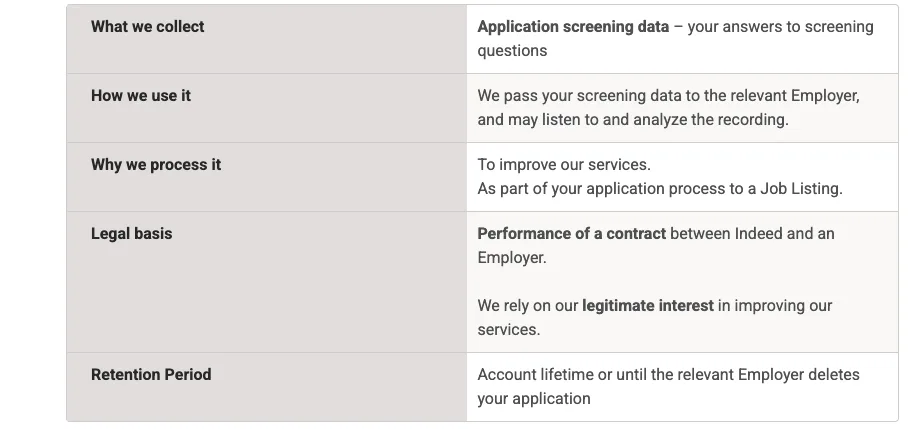
And here is the subtle difference in regarding retaining and use of demographic data – this is the demographic data collected in the job seeker profile – an entirely separate classification of data by Indeed.
How can I tell? – No veteran status (required for federal contractors), additions of conviction history and LGBTQ+ membership (data not collected under federal law).
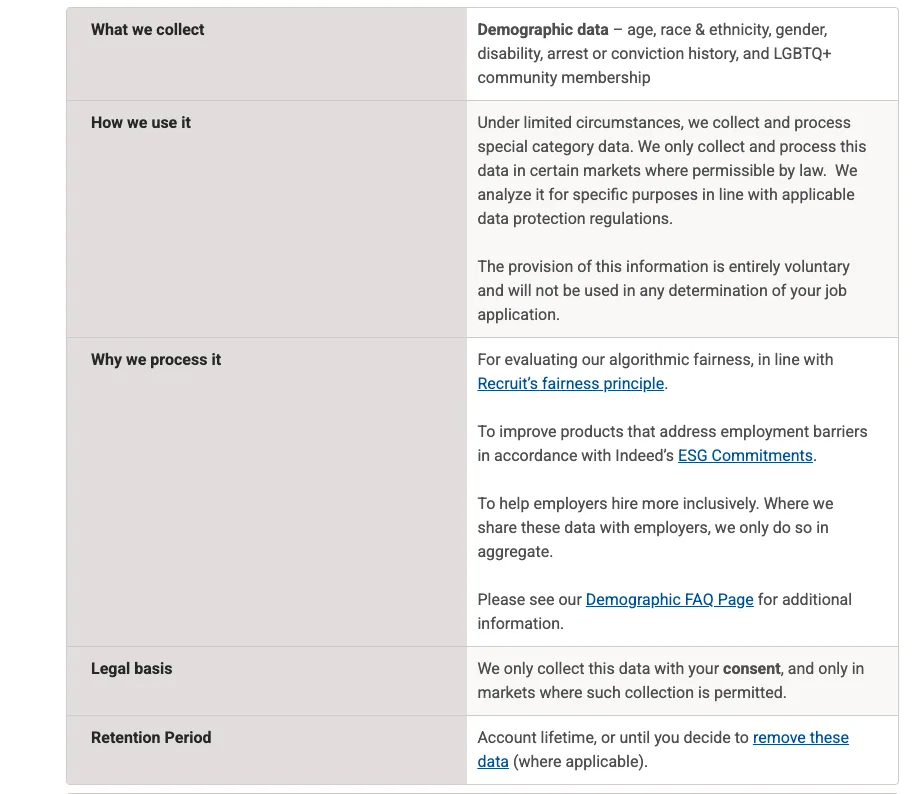
CAVEAT: When completing EEO questions on Indeed Apply, Indeed says this data usage is covered by the employer privacy policy. It says the data won’t be used by Indeed with a link out to their demographics FAQ, which does not explicitly say they will not use employer required data collected.
So if a jobseeker, bothers to go and check the privacy policy of a potential employer, they may well likely find that demographic data is shareable when completing certain activities on their site, like completing job applications. That data may be shareable in performance of a contract or service provided by the vendor.
Clear as mud? Yeah, that is the point. Could I be wrong? ABSOLUTELY. My counter – everything with Indeed is sloppy, cloaked in secrecy and shrouded in so round robins T and C’s it will literally have your head spinning.
OH MY GOD, I AM EXHAUSTED and this is getting really, really long.
So, I am going to stop here and give all of our brains a break. On Tuesday, I will release the next part of Reason #3 – Disposition Data. In addition to reviewing the loss of your candidate data, I will walk through how dangerous and potentially legally risky it could be when paired with EEO data. Next Friday, we will wrap up the end of the year Indeed series with contracts and AI.
These two pieces together, I believe, cement the case for giving Indeed the boot in 2026.
Until Next Time,
Julie “The Doc” Sowash
[Want to get Job Board Doctor posts via email? Subscribe here.]
[Got a tip, document or intel you want to share with the Doc? Tell me. Tip so hot you need it to be encrypted? Use Signal.]
Disclaimer: I am not a lawyer and you should not construe this to be legal advice. You may however construe it as a kick in the pants to get in front of your corporate attorneys to untangle the reality before you sign those long contracts and submit your company’s data to Indeed.

Comments (0)