
When Agents Meet Agents: Recruitment Has a New Scarcity Problem
 Recruitment has a new abundance problem.
Employers still struggle to find critical skills. According to ManpowerGroup, 74% of employers globally report difficulty finding the talent they need. Yet recruiters are processing more applications than ever.
Greenhouse’s latest benchmark, drawn from more than 640 million applications across over 6,000 companies, found that the average number of applications per job rose from 116 in 2022 to 244 in 2025, an increase of 111%. Over the same period, applications handled per recruiter increased by 412%.

Talroo brings clarity to improve new-hire retention
You filled the seat, but not with someone who plans to stay. The candidate made it through your entire interview process while quietly interviewing with other companies that pay 25% more.
When expectations aren't clear up front, retention suffers.
Get clarity up front with Talroo's SmartQualify.
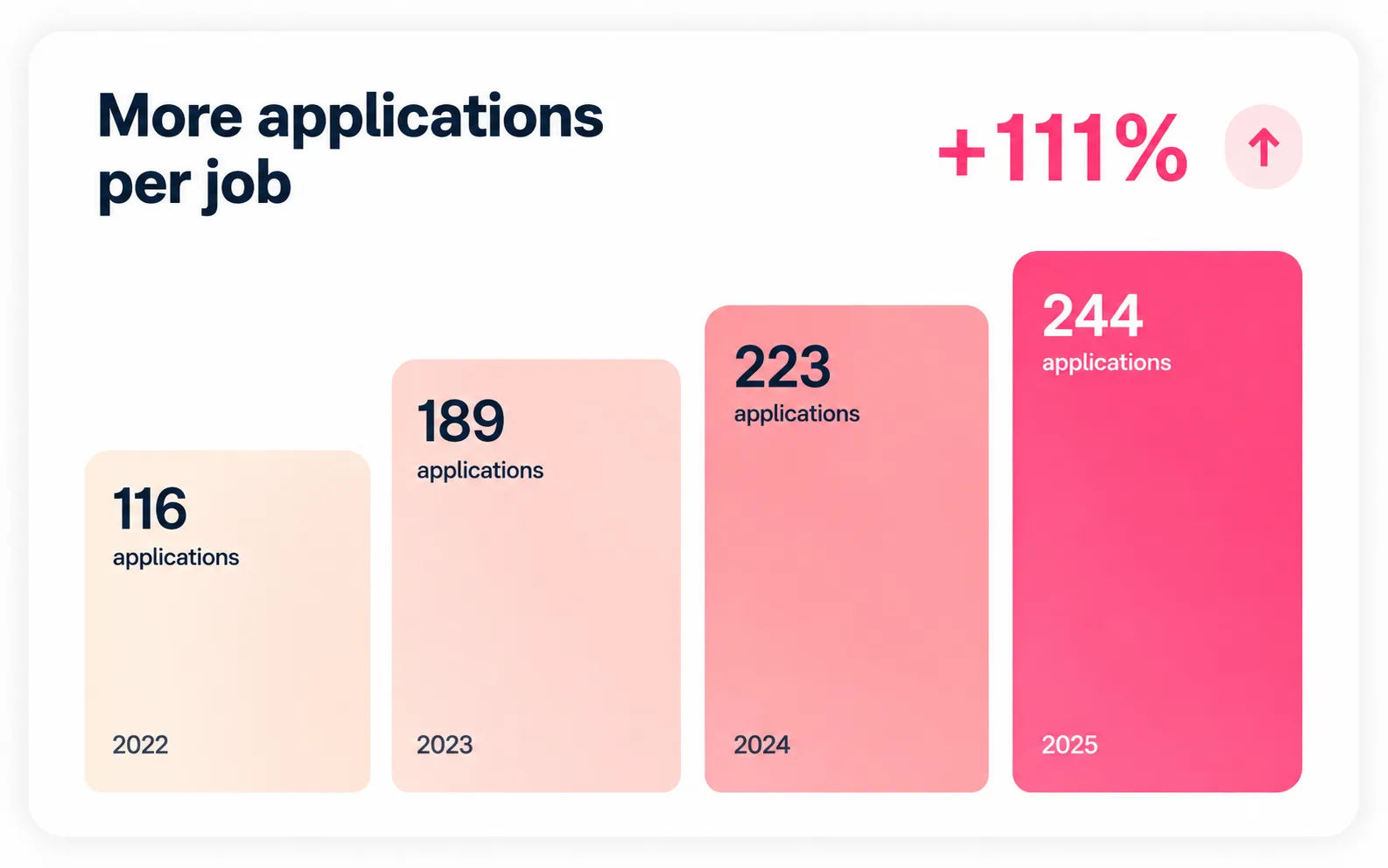
Those figures appear contradictory. How can talent remain scarce when applications are multiplying?
Because applications and talent are not the same thing.
An application is a claim about someone’s suitability. It may contain useful evidence, but it is not the talent itself. As AI makes applications faster to produce, easier to polish and increasingly possible to automate, the distance between the application and the person behind it is growing.
At the same time, employers are deploying their own AI agents to screen applications, communicate with candidates, conduct structured interviews and support shortlisting.
Hiring is entering an era in which agents increasingly meet agents.
The scarce resource will no longer be applications. It will be a reliable signal and the trust created when that signal can be understood, tested and challenged.
The application is separating from the applicant
Think about what an application used to represent.
A candidate found a vacancy, read it and decided it was worth pursuing. They updated a CV, perhaps wrote a cover letter, answered several questions and pressed submit.
None of that proved they could do the job. The effort involved was never a reliable measure of quality, and it was not always a fair test. It could disadvantage people applying in a second language, those with disabilities, people returning to work or candidates unfamiliar with modern application conventions.
But the process did place a natural limit on volume. It also provided at least a weak indication that the candidate had consciously chosen to pursue that particular role.
AI is weakening that relationship.
Candidates now routinely use AI to improve CVs, write cover letters, prepare assessment answers and present their experience more effectively. This can be enormously valuable. A capable candidate who struggles to write a CV can communicate their experience more clearly. Someone applying in a second language can remove errors that might otherwise distract from their suitability. A person who has not changed jobs for a decade can get help navigating unfamiliar conventions.
The problem is not that AI makes candidates worse. In many cases, it makes legitimate candidates better at applying.
The problem is that it makes almost everyone’s application materials better at roughly the same time.
When every candidate can produce a polished CV and tailored cover letter, polished writing tells an employer less about the person behind it. The information has not disappeared, but its value as independent evidence has weakened.
From AI-assisted to agent-led applications
We are also moving beyond candidates asking ChatGPT to improve a cover letter.
Greenhouse found that 22% of candidates already use bots to apply for jobs automatically, rising to 31% among Gen Z. That points towards a much bigger shift: from AI-assisted applications to agent-led job seeking.
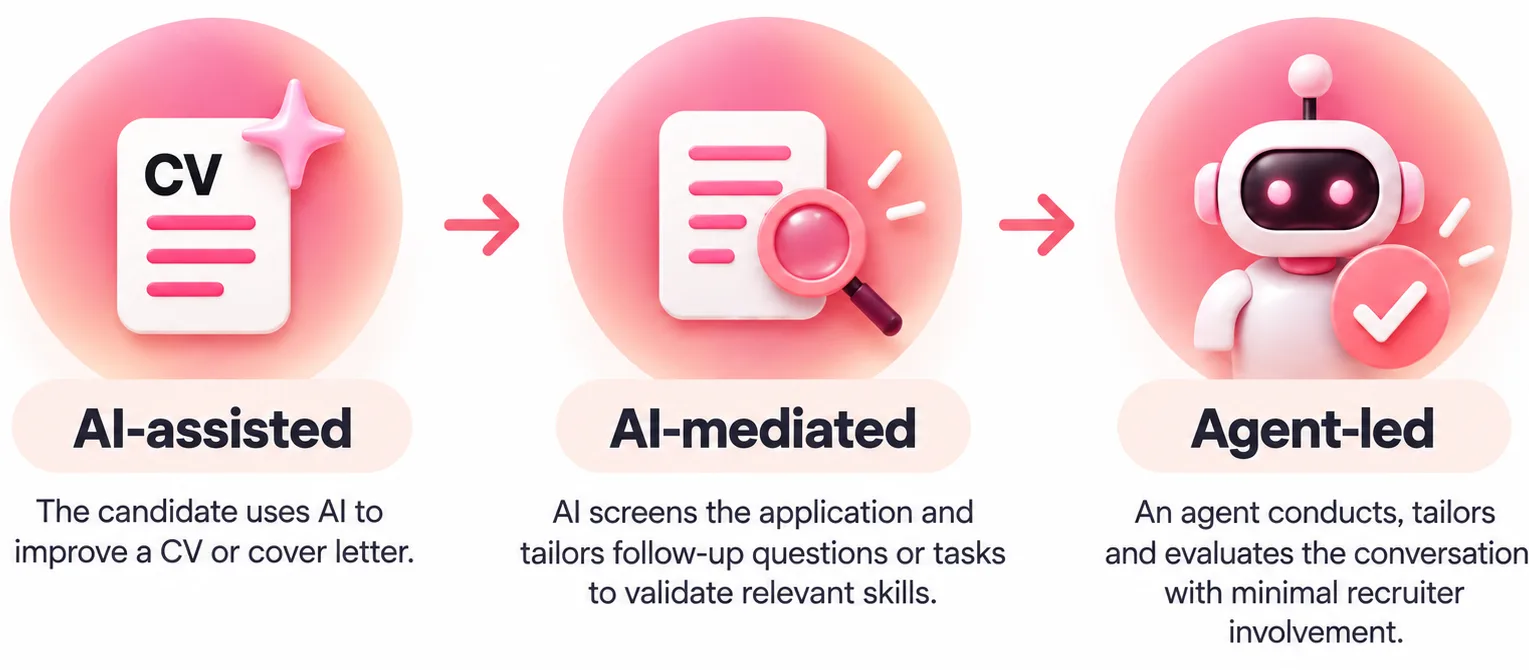
Imagine a candidate looking for work several years ago. They might identify ten interesting vacancies in an evening and complete two or three applications.
Now imagine that search delegated to an agent. It could scan hundreds of vacancies, compare them with the candidate’s skills, salary expectations, location and preferences, rank the best matches and tailor the application materials. With the candidate’s permission, it could increasingly handle much of the submission process too.
That could improve access. Candidates may discover relevant opportunities they would otherwise miss, and employers may reach people who would never have found their vacancy.
It also changes the economics of applying. When the time and effort required for each additional application approaches zero, volume can grow almost without limit.
Recruiter capacity cannot.
The consequences are already becoming visible: relevant candidates are buried inside larger pools, response times lengthen and recruiters become more dependent on blunt filters simply to make the workload manageable. Candidates receive less meaningful feedback, encouraging them to apply even more widely.
The result is a self-reinforcing cycle. Easier applications create more volume; more volume produces poorer candidate experiences; poorer experiences encourage candidates to spread their chances across even more roles.
The traditional top-of-funnel model begins to break.
Better applications, weaker signals
For years, recruitment has relied on imperfect proxies.
A well-written CV could suggest communication ability. A carefully tailored application might indicate interest. Previous employers, job titles, qualifications and career progression were used to infer capability.
AI does not make those signals useless, but it does make them less dependable on their own.
A fluent cover letter may demonstrate the quality of the tool rather than the candidate’s writing. A perfectly tailored CV may reveal little about how carefully the person considered the opportunity. An impressive answer to an application question may have been written, rewritten and optimised by an AI assistant.
This creates an uncomfortable question for employers: what exactly are we measuring when we assess materials created partly, or entirely, by AI?
The answer cannot be to penalise candidates for using it. Employers are already using the same technology to write job descriptions, source candidates, personalise communications and automate administrative work. Demanding that candidates avoid tools employers freely use would be both unrealistic and hypocritical.
Instead, employers need stronger evidence of what someone can do.
That is one reason skills-based hiring has gained momentum. LinkedIn found that 93% of talent acquisition professionals believe accurately assessing candidates’ skills is crucial to improving quality of hire. Companies making the greatest use of skills-based searches were also 12% more likely to make a quality hire.
But replacing weakened CV signals with more assessment does not solve the whole problem. How that evidence is collected, interpreted and explained matters just as much.
Candidates are using AI. They just do not necessarily trust yours
This is one of the most revealing contradictions in the market.
Candidates are increasingly comfortable using AI on their own behalf while remaining deeply suspicious of employers using it to evaluate them. Gartner found that only 26% of candidates trust AI to assess them fairly, while 52% believe AI is already screening their application information. One in four said they would trust an employer less if AI were used to evaluate them.
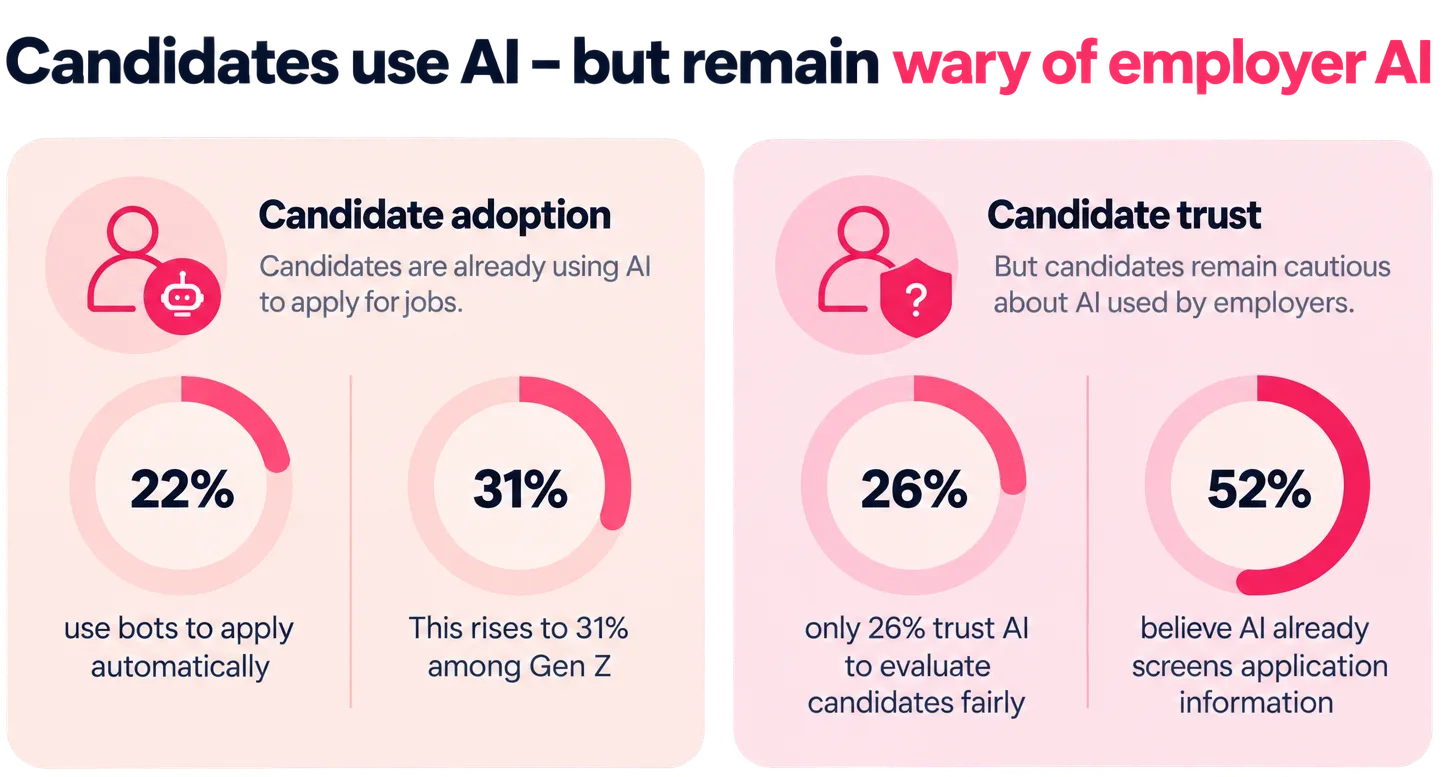
That difference is understandable.
Candidates can see and control the AI they use. They know what they asked it to do. They can inspect the CV it produced, change an answer or reject a recommendation.
Employer-side AI asks them to surrender that control. A system they cannot see may be analysing their history, interpreting their answers, assigning scores or influencing whether they progress.
That distrust should not be dismissed as resistance to technology. Candidates have good reason to question systems that can affect their livelihood while revealing little about the evidence, criteria or logic behind a recommendation.
If an agent is involved in screening, interviewing or scoring someone, several questions need clear answers:
- What information was assessed?
- Which criteria were used?
- Were those criteria genuinely relevant to the job?
- How was the recommendation reached?
- Can a recruiter examine and challenge it?
- Who remains accountable for the final decision?
If a recruiter cannot explain why an AI system recommended one candidate over another, that system is not ready to influence a hiring decision.
Recruiter agents need to do more than process volume
Candidate agents will inevitably accelerate the use of recruiter-side automation. Employers cannot respond to almost unlimited application generation by asking already-stretched recruiters to work through every submission manually.
But speed alone is a weak objective. A recruiter agent that processes thousands of applications through an opaque scoring model may reduce administrative work while making the underlying hiring decision no better. It may also reject strong candidates more efficiently.
The real opportunity is to recover the signal being lost in increasingly standardised application materials.
That means looking beyond whether a CV contains the right keywords. It means gathering job-relevant evidence through structured questions and conversations, assessing it consistently and showing recruiters the reasoning behind any recommendation.
Human oversight also needs to mean more than placing a recruiter at the end of an automated process to approve its output. The recruiter must be able to understand the evidence, challenge the recommendation and make a different decision.
The goal should be to screen people in: to identify relevant capability that an unconventional career path, missing keyword or imperfectly written CV might otherwise conceal.
What this means for job boards
For job boards, agent-led applications create an uncomfortable commercial question.
If software can generate applications almost without limit, application volume becomes a weaker measure of marketplace value. A board that delivers twice as many applications has not necessarily created twice as much value for an employer. It may simply have delivered twice as much work.
The metrics will need to move downstream: relevance, verified interest, progression, interview conversion and ultimately hiring outcomes.
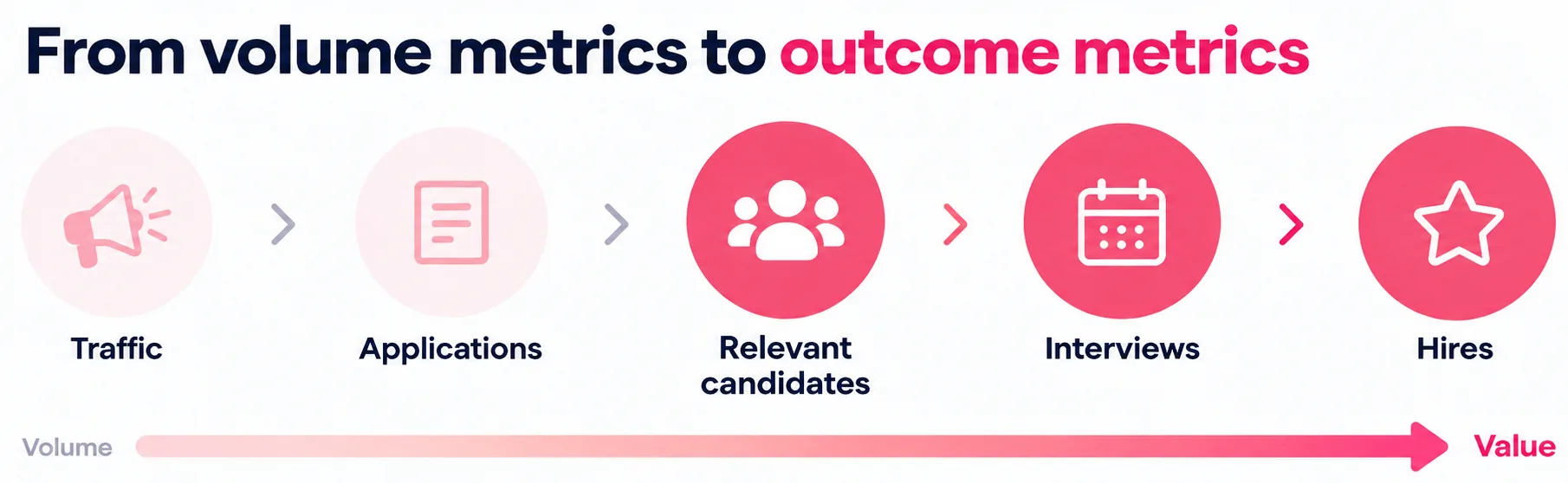
Job boards may also need to distinguish between different types of applications. Was it submitted directly by a person, prepared with AI assistance or completed by an agent acting on the candidate’s behalf? Automated does not automatically mean irrelevant, but employers will want to understand the source and level of candidate involvement.
The change affects the other side of the marketplace too. Candidate agents will need accurate, structured and machine-readable job information. They will need to know whether a role is still open, where it can be performed, what it pays, which requirements are essential and whether the employer is genuine.
Poor job data will no longer frustrate only human candidates. It will also produce poor agent decisions at enormous scale.
This creates a larger role for job boards as trust infrastructure. They can verify employers and vacancies, improve the quality and structure of job information, detect abusive automation and provide stronger evidence of candidate relevance and intent.
The boards that continue to sell traffic and application volume alone risk becoming suppliers of noise. Those that can prove quality, authenticity and outcomes will become more valuable to both sides.
Building for an agent-to-agent market
At VONQ, this thinking is shaping how we are building EQO®, our Talent Attraction Platform.
EQO connects six stages of talent attraction: Write, Distribute, Attract, Screen, Interview and Score, within one agentic workflow. Its specialised agents combine evidence from the application and structured candidate conversations, helping recruiters identify relevant people without depending solely on the CV.
The more important design choice is how those recommendations are used.
AI should support hiring decisions, not own them. We capture that principle through our HEAT framework: Human-in-the-loop, Explainable, Audit-ready and Transparent.
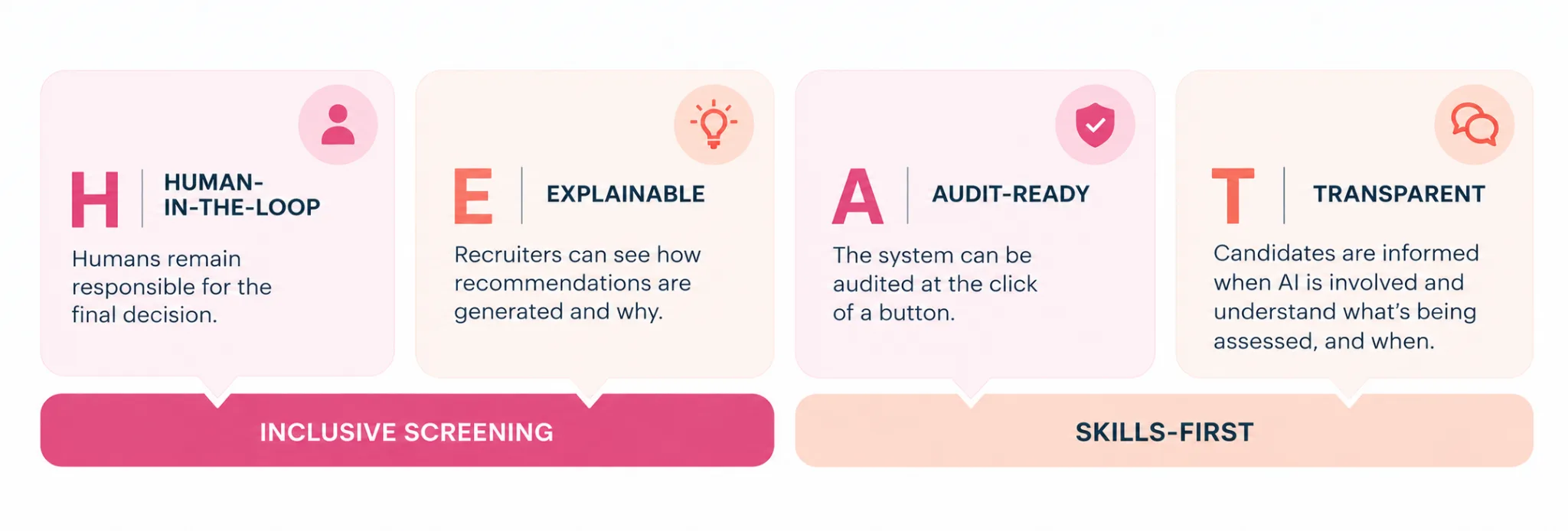
Recruiters retain responsibility for the decision, scoring rationales are visible and traceable, and recommendations can be examined rather than accepted blindly.
EQO’s screening and interview capabilities have also undergone independent assessment by Warden AI. As regulation develops, auditability, transparency and meaningful human oversight will need to be treated as product requirements, rather than promises added to the marketing afterwards.
Matching candidate-side automation with employer-side automation is not enough. If we simply place another black box on the opposite side, we replace a capacity problem with a credibility problem.
When agents meet agents
The arrival of candidate agents does not make the application obsolete. It changes what employers can reasonably infer from it.
A polished CV will reveal less about a person’s writing ability or the effort they invested. Application volume will reveal even less about the actual availability of talent. Employers will need to replace those weakened proxies with stronger evidence: job-relevant skills, structured conversations, transparent criteria and recommendations that people can examine and challenge.
Job boards and recruitment platforms face the same choice. They can help both sides generate and process ever-greater volumes, or they can build the infrastructure that makes those interactions more relevant, verifiable and trustworthy.
The next competitive advantage in recruitment will not come from processing the greatest number of applications. It will come from producing the clearest evidence while preserving confidence on both sides of the hiring process.
When agents meet agents, scale becomes cheap. Credibility becomes valuable.
Sources
- ManpowerGroup, Rehumanizing the Candidate Experience
- Greenhouse, Hiring Benchmarks 2026: The Hire Standard
- Greenhouse, 2025 Workforce & Hiring Report
- Gartner, Just 26% of Job Applicants Trust AI Will Fairly Evaluate Them
- LinkedIn, The Future of Recruiting 2025
Got a tip, a press release that deserves a closer read, or a correction? Send it my way. The tip line is always open.
[Want to get Job Board Doctor posts via email? Subscribe here.]

Comments (0)