Job Postings Are Up. How They Reach Candidates Is Changing.
 Happy Friday, Job Board Doctor friends! This week, we have our monthly analysis provided by the team at Aspen Tech Labs. I’ll be back next week. Enjoy! -The Doc.
Q3 2026 in brief: U.S. job postings reached 6.74 million in September 2026, up 5.7% YoY, according to Aspen Tech Labs’ JobMarketPulse data. Growth was broad: 44 of 51 states (including DC) and 19 of the 20 largest metros posted more jobs than a year ago. The bigger story for job boards sits underneath that growth, in which channels carry those jobs to candidates. Read the full Q3 2026 JobMarketPulse report.
Three shifts in how jobs reach candidates

Talroo brings clarity to improve new-hire retention
You filled the seat, but not with someone who plans to stay. The candidate made it through your entire interview process while quietly interviewing with other companies that pay 25% more.
When expectations aren't clear up front, retention suffers.
Get clarity up front with Talroo's SmartQualify.
- Healthcare demand surged through agencies. Agency nursing postings rose 64.4% YoY, while direct-employer nursing postings fell 1.7%.
- Google for Jobs reshuffled. Glassdoor’s share of apply buttons fell from 4.7% to 1.9%, Indeed retook the top spot from LinkedIn at 19.7%, and Recruit’s combined share across its job sites held steady.
- Direct apply dipped. Employer career site and ATS links fell from 12.0% to 10.2% of Google for Jobs apply buttons between August and September, a one-month move worth watching.
Also in the report: hybrid postings rose 69.3% and remote postings 22.0%. September payrolls added 29,000 jobs in the first BLS estimate, a figure that will be revised in the coming months.
Why are staffing agencies posting more healthcare jobs?
Direct employers and agencies moved in opposite directions. In September 2026, agency nursing postings rose 64.4% YoY, while direct-employer nursing postings fell 1.7%. Healthcare and nursing now make up more than half of all recruiting agency postings.
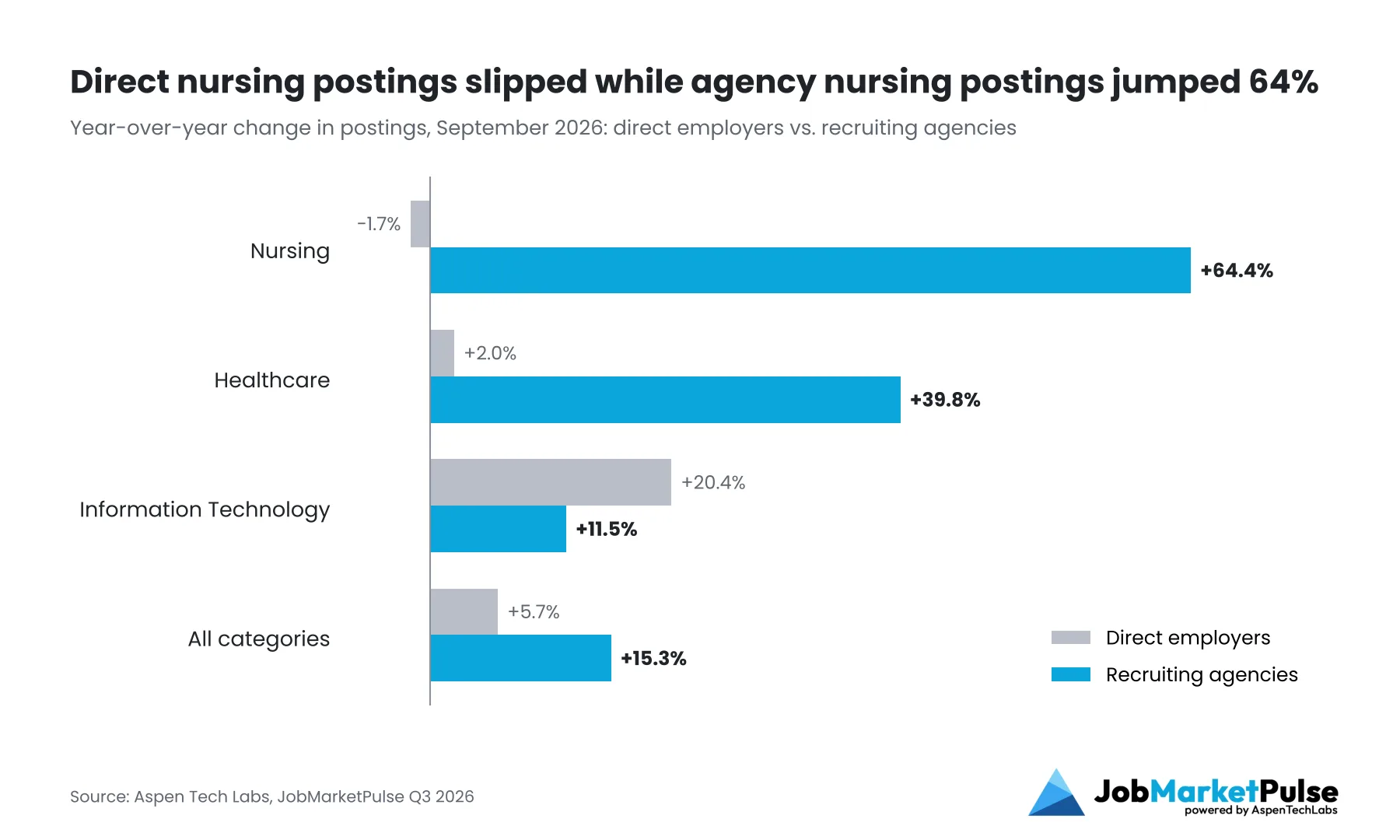
Looking only at direct employers, healthcare looks like it’s cooling. Nationally, healthcare postings were up just 2.0% YoY and down 1.8% from June, and nursing fell 1.7% YoY. The pullback shows up locally too: in Sacramento, the weakest large metro in Q3, Sutter Health and CommonSpirit both cut postings.
Now look at staffing agencies, which JobMarketPulse tracks separately and leaves out of the direct-employer numbers above.
| Category | Direct employers, YoY | Recruiting agencies, YoY | Agency postings, Sept 2026 |
| Nursing | −1.7% | +64.4% | 565,793 |
| Healthcare | +2.0% | +39.8% | 330,384 |
| Information Technology | +20.4% | +11.5% | 123,051 |
| All categories | +5.7% | +15.3% | 1.57 million |
Agency nursing postings rose 50.5% in a single quarter. Total agency postings climbed to 1.57 million in September, up from a February low of 1.2 million, and their growth rate jumped from 2.7% in Q2 to 15.3% in Q3. The busiest posters were healthcare names: Soliant Health, Medical Solutions, Nomad, and AMN Healthcare, plus Gpac.
Pay tells the same story. Frontline healthcare leads the titles in Aspen’s Q3 pay table. Certified Nurse Assistant pay rose 9.3% YoY, to $22.95 an hour. Registered Nurse pay rose 5.1%, to $108,160, faster than the 3.6% it grew in Q2. Rising advertised pay is hard to square with falling demand.
One caution: an agency posting signals demand, not a placement. Agencies post when a facility places an order, and that order may take weeks to fill, or may not be filled at all.
IT runs the other way. Direct-employer IT postings grew almost twice as fast as agency IT postings. In IT, more demand is coming straight from employers. In healthcare, more of it is coming through agencies.
Why it matters for job boards: if you run a healthcare board, the buyer mix is shifting under you. A growing share of nursing demand now comes through agency postings. That changes who you sell to, how you handle duplicate listings, and what candidates see when several agencies post the same opening.
Who leads Google for Jobs in 2026?
Indeed led Google for Jobs apply buttons in September 2026 with a 19.7% share, ahead of LinkedIn at 17.8%. That was a switch of the top position, as LinkedIn led in July and August. Together with ZipRecruiter, the top three held about 47% of apply buttons in Q3.
When a job seeker searches on Google, apply buttons decide where they click. The biggest move happened inside one company. Glassdoor’s share fell from 4.7% in July to 1.9% in September, more than half its presence gone in one quarter. Recruit Holdings as a whole didn’t lose ground, though. Its combined share across Indeed, SimplyHired, and Glassdoor was nearly unchanged (26.1% to 26.7%), with Indeed gaining about 1.9 points and SimplyHired about 1.5.
| Google for Jobs apply-button share, September 2026 | Share |
| Indeed | 19.7% |
| 17.8% | |
| Employer career sites / ATS | 10.2% |
| Glassdoor | 1.9% |
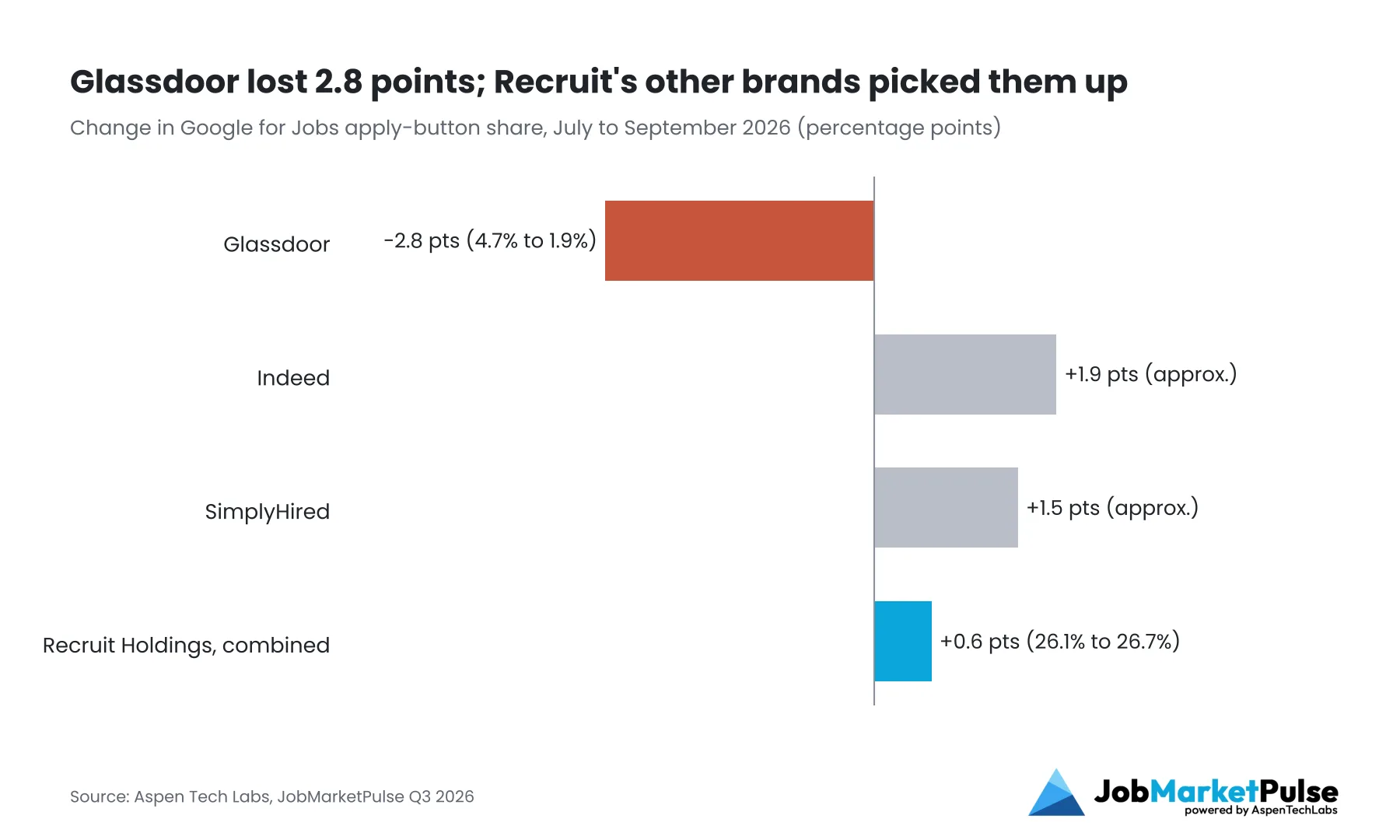
That looks less like Glassdoor losing a fight and more like Recruit deciding where its traffic goes. In July 2025, Recruit announced it would integrate Glassdoor into Indeed as part of cutting about 1,300 jobs across its HR tech business. Glassdoor’s CEO left that October. A year later, the Google for Jobs data is consistent with that integration: as Glassdoor’s share fell, Indeed and SimplyHired gained, and Recruit’s combined share held up.
Are employers’ own apply buttons losing ground?
Yes, slightly. Employer career site and ATS apply links fell from 12.0% of Google for Jobs apply buttons in August 2026 to 10.2% in September, averaging about 11% across Q3. The “direct apply will eat the job boards” prediction gets made every few years. On Google for Jobs, at least, September pointed the other way. A 1.8-point drop in one month isn’t a trend on its own, but roughly nine in ten Google apply buttons now point somewhere other than the employer.
One caution on all of this: these are three months of share data. We’d call the Glassdoor shift a structural story, and the Indeed-versus-LinkedIn lead and the direct-apply dip month-to-month moves worth watching, not verdicts.
Why it matters for job boards: if you syndicate to Glassdoor or price against it, the audience you’re paying for may now be sitting on Indeed. And if a single owner can move 2.8 points of share between its own brands in a quarter, “share of Google apply buttons” is partly a corporate decision, not just a measure of what job seekers prefer.
Also in the report: how fast are remote and hybrid postings growing?
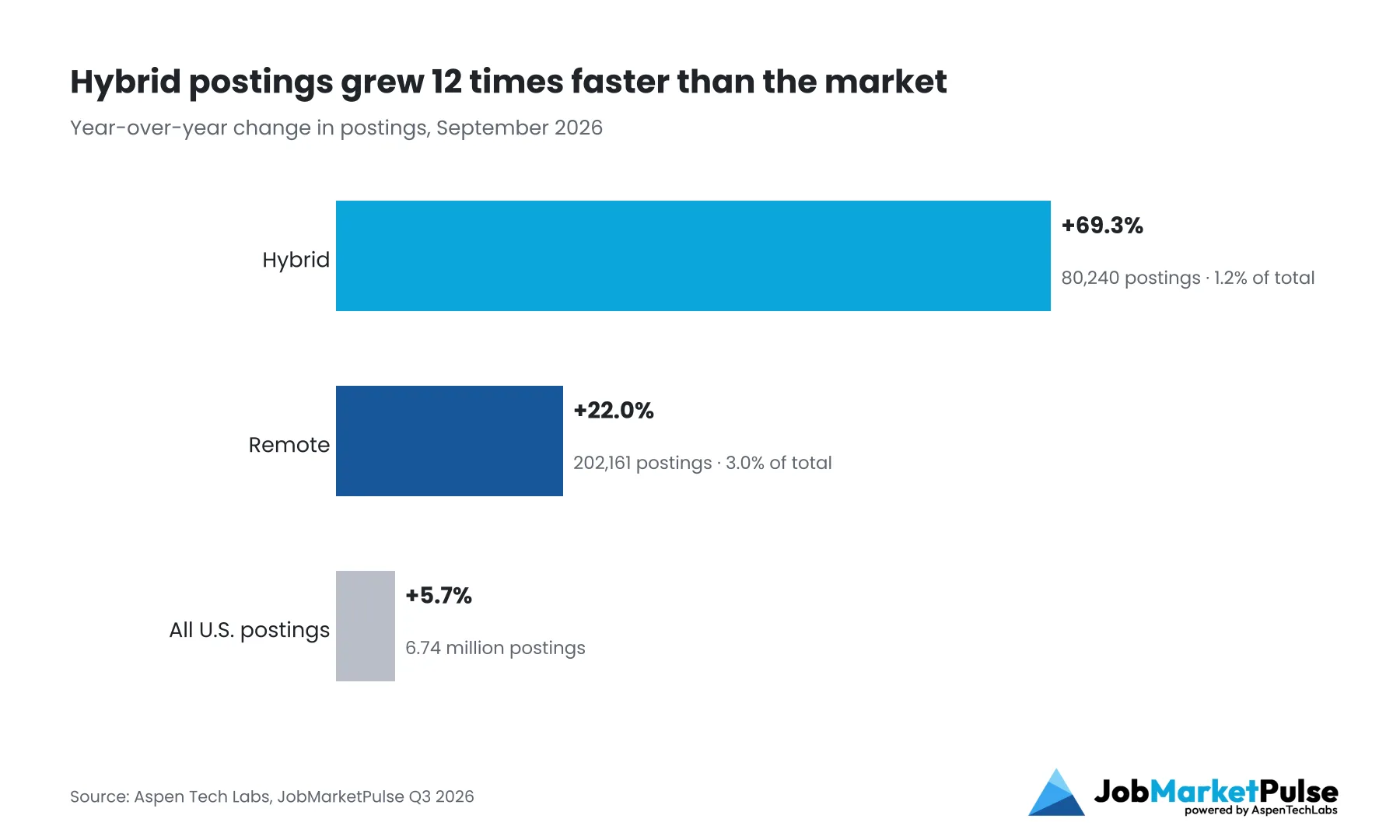
Hybrid job postings rose 69.3% YoY in September 2026, and remote postings rose 22.0%, against 5.7% growth for all U.S. postings. Remote reached 202,161 postings and hybrid 80,240, together about 4.2% of all postings, up from about 3.3% a year earlier.
The growth is concentrated in white-collar categories. Business Services led remote postings (27,639, up 24.7%), followed by IT (24,215, up 22.2%). IT led hybrid (10,666, up 70.4%). Engineering hybrid postings more than doubled, up 134.9% to 5,422, though from a small base. Boards that can reliably tag and surface these listings have something aggregators that lump everything together don’t.
How do job postings compare with government data?
Government data paints a softer picture. Nonfarm payrolls added 29,000 jobs in September in BLS’s first estimate, against a consensus of about 90,000. July and August were revised down by a combined 60,000, and September’s figure will be revised too. Unemployment ticked up to 4.2%. JOLTS openings slipped to 7.08 million in August, and there’s now roughly one opening per unemployed worker (1.01), down from 1.04 in May.
The sources measure different things on different clocks. Payrolls count net jobs added and get rewritten for months afterward. JOLTS runs a full month behind posting data. Postings show employer demand as it happens, by category, location, and channel.
For job boards, that timing matters. When government data is slow and subject to revision, posting data is the earliest read on where demand is moving.
What should job boards do with the Q3 2026 data?
Q3 demand was healthy, but more of that volume flowed through intermediaries. Four things to act on:
- Rethink your healthcare buyer list. If you serve healthcare, agencies are posting a growing share of nursing demand. Plan for who you sell to and how you handle duplicate listings.
- Check where your Glassdoor traffic went. If you syndicate to or price against Glassdoor, see whether that audience now sits on Indeed or SimplyHired. Watch Indeed versus LinkedIn in Q4 before calling a winner.
- Don’t plan around direct apply taking over. Employer career sites dipped on Google in September even as postings grew.
- Read postings next to government data. Payrolls and JOLTS lag and get revised. Postings show where demand is moving now, so use both when planning for Q4.
Boards that know which channel their postings arrive through, and which channel their candidates leave through, will read Q4 more clearly than boards watching the headline count.
Get the full picture: the Q3 2026 JobMarketPulse report covers metros, employers, salaries, and seasonal hiring in more detail.
Until next month,
The Aspen Tech Labs Data Team
Frequently asked questions
Are staffing agencies posting more healthcare jobs in 2026?
Yes. Recruiting agency postings for nursing rose 64.4% YoY in September 2026, and agency healthcare postings rose 39.8%. Direct-employer nursing postings fell 1.7% over the same period. Healthcare and nursing now make up more than half of all agency postings.
Which job board has the largest share of Google for Jobs apply buttons?
In September 2026, Indeed held 19.7% of Google for Jobs apply buttons and LinkedIn held 17.8%, according to JobMarketPulse. LinkedIn led in July and August. Indeed, LinkedIn, and ZipRecruiter together held about 47% of apply buttons in Q3 2026.
Why did Glassdoor’s share of Google for Jobs drop in 2026?
Glassdoor’s share of Google for Jobs apply buttons fell from 4.7% in July 2026 to 1.9% in September. Its parent, Recruit Holdings, announced in July 2025 that it would integrate Glassdoor into Indeed. Recruit’s combined share across Indeed, SimplyHired, and Glassdoor was nearly unchanged (26.1% to 26.7%), with Indeed and SimplyHired picking up share.
How many job postings were there in the U.S. in Q3 2026?
Aspen Tech Labs’ JobMarketPulse counted 6.74 million U.S. job postings in September 2026, up 5.7% YoY. Recruiting agency postings reached 1.57 million, up 15.3%.
Are remote and hybrid job postings increasing in 2026?
Yes. In September 2026, remote job postings rose 22.0% YoY to 202,161, and hybrid postings rose 69.3% to 80,240. Together they made up about 4.2% of U.S. job postings, up from about 3.3% a year earlier.
Data methodology
The findings in this analysis are based on Aspen Tech Labs’ JobMarketPulse platform, which collects job posting data directly from employer career websites, updated daily. Recruitment agency postings are excluded from all direct-employer trends and reported separately in the agency section. Google for Jobs figures reflect each provider’s share of apply buttons shown in Google’s job search results. Salary data reflects advertised compensation extracted from job listings and may not represent final offers. Job counts represent unique active postings per month, deduplicated, and exclude changes caused solely by improvements to Aspen’s data coverage. Because employers are added to and removed from the sample each month, earlier figures are restated in each new report; compare numbers within this report rather than against previously published releases. Government figures (payrolls, unemployment, JOLTS) are from the Bureau of Labor Statistics as summarized in the Q3 report.

Comments (0)