
How AI is reshaping talent attraction and what TA leaders must do next
PLEASE: Before you read this week’s content, please take this year’s survey and then share the survey with one other job board or recruitment site tech operator in your network. The data is only meaningful if we all participate.
2026-2027 GLOBAL RECRUITMENT SITE PLATFORMS SURVEY
The survey is still open. Fifteen minutes, anonymous, and respondents who leave an email get the full report before publication.
Executive Summary
The final months of the year traditionally bring renewed momentum to the talent market. Hiring priorities accelerate, candidate activity increases and pressure builds to deliver before year-end. In 2026, that seasonal momentum is colliding with a much bigger structural change.
AI is increasing the speed and volume of activity on both sides of hiring. Employers can create and distribute opportunities more efficiently, candidates can discover roles, research employers and submit increasingly polished applications with less effort. This creates three interconnected priorities for TA leaders:
- ▪ Attract: earn attention through compelling content, intelligent distribution and distinctive employer storytelling.
- ▪ Signal: uncover meaningful evidence of skills and potential as application volumes rise and traditional CV-led signals become less reliable.
- ▪ Trust: use AI transparently, with clear accountability and human oversight of consequential decisions.
The opportunity extends beyond automating individual recruitment tasks. As AI takes on more execution, TA teams increasingly orchestrate the hiring journey: setting the strategy and criteria, overseeing AI-supported recommendations and focusing human attention where judgement, empathy and accountability matter most.
This edition of VONQ View examines how TA teams can attract the right talent, identify stronger signals and build trust as AI changes both sides of hiring.
Autumn brings renewed hiring momentum
The 2025 data illustrates the seasonal pattern. In 2026, that familiar autumn acceleration is colliding with a broader structural shift: the growing use of AI by employers and candidates.
While September has traditionally been seen as the point when hiring rebounds after summer, the data suggests it is better understood as the beginning of a broader autumn hiring wave.
In the UK, Recruitment and Employment Confederation (REC) data shows new job postings jumped 11.3% between August and September 2025, reaching 742,967.1 Importantly, the momentum continued into Q4: October recorded a further 2.1% increase to 754,359 new postings, while the total number of active postings was 7.5% higher than in October 2024.2
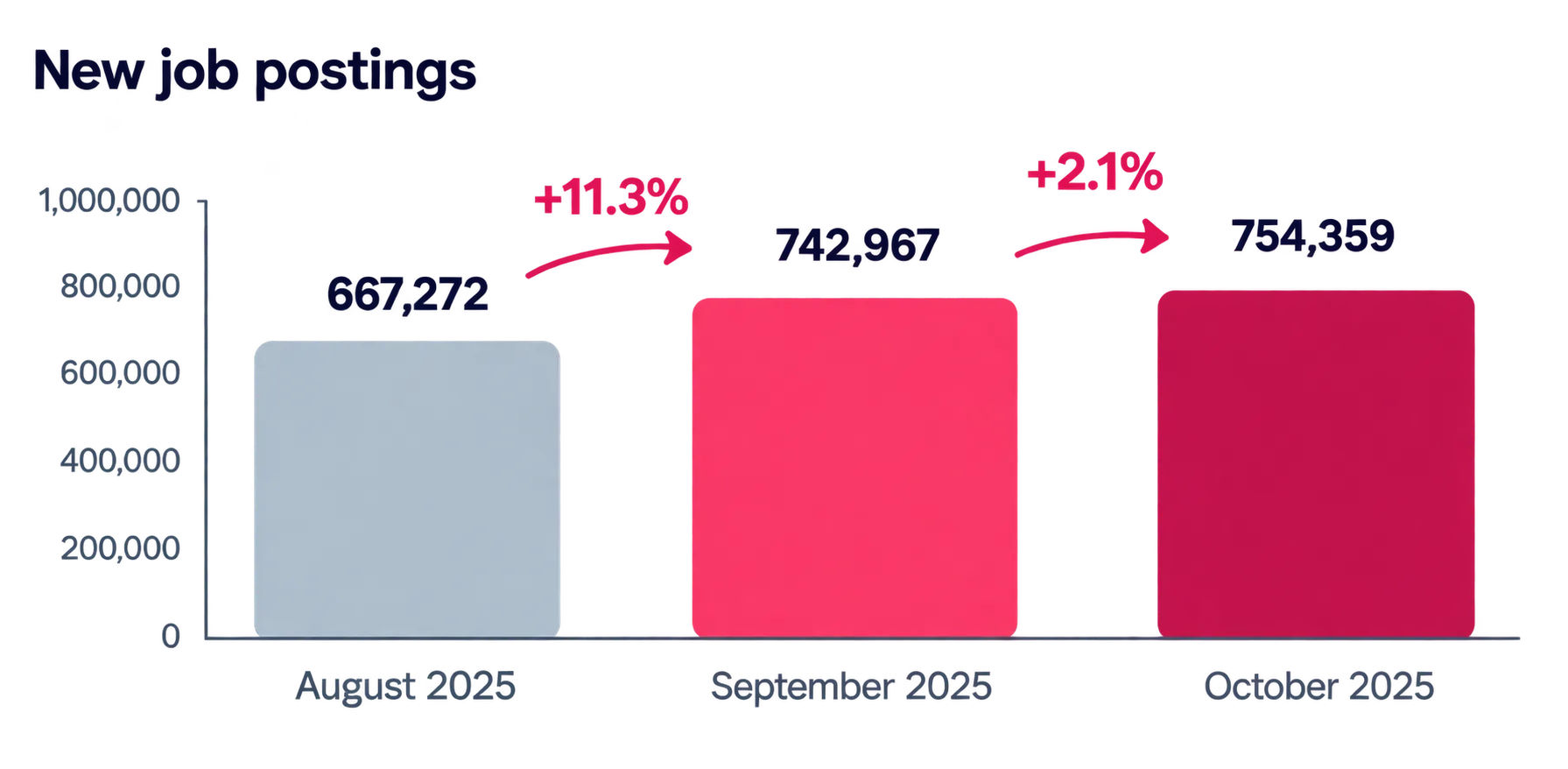
Source: Recruitment and Employment Confederation (REC), Labour Market Tracker, 2025.1 2
VONQ’s proprietary Job Marketing data provides a directional view of that autumn acceleration. Across a consistent sample of customers in financial services, industrial equipment and technology, applications to jobs distributed through VONQ increased 6.8% between August and September 2025, before rising a further 36.5% in October. Overall, applications increased 45.9% between August and October.3
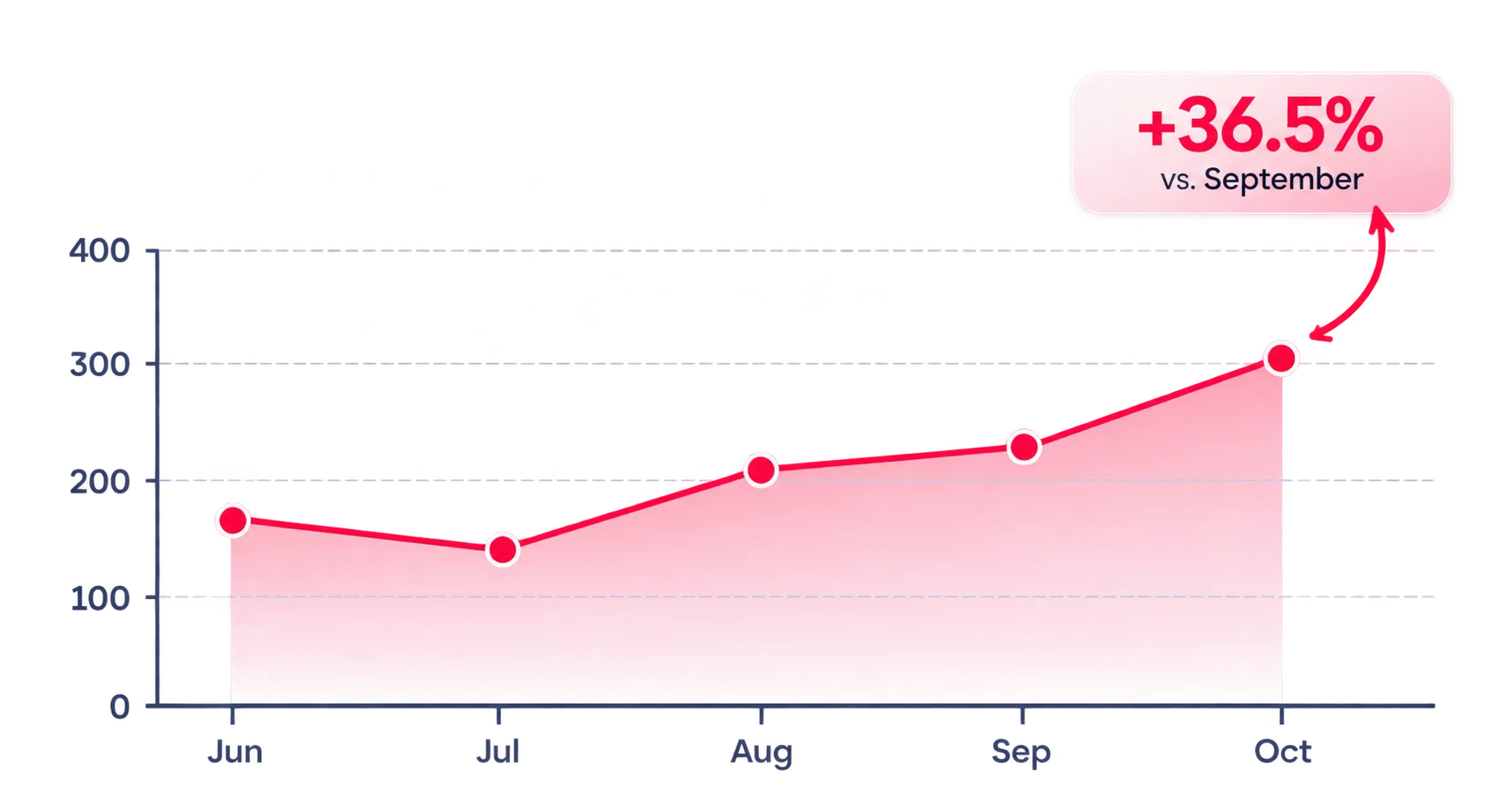
Source: VONQ Job Marketing platform data, 2025. Based on a consistent sample of three enterprise customers, primarily covering roles in Germany.
Candidate activity is rising too. VONQ data shows applications in September 2025 were 28.1% higher than the July and August average. The autumn market therefore combines rising hiring activity with renewed candidate activity, increasing pressure on both sides of the funnel.
This year, the autumn surge comes with an AI multiplier
In 2026, that familiar seasonal acceleration is colliding with a bigger structural shift. AI is making it easier for employers to create and distribute opportunities, while candidates can discover roles, research employers and prepare applications with less effort than ever before.
For TA teams, that makes returning to the usual recruitment routine increasingly difficult. Winning this autumn means being more deliberate about where technology and human attention create the greatest advantage. And that starts with the first challenge in the hiring journey: getting the right talent to notice you.
1. Winning Attention: How do employers become the opportunity candidates notice?
Talent attraction has become an attention challenge. Candidates encounter opportunities across job boards, search, social media, professional communities and a growing range of AI-powered discovery tools. Employers, meanwhile, can create and distribute recruitment content at unprecedented speed.
Publishing more vacancies or generating more content does not guarantee attention from the right people. Employers need to make three connected decisions: what to say, where to appear and how to make the opportunity distinctive.
Turn a job description into a reason to apply
For many candidates, discovery begins with a search. With 36% of job seekers searching for an exact job title, clear and discoverable content influences whether an opportunity is found.4 Visibility is only the first step; the content must also give candidates a reason to explore the role and apply.
AI can help employers produce consistent, audience-relevant content across roles, markets and languages. As discovery expands beyond traditional keyword search, the structure and clarity of job content will increasingly influence how opportunities are surfaced by both search engines and AI-powered tools.
How EQO helps: EQO Write creates on-brand job content across 30+ languages, optimised for traditional and AI-powered discovery, with checks for bias and inclusive language.
Be present where the right candidates are
 Recruitment media has become increasingly fragmented. Generalist job boards still matter, but candidates also discover roles through specialist platforms, aggregators, professional communities, search and social channels. There is no single channel mix that works equally well for every role, market or audience.
That makes distribution a decision problem rather than simply a publishing task. Instead of asking “Where should we post this vacancy?” employers need to ask “Where is this particular talent most likely to be reached, and which channels are actually performing?”
Data can make that decision increasingly dynamic. Historical performance can inform the initial media mix, while live campaign data can show where applications are coming from and where budget should move. The objective is not maximum reach. It is relevance.
How EQO helps: EQO Distribute connects multiposting, programmatic advertising and data-driven promotion across 5,000+ channels, using AI to recommend the right media mix and optimise spend based on performance.
Being seen is not the same as being noticed
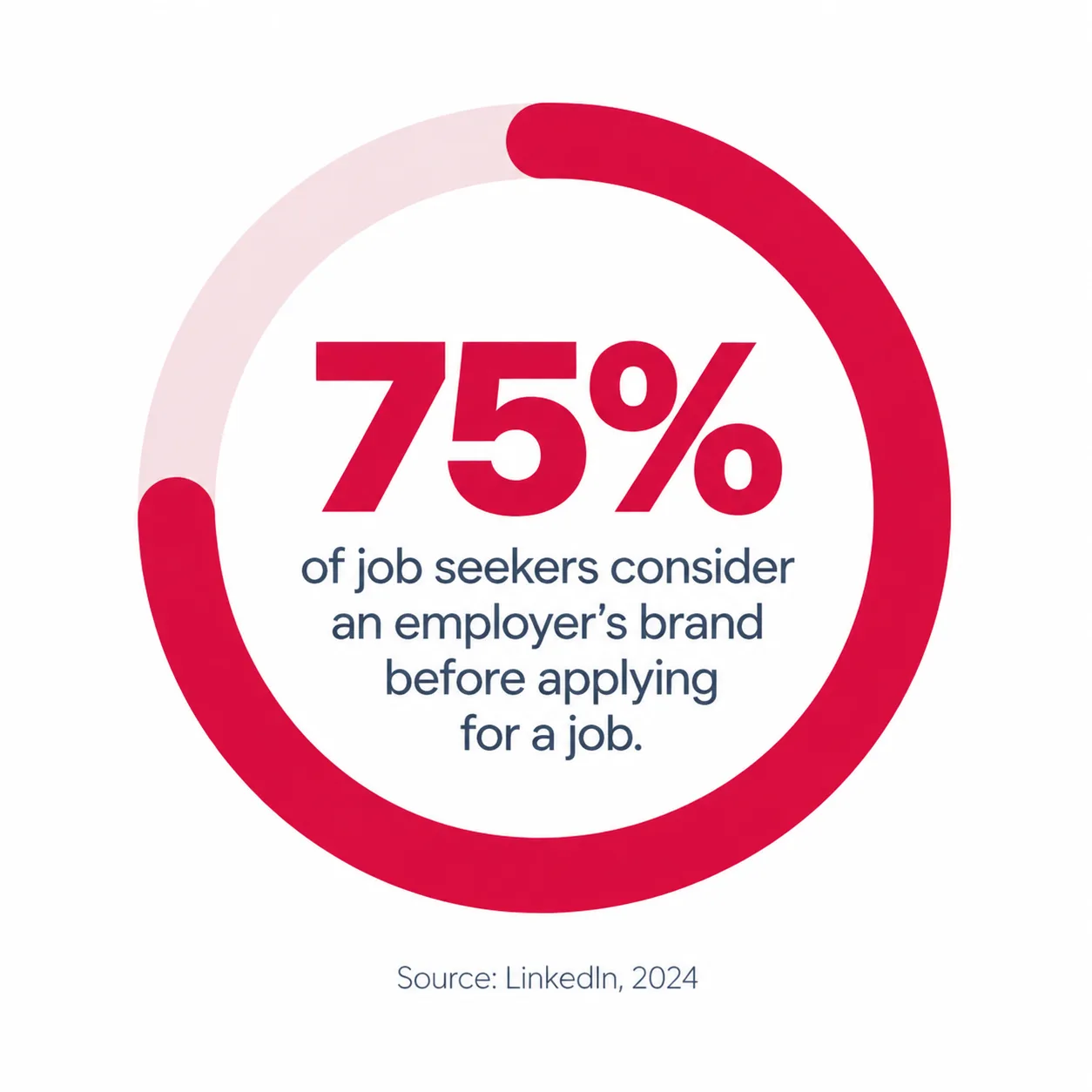 Reaching the right audience creates visibility; distinctive employer storytelling earns attention. With 75% of job seekers considering an employer’s brand before applying, candidates need to see more than a well-written job description.5
Short-form video, imagery and authentic employee stories can make opportunities more tangible. Always-on employer branding also builds familiarity before a specific vacancy gives someone a reason to act.
AI can help turn existing vacancy and employer-brand content into channel-specific creative at greater speed, while brand controls preserve consistency across audiences and markets.
How EQO helps: EQO Attract turns existing job content into on-brand video and image campaigns, optimised for the formats and audiences of Instagram, LinkedIn, Meta, Reddit, Google, X, Youtube, Threads and TikTok with a continuous stream of fresh creative to keep always-on campaigns relevant and engaging.
From attention to action
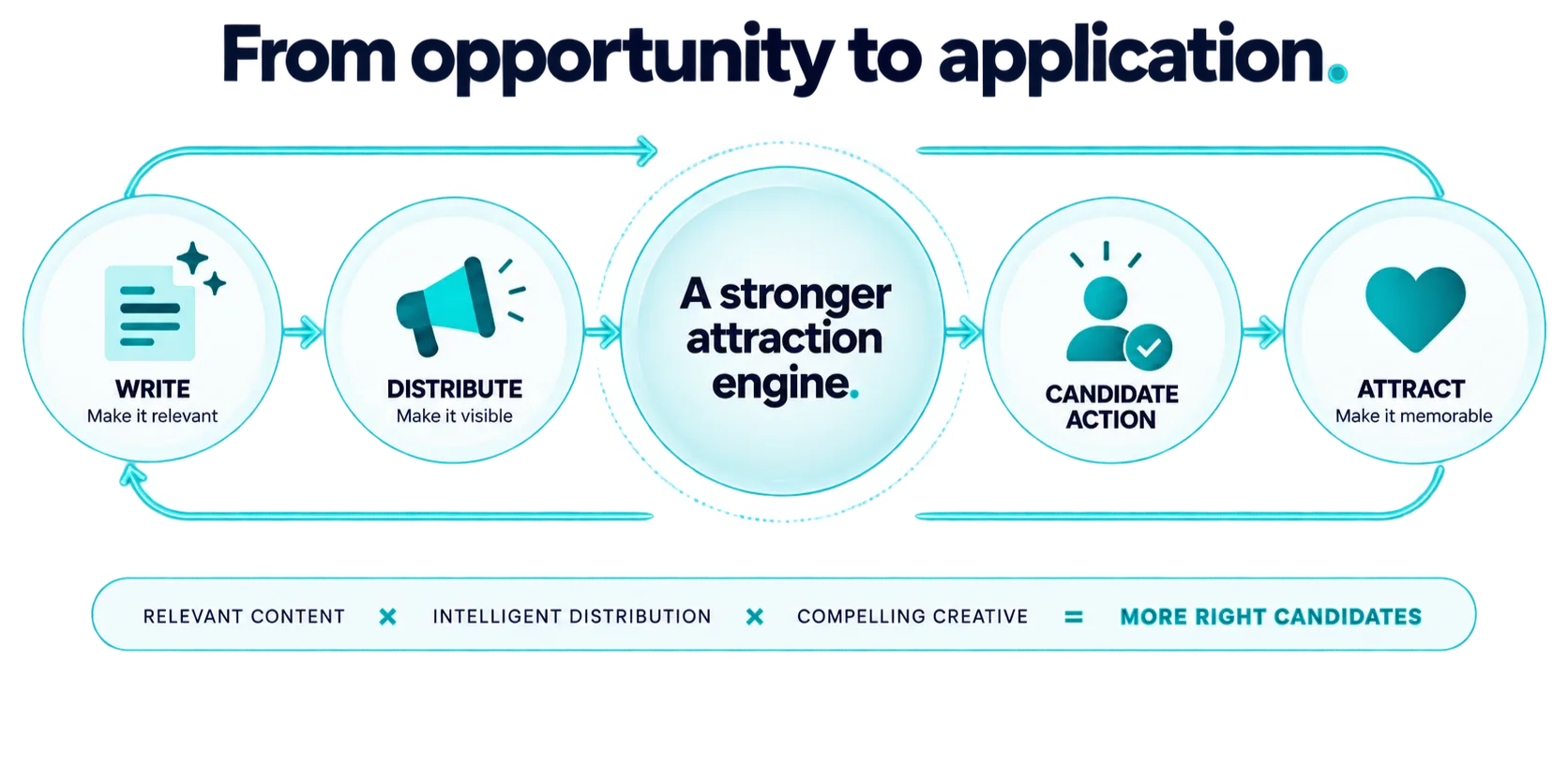
Winning attention means connecting the moments that bring candidates into the funnel: compelling content, intelligent distribution and employer storytelling. The advantage comes from making these work together as one attraction strategy.
But AI is changing both sides of hiring. As employers get better at reaching talent, candidates are using AI to find, assess and apply for more opportunities. The next challenge is no longer generating applications, but identifying the signal within them.
2. Signal: How can employers identify genuine potential when application volumes rise and every candidate looks polished?
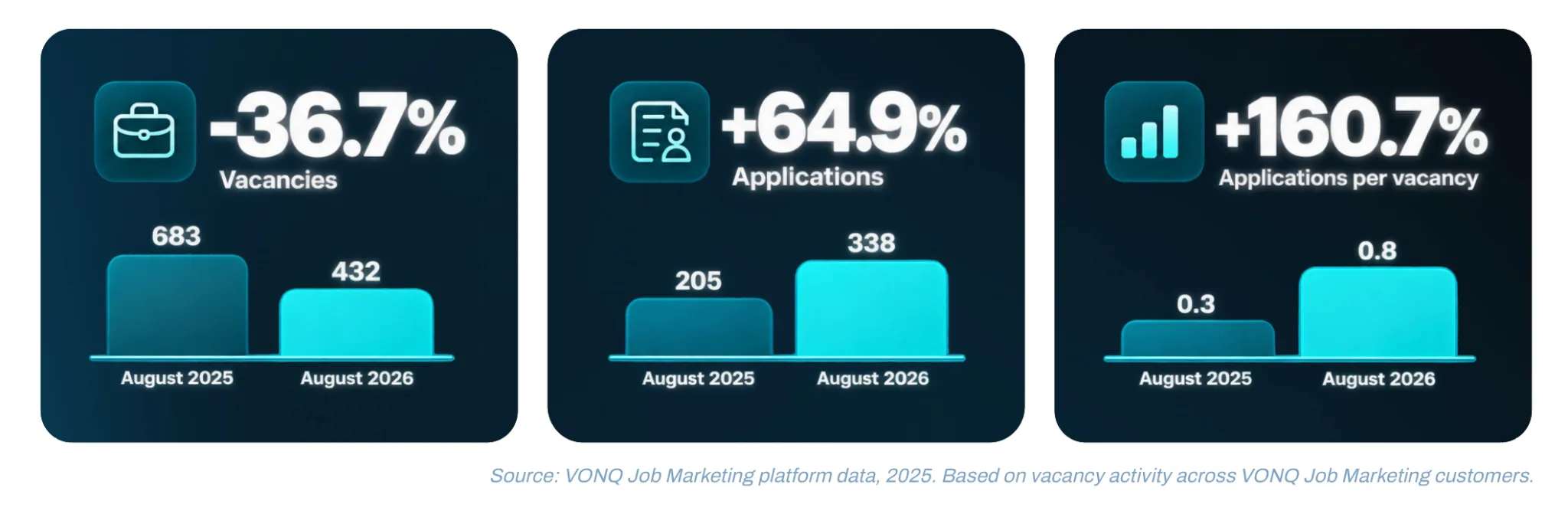
Application volume is rising faster than recruiter capacity. Across a consistent sample of VONQ enterprise Job Marketing customers in financial services, industrial equipment and technology, vacancies fell 36.7% between August 2025 and August 2026, while applications increased 64.9%. Applications per vacancy consequently rose by 160.7%.
The wider market shows the same pattern. Greenhouse found that applications per opening increased by 111% between 2022 and 2025. Applications handled per recruiter rose by 412%, while recruiters per organisation fell by 56%.6
TA teams are therefore evaluating far more candidates with fewer resources. The challenge becomes harder as AI enables applications to be tailored, polished and submitted at scale.

Higher application volumes combined with reduced recruiter capacity create a difficult equation. TA teams are being asked to evaluate dramatically more candidates with fewer resources. At the same time, average time-to-fill in the Greenhouse data increased from 43.6 days in 2022 to 59.7 days in 2025, a rise of 37%.6
The application is separating from the applicant
More applications are only part of the problem. AI can help legitimate candidates communicate their experience more effectively, but it also makes applications easier to polish, tailor and replicate.
That weakens some of the signals employers have traditionally relied on. A polished CV may reveal less about a candidate’s unaided writing or the strength of the underlying evidence. A highly tailored application may also reveal less about individual effort or intent.

And the shift is moving beyond AI assistance. Greenhouse found that 22% of candidates already use bots to apply automatically, rising to 31% among Gen Z.7
The issue is not candidates using AI. Employers use it too. The issue is that when every application can look polished, employers need better evidence to understand who can actually do the job.
Agent meets agent
Employers are responding with AI of their own. Among companies already using AI in hiring, Resume.org found 79% use it for resume review and screening, 66% for candidate assessments and 63% for applicant research.8 AI is also moving into candidate communication and interviews.

Source: Resume.org, AI Hiring Survey, 2025.
Candidate agents can help people pursue more opportunities. Employer agents can help TA teams process that additional volume.
But simply answering AI with more AI is not the advantage. The opportunity is to use employer-side AI to recover the signal behind increasingly abundant and polished applications.
When every application can look good, evidence becomes the differentiator
Gartner predicts that by 2028 one in four candidate profiles worldwide will be fake and contain material identity misrepresentation.9
Employers therefore need to move from asking “How good does this application look?” to “What evidence do we have that this person can do the job?”
Gather consistent early evidence at scale
The CV remains useful, but it cannot carry the full weight of early-stage selection, particularly when applications are increasingly polished with AI. Screening needs to go beyond what candidates have chosen to put on the page and identify the information recruiters actually need to assess relevance.
AI-led screening can engage candidates directly, complete missing information and surface relevant skills and experience before recruiter intervention is needed. This gives employers a more complete view of each candidate without asking recruiters to manually work through every application. The aim is to identify evidence of potential earlier and give recruiters a stronger basis for deciding where to focus their attention.
How EQO helps: EQO Screen engages candidates 24/7 across web, WhatsApp, SMS, email and voice, completing missing information and surfacing relevant evidence against role requirements.
Turn applications into evidence
Screening can establish relevance, but some capabilities only become visible through conversation. Structured AI-led interviews can explore achievements, clarify vague or incomplete answers and ask relevant follow-up questions when more depth is needed.
Running those conversations consistently also matters. When every candidate is asked questions against the same role-specific criteria, employers gain richer and more comparable evidence of what candidates can actually demonstrate, rather than relying on how effectively they present themselves on a CV. And because first-round interviews can happen without the usual scheduling burden, that depth does not have to come at the expense of recruiter capacity.
How EQO helps: EQO Interview assesses candidates against consistent role criteria, using adaptive follow-up questions to gather deeper evidence and give recruiters structured, comparable insights with transparent rationales.
Find the signal you can trust
More evidence only creates value if employers can turn it into a clear and defensible view of candidate relevance. Rather than treating the CV, screening and interview as separate stages, the evidence gathered across them can be assessed together against the skills and criteria that matter for the role.
This moves selection beyond simple CV-to-job matching towards a more complete picture of what a candidate has demonstrated and why they are relevant. But as AI plays a greater role in that assessment, explainability becomes essential. Gartner found that only 26% of candidates trust AI to evaluate them fairly.10 Recruiters therefore need to understand what contributed to a score, examine the supporting evidence and challenge a recommendation when necessary.
The objective is not for AI to make the decision. It is to give recruiters a stronger evidence base on which to make it.
How EQO helps: EQO Score combines CV, screening and interview evidence against role-specific criteria, giving recruiters a prioritised view of candidates with clear rationales for human review.
Candidate-side AI creates scale. Employer-side AI creates capacity. But the advantage is not processing more applications faster. It is finding the signal behind them.
When agents meet agents, scale becomes abundant and reliable signals become scarce. And as AI does more, one question becomes critical: who remains accountable?
3. Trust: Rethinking TA in an AI-led hiring journey
As AI takes on more of the recruitment workflow, trust becomes a core TA responsibility.
Recruiters increasingly need to decide where AI should be used, define the criteria it works against, examine the evidence behind its recommendations and recognise when human judgement must take over. Their role shifts from administering each step to orchestrating the overall hiring journey.
Bullhorn’s 2025 GRID research estimates that applying AI across the workflow could eventually reclaim up to 17 hours per recruiter each week.11 That creates capacity, but it also increases TA’s responsibility for how automation is designed, governed and experienced.
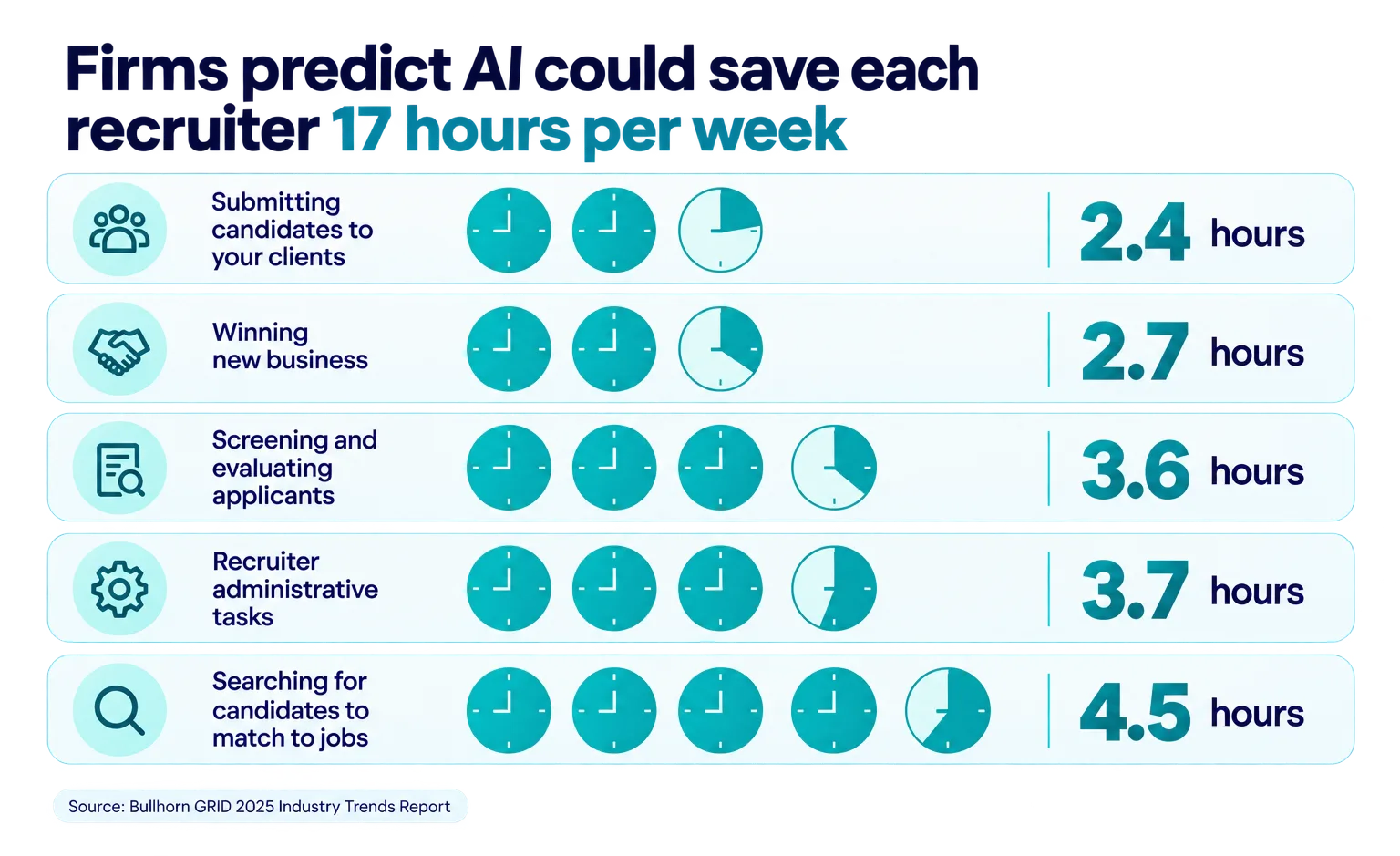
Source: Bullhorn, GRID 2025 Industry Trends Report.
From doing the work to directing the workflow
As AI takes on high-volume execution, recruiter value increasingly lies in improving hiring decisions, strengthening relationships and shaping the candidate experience.
That includes advising hiring managers, challenging unrealistic requirements, engaging candidates and understanding the context that a score or recommendation may miss. For example, a candidate whose experience does not follow a conventional career path may warrant closer review rather than an automatic rejection.
There are signs of that change already. LinkedIn found that employers were 54x more likely to include relationship development as a required recruiter skill than the year before. At the same time, 89% of TA professionals say measuring quality of hire will become increasingly important, yet only 25% are highly confident that their organisation can do it effectively.12
The opportunity is to use the capacity AI creates deliberately, giving recruiters more time for work that requires judgement, empathy and influence.
TA-in-the-loop
TA-in-the-loop means that TA remains responsible for the design and governance of the process, without requiring a recruiter to approve every automated action.
TA teams set the strategy and criteria. AI executes appropriate parts of the workflow. Recruiters examine the evidence, manage exceptions, challenge recommendations and retain oversight of consequential decisions.

This requires more than placing a human at the end of an automated process. Recruiters need the information, authority and ability to intervene meaningfully.
For TA leaders, that responsibility comes down to three principles.
1. Choose technology you can explain
Before scaling AI screening, interviewing and scoring, TA leaders need to understand what information the technology assesses, which criteria it applies and how its recommendations are produced.
That changes the questions employers should ask providers. A claim that a system “matches skills” is insufficient; recruiters need access to the supporting evidence, an explanation of the assessment and a clear understanding of its limitations.
Technology evaluation should also consider evidence of performance, potential bias, accessibility and the controls available for human review. Explainability helps TA teams assess whether a recommendation is justified and confidently challenge it when necessary.
2. Direct human attention where it matters
AI can reduce repetitive work and help recruiters focus on the moments where human involvement materially affects the outcome.
Those moments include advising hiring managers, engaging priority candidates, handling exceptions, navigating sensitive decisions and providing meaningful feedback. Human attention should be concentrated where empathy, persuasion, context and judgement create the greatest value.
Candidate experience is also an important indicator of how well automation is working. Confusion, frustration or a sense of unfairness should prompt a review of the process, with a clear route for candidates to seek clarification or appropriate human support.
3. Own the decisions AI supports
Using AI does not transfer accountability away from the employer. TA teams need to understand what happened, why it happened and when human intervention is required.
That means maintaining a clear audit trail across AI-supported screening, interviewing and scoring. Recruiters should be able to examine the evidence behind a recommendation, challenge it and reach a different conclusion when context or judgement warrants it.
Candidates should also receive clear information about where AI is involved, how it supports assessment and how they can raise concerns.
Transparency, traceability and meaningful human oversight need to be built into the hiring process from the outset.
How EQO supports a connected, accountable workflow
VONQ’s Talent Attraction Platform, EQO®, reduces the complexity of top-of-funnel hiring by connecting six key stages, from job creation and distribution to attraction, screening, interviewing and scoring, in one agentic workflow.
Transparent rationales, traceable evidence and human oversight help recruiters remain in control of candidate evaluation. By bringing the stages together, EQO helps TA teams review the evidence gathered across the journey and focus their attention where it is most valuable.
EQO’s screening and interviewing capabilities have been independently assessed by Warden AI, supported by VONQ’s ISO 27001 certification and GDPR compliance.
The same report is also available as a PDF download.
Got a tip, a press release that deserves a closer read, or a correction? Send it my way. The tip line is always open.
[Want to get Job Board Doctor posts via email? Subscribe here.]Sources & Methodology
1. Recruitment and Employment Confederation (REC). “Labour Market Tracker: Signs of stability in job ad postings after summer holiday slowdown.” 20 October 2025.
2. Recruitment and Employment Confederation (REC). “Labour Market Tracker: Pre-Budget boost for Chancellor as job postings pick up.” 20 November 2025.
3. VONQ. Proprietary Job Marketing platform data, 2025. Internal analysis of vacancy and application trends.
4. Indeed. “How to Improve Your Job Post by Thinking Like a Job Seeker.” 2025.
5. LinkedIn. Kanade, Nikhil. “5 Ways to Promote Your Employer Brand on LinkedIn.” 27 March 2024.
6. Greenhouse. The Hire Standard: Hiring Benchmarks 2026. March 2026. Analysis of more than 6,000 companies and 640 million applications, 2022-2025.
7. Greenhouse. 2025 Workforce & Hiring Report. 2025. For the 22%/31% bot statistic, Greenhouse’s findings are also reproduced in its July 2025 release.
8. Resume.org. “1 in 3 Companies Anticipate AI Running Their Entire Hiring Process by 2026.” August 2025. Survey conducted via Pollfish among 1,399 US workers with management-level knowledge of their companies’ hiring practices.
9. Gartner. “Gartner Survey Shows Just 26% of Job Applicants Trust AI Will Fairly Evaluate Them.” 31 July 2025. Candidate fraud prediction.
10. Gartner. “Gartner Survey Shows Just 26% of Job Applicants Trust AI Will Fairly Evaluate Them.” 31 July 2025. Candidate trust finding.
11. Bullhorn. GRID 2025 Industry Trends Report. 2025. Survey of more than 1,500 recruitment professionals globally.
12. LinkedIn. The Future of Recruiting 2025: How AI Redefines Recruiting Excellence. 2025.
VONQ product information
All EQO product capabilities referenced in this report are based on VONQ product documentation current as of 2026.

Comments (0)