The Sonderling Doctrine.
Happy Friday, Job Board Doctor friends.
I want to start today with a note about what you are about to read. I want you to know what I am writing is highly personal. I met Keith Sonderling during the pandemic. His chief of staff reached out to me because of his self-identified interest in hiring discrimination for people with disabilities: my life’s work for the last 18+ years. I introduced him to Chad to talk about veterans and subsequently to Chad and Cheese. I went to his confirmation hearing in D.C. I believed when he entered the DOL in early 2025 that we were better off because of it. In short, I believed what he said.
On August 21, 2026, the Department of Labor (DOL) published three final rules that finished demolishing the federal contractor compliance framework.

Talroo brings clarity to improve new-hire retention
You filled the seat, but not with someone who plans to stay. The candidate made it through your entire interview process while quietly interviewing with other companies that pay 25% more.
When expectations aren't clear up front, retention suffers.
Get clarity up front with Talroo's SmartQualify.
This is something we have all long expected and the communication around it has mostly been from compliance people and lawyers, who, to be fair, aren’t known for explaining stuff in easy to understand terms.
So let me translate it for everyone else: nobody won.
- ▪ Not employers.
- ▪ Not jobseekers.
- ▪ Not TA tech vendors.
- ▪ Not even United States veterans.
The DOL managed to make every single stakeholder in the employment ecosystem worse off in a single Federal Register issue, and it did it under the leadership of the man who has demonstrated he knew exactly what he was breaking and why it matters.
The man who knew better
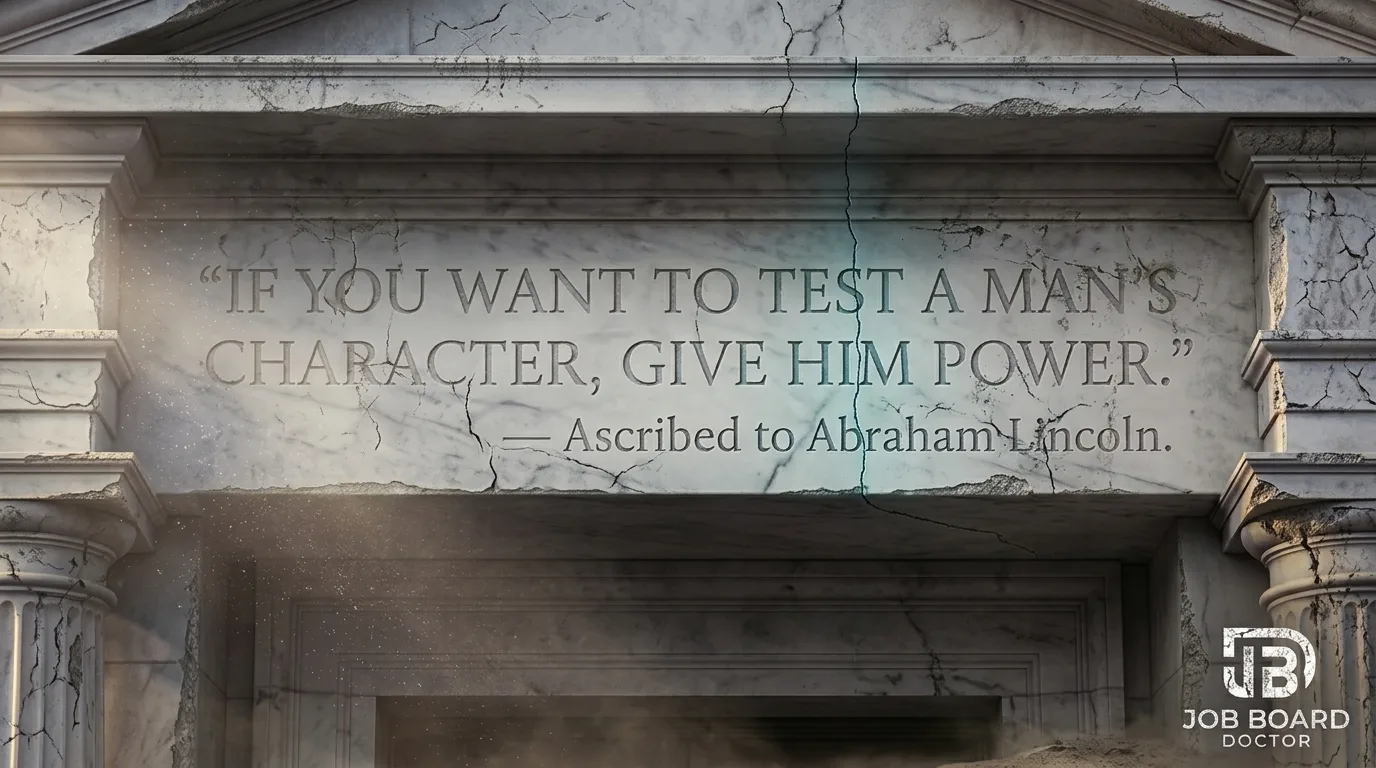
“If you want to test a man’s character, give him power.” — Ascribed to Abraham Lincoln
Keith Sonderling has been Acting Secretary of Labor since April 2026 and was nominated for the permanent job in late June. Sonderling has basically been running the department all along. (Washington Post)
Who was Keith Sonderling before that? He was an EEOC commissioner from 2020 to 2024, who subsequently built a national profile as the government’s leading voice on AI hiring discrimination.
Let’s, just for fun, review the words Acting Secretary Sonderling built his public persona upon.
He told MIT Technology Review in 2021 that enforcement and litigation had lagged because candidates rarely know a computer is scoring them.
He told a Federalist Society audience in 2023 that an employer cannot point to the computer as its defense when the outcome discriminates. (Washington Examiner)
He wrote in the University of Miami Law Review that AI is “only as good as those who ‘feed the machine.’”
And he had one answer he gave everywhere, on the Harvard Business School podcast, onstage at UNLEASH World, repeatedly on The Chad and Cheese Podcast, whenever anyone asked whether America needed new AI laws: we don’t, because “we can enforce the laws that have been on the books.”
That was the whole Sonderling doctrine. The guardrails already exist. The agencies have the tools and existing standards, like the Uniform Guidelines on Employee Selection Procedures.
On Charles Handler’s Help Wanted podcast, Sonderling specifically mentioned that the UGESP covered AI-driven employment decisions.
And far from treating workforce data as a threat, his position on the HBS podcast was that responsibly gathering data throughout the AI-enabled employment lifecycle was not just permissible but beneficial, because the data is how you catch the machine discriminating.
That man, who built a “good guy” reputation as an advocate for using data to ensure fairer hiring, now runs the department that erased the federal definition of a job applicant, the data infrastructure that made algorithmic discrimination measurable, and the validation framework employers used to prove their selection tools were lawful.
He did not inherit this demolition. He presided over it. Like so many other “allies”, eventually the sheep skin falls away.
What employers lost: safe harbor
If you think this is deregulation that helps business, you have already lost the plot. Employers lost three layers of protection and kept all of the liability.
First, the Internet Applicant Rule dies October 26 with the rest of the EO 11246 regulations. The Internet Applicant Rule was not a burden.
The Internet Applicant Rule was a shield. Its four-prong definition, including the basic qualifications carve-out, told employers exactly whose data counted in adverse impact analysis and whose didn’t. Gone.
Second, the UGESP will die in phases. Rescinding the Uniform Guidelines removes the employer’s validation safe harbor while leaving statutory disparate impact liability intact.
The roadmap for proving your hiring test is lawful disappears. The requirement to prove it does not.
The validation framework Sonderling spent four years telling employers already covered AI is the same one his department just rescinded and his former agency is queued up to erase.
Third, the oversight changed. An employer in 2027 defends its AI screening tool with no federal definition of who counts as an applicant, no validation playbook, and no agency guidance to rely on in good faith.
The Sonderling doctrine was never “existing law is enough.” The doctrine was “no new laws,” and only the second half survived his contact with power.
The Sonderling Doctrine is a rudderless Titanic and he’s already dumped employers’ lifeboats.
What jobseekers lost: opportunity and accountability
I am too aggrieved to cover the Section 503 rule rescission at length, right now. Let me be fully transparent; this is the literal undoing of my life’s work.
But here is the gist, as of September 21, the requirement to invite applicants and employees to self-identify as individuals with disabilities is gone. Data collection requirements are eliminated, and the 7% target is gone.
There is no Sonderling quote about Section 503, because he never needed one. His position on measurement was universal.
“
“If you can’t account for [a person’s] characteristics, the tech can’t be used properly”
Sonderling told HR leaders as EEOC commissioner (HR Executive), in the same conversation where he warned that badly built AI could scale discrimination beyond anything the country had seen.
Every word of that requires data.
You cannot account for a characteristic you are not allowed to ask about. You cannot audit a disability bias when you have no disability data to measure.
He didn’t change his mind about a form. He reversed his entire theory of how discrimination gets identified and can subsequently be corrected.
And understand that the data blackout is not a disability story. It is everybody’s story. Race, sex, national origin, disability: the entire 60+ year federal apparatus for counting who gets hired in America is being dismantled piece by piece.
Subminimum Wage:
Here is something that most of my readers have likely never heard of: subminimum wage.
In a Federal Register notice, the DOL withdrew a proposed rule that would have phased out an employer’s ability to pay employees with disabilities at what is called “subminimum wage”. What is the subminimum wage? The ability to, literally, pay people to work for pennies on the dollar.
Something the disability community has been fighting against for decades. (Want to know more about the impact of subminimum wage? Check this out.)
Put the two actions together. This department dismantled the machinery that pulled disabled people into integrated, competitive, measured employment, and preserved the machinery that keeps disabled people in segregated settings at sub-minimum pay. That is the dictate of The Sonderling Doctrine.
In my opinion, and I own this as an opinion, you do not produce that pair of outcomes by accident.
“If you want to test a man’s character, give him power.” — Ascribed to Abraham Lincoln
What TA tech lost: much more than they realize
The absence of rules will open vendors and employers up to a world of new litigation.
Readers of the Maki People series already know where this goes. The entire non-discrimination story that AI screening vendors sell to enterprise buyers was built on scaffolding that no longer exists in the United States.
“Our tool is validated” against what framework? “Our adverse impact testing” uses whose definition of applicant?
The question we asked in that series, whether pre-apply AI screening manufactures consideration at scale and creates applicants the employer never records, does not disappear with the Internet Applicant Rule.
It relocates to the worst possible venue for a vendor: private litigation, where the applicant definition is a fact question, the validation safe harbor is dying, and Mobley v. Workday may establish that AI vendors face discrimination liability directly, not just their customers.
Vendors now get to discover that regulatory uncertainty is a worse sales environment than a regulated one ever was.
And veterans? DOL failed veterans, too.
The Vietnam Era Veterans’ Readjustment Assistance Act (VEVRAA) survives.
The only demographic the federal government still requires employers to count is veterans.
The only definition of “applicant” OFCCP ever codified sits in the part of the rules being deleted on October 26. VEVRAA still requires counting applicants and no longer has a definition of the word.
The one affirmative action program this administration kept, the one it points to as proof it cares about somebody, now runs on an undefined unit of measure. They kept the veterans’ scoreboard and deleted the ruler.
For an administration that loves to wave the flag, they have forgotten why it is still flying.
Why the statutes are still important to understand
Every change described above withdraws rules and reporting requirements. Not one of them touches the underlying laws, because a rules rescission can’t.
The responsibilities live in statutes, and each protected group has its own:
- ▪ Title VII of the Civil Rights Act covers race, color, religion, sex, and national origin.
- ▪ The Americans with Disabilities Act covers disability discrimination.
- ▪ Section 503 of the Rehabilitation Act itself also survives and requires affirmative action and non-discrimination for disability.
- ▪ Age discrimination lives in the ADEA, which is the statute the Mobley collective is certified under.
- ▪ Veterans’ obligations live in VEVRAA.
- ▪ State regulations and local laws, all with their own set of rules.
The regulations told employers how to comply. The statutes are why they must.
The Department of Labor and The Sonderling Doctrine shredded the “how” and left every word of the “why” in force, across every group. The obligations do not disappear. The instructions did.
The litigation is going to be the wild west.
when The bill comes due
So here is the full accounting of the Sonderling Department of Labor Doctrine.
- ▪ Employers: liability retained across five statutes, safe harbors deleted.
- ▪ Jobseekers: the counting infrastructure for race, sex, national origin, and disability dismantled, and the subminimum wage preserved.
- ▪ TA tech vendors: direct liability exposure live in federal court.
- ▪ Veterans: the last group standing, for now.
That is a department that made the employment system worse for every party in it, run by a man whose entire prior public career was explaining, correctly, why these exact guardrails mattered, and who told anyone with a microphone that America needed no new AI laws because the ones on the books were enough.
So when this administration is over, you will then have Secretary of Labor Keith Sonderling to thank for the mess he created for all of us.
The feckless part isn’t just that he broke it. It is that he thinks you have the memory of a goldfish.
“If you want to test a man’s character, give him power.” — Ascribed to Abraham Lincoln
Until Next Time,
Julie “The Doc” Sowash
Standard Disclaimer: Julie is not a lawyer. She has never been a lawyer. She does not play one on TV, at parties, or in this newsletter. Nothing here constitutes legal advice, and citing “but the Job Board Doctor said…” will impress exactly zero judges. Hire a real attorney for real legal questions.
Got a tip, a press release that deserves a closer read, or a correction? Send it my way. The tip line is always open.
[Want to get Job Board Doctor posts via email? Subscribe here.]

Comments (0)