
Job Slop and the Golden Opportunity Indeed is Giving
 Happy Friday, Job Board Doctor friends.
If you listened to Chad and Cheese last week, outside of my Job.com update, Chad hit on a term we have affectionately coined as “job slop.”
Job slop is the low-quality sludge filling our marketplaces. Content we are blindly accepting and sending without regard to where our brands and our clients’ brands end up.
Talroo brings clarity to improve new-hire retention
You filled the seat, but not with someone who plans to stay. The candidate made it through your entire interview process while quietly interviewing with other companies that pay 25% more.
When expectations aren't clear up front, retention suffers.
Get clarity up front with Talroo's SmartQualify.
Go with me on this one, because I am about to lay out what I believe is a golden opportunity that Indeed keeps handing the rest of us, if, and right now that is a big if, we get our act together.
Here is what we are getting into this week:
- TA does not actually understand programmatic or the players running it
- A TA leader’s first real encounter with programmatic distribution is too often a bad one
- What an actual bad programmatic experiences look like, with receipts
- The quiet part Indeed (finally) said out loud this week, and
- Why it is an opening for programmatic players and job boards
Let’s start with two foundational points to take us through our conversation today.
Foundation #1: TA Does Not Understand Programmatic, Or The Players
Over the last few weeks I have talked with some genuinely smart TA practitioners, and one thing has become impossible to ignore: we have done a terrible job explaining how programmatic syndication actually works.
That is on us, not them.
Foundation #2: the First Encounter With Programmatic and their brand Is Too Often Negative
So when something goes wrong, they do not see a media-buying chain with a tunable set of rules, which should be constantly getting retuned.
They see chaos with their company’s name on it.
Explainer: How does programmatic advertising work
A programmatic platform takes an employer’s jobs, distributes them across a network of job boards and publisher sites, and buys traffic against those jobs in real time based on a budget and a set of rules. The platform optimizes toward whatever goal it is told to chase: clicks, applies, cost per application.
The job boards in the network get paid for the traffic they send. The programmatic vendor takes a margin in the middle. Nobody in that chain is automatically the villain. It is a media-buying system, the same way digital advertising works everywhere else.
The problem is not the mechanism. It is that TA leaders are (smartly) outsourcing distribution and then being surprised when they see their jobs on aggregators and boards they are not familiar with.
A Brand Audit Begins
Allow me to set the scene. (I will use several companies as example for this walk through. I did not speak to anyone from example companies regarding this content.)
A TA leader is doing a brand audit while updating their recruitment marketing strategy and daydreaming about winning their next employer brand award.
Mindlessly, they run a search for their company name + jobs into the Google machine.
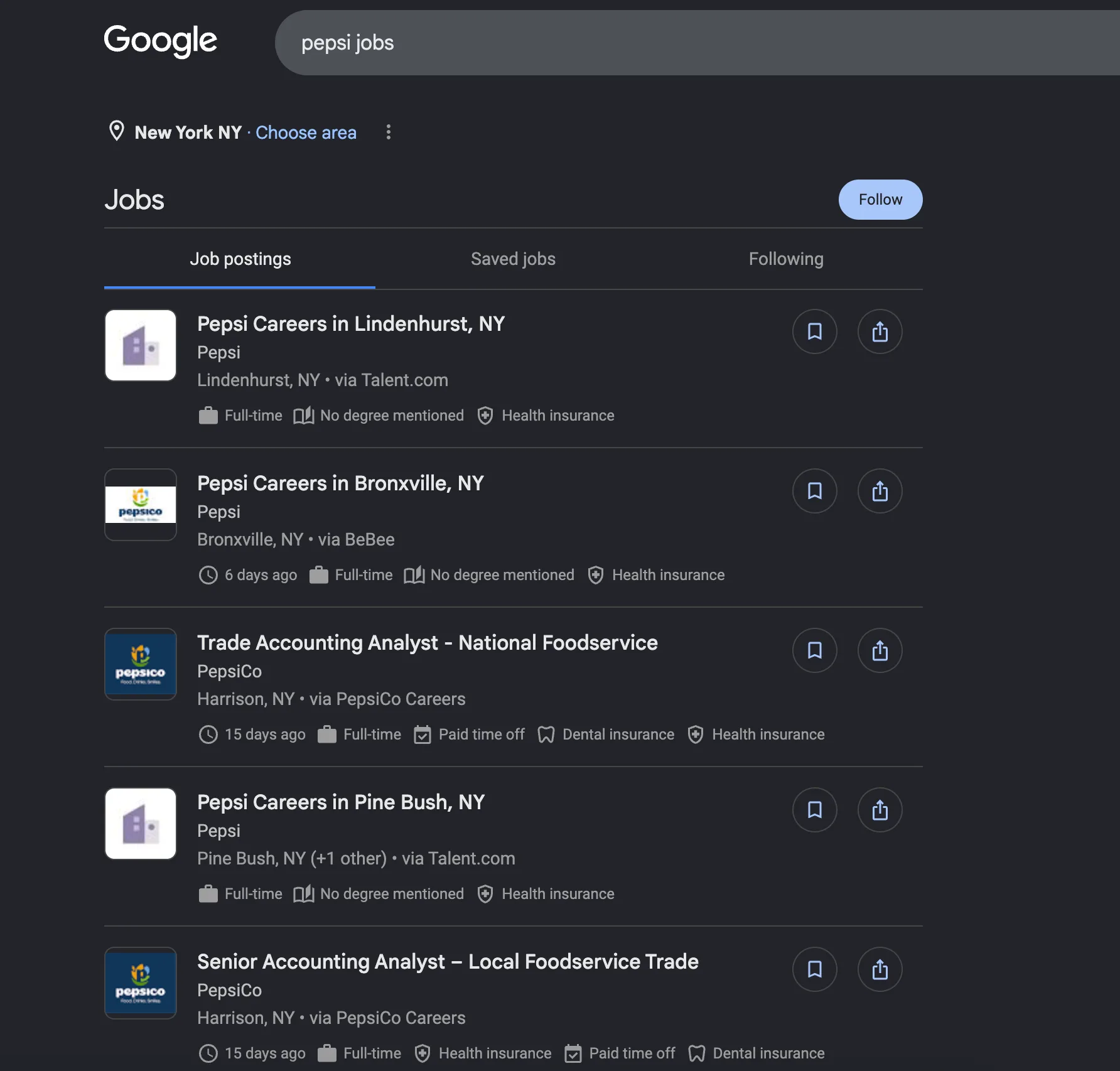
They land on Google for Jobs. No worries there. Generally speaking, Google for Jobs is a trusted source for completed applications from qualified candidates.
Pepsi is not hiring for “Pepsi Careers” in these cities. Based on my understanding, there is no Pepsi bottling, distribution, or corporate office in Bronxville, NY.
Nonetheless, programmatic vendors and job boards are using the Pepsi brand, and in some cases the logo, to actively sucker people trying to find a job into giving up their personal information.
And in some cases putting them through a paywall to view a job that does not exist.
The odyssey continues
Now said TA leader is awake, clicking furiously, and is NOT happy.
The journey continues as they click on to some job titles that actually exist and offer a variety of places to learn more or apply.
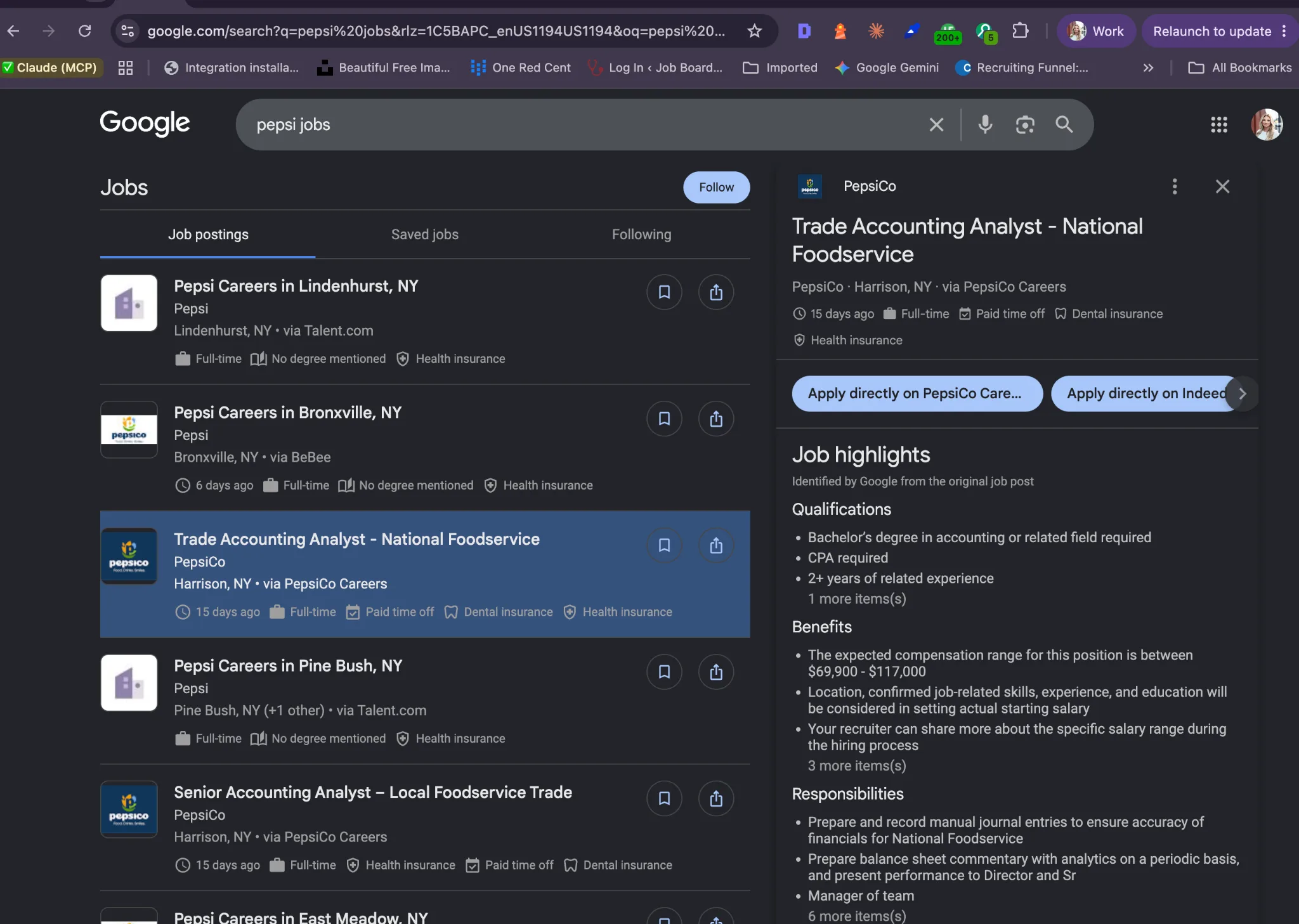
(Using the Trade Accounting Analyst, National Foodservice role that was live on the PepsiCo career site on June 11, 2026 at 10:30 WET as our example.)
Clicking through these job boards, the TA leader finds that most are reputable, and the jobseeker can relatively (some with minimal redirects) quickly get to complete an application on the ATS.
✔ Indeed. ✔ Glassdoor ✔ ZipRecruiter. ✔ Nexxt ✔ Jooble
But does that good experience register in their head?
Nope. All they can think of now are the sites that used their brand and a role they need to fill as clickbait.
✘ BeBee: nope, paywall.
So this is the memorable experience that cements in a TA leader’s brain what programmatic is and what it does.
It isn’t a clean walkthrough from a vendor who explains the model. It is a Slack message from a hiring manager asking why their req is showing up on a site nobody has heard of. It is a candidate complaint about a listing that looks slightly off.
In their mind it is brand theft, where their jobs and logo end up on a site they never authorized, scraped and reposted to harvest applicant traffic and/or monetize the jobseeker.
So the first time programmatic truly enters their consciousness, it is attached to a problem. Not efficiency. Not reach. A problem.
That is a structural failure in two ways. The first is how we onboard employers using our programmatic distribution. When the only time you hear about a system is when it breaks, you conclude the system is broken. TA is not wrong to feel that way.
You all know I support programmatic advertising. I partnered with programmatic advertisers to build Disability Solutions, and I use them in the job boards I manage. I believe it is a cost-effective way to find the quality and quantity mix a company needs to hire.
It is time to correct what is plaguing the system and pulling the good down with the bad.
bad experiences compound
Let me make this concrete with a few more examples, because “job slop” stays abstract until you watch it harvest a real person.
Here are two examples I pulled in the last 7 days.
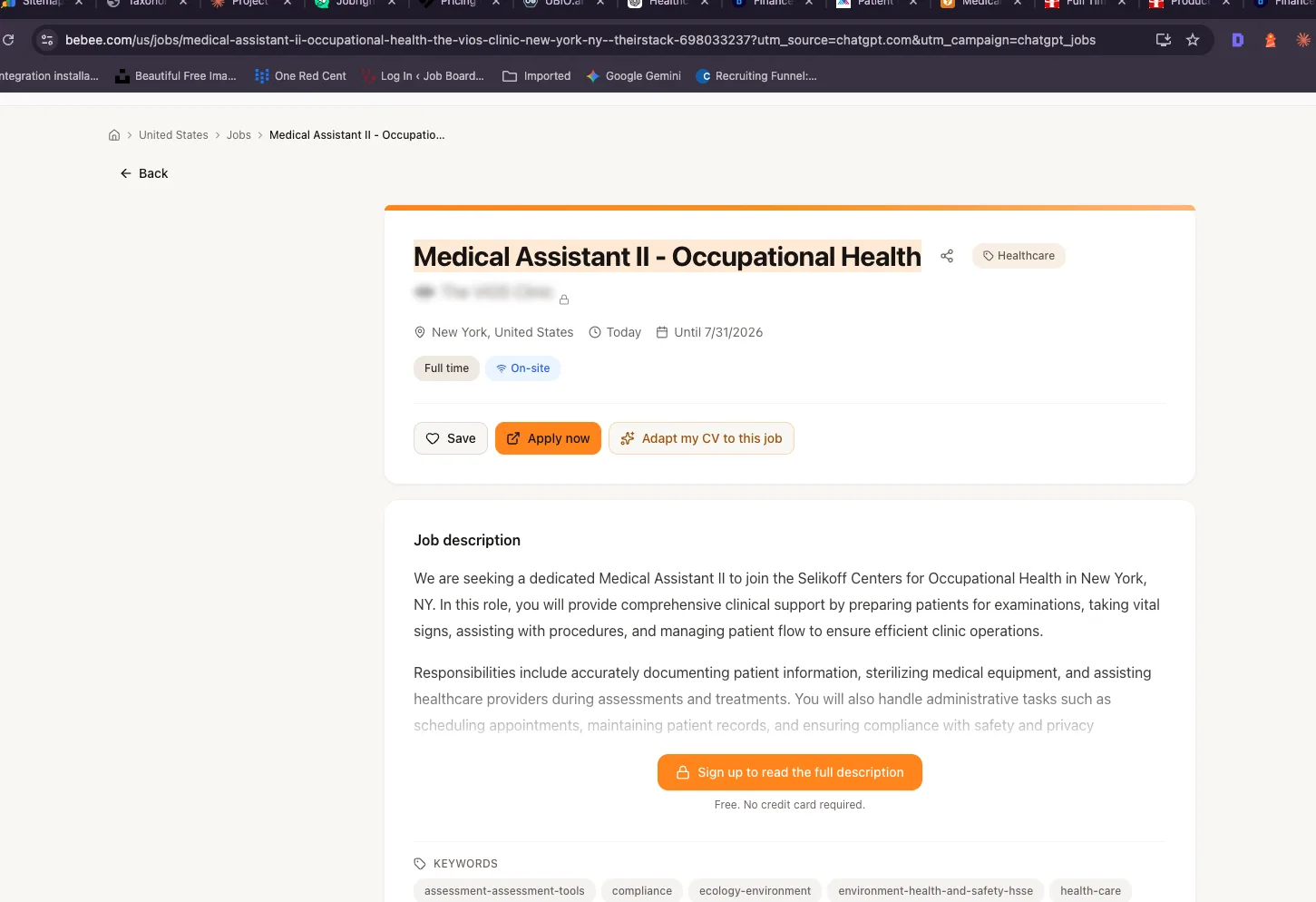
A listing on BeBee for “Medical Assistant II, Occupational Health,” located in New York, posted “today.” The description names the Selikoff Centers for Occupational Health, a real, recognizable clinical brand. Looks legitimate.
Then you look closer.
The job description cuts off mid-sentence behind a wall that reads “Sign up to read the full description. Free. No credit card required.”
You cannot read the full posting without handing over your information first. The page offers two AI buttons, “Adapt my CV to this job” and “Apply now,” on a listing you are not even allowed to finish reading.
And the part that ties it back to everything above: the URL carries the tags utm_source=chatgpt.com and utm_campaign=chatgpt_jobs. This listing reached the jobseeker through ChatGPT’s job surface.
The job slop did not crawl out of some basement board with no traffic. It got distribution through one of the most trusted AI players on the planet.
This is the slop loop reinvented (because job slop isn’t new). A real brand is used as bait, AI surfaces the bait, AI offers to write your application to the bait, and the only thing on the other side is a registration gate.
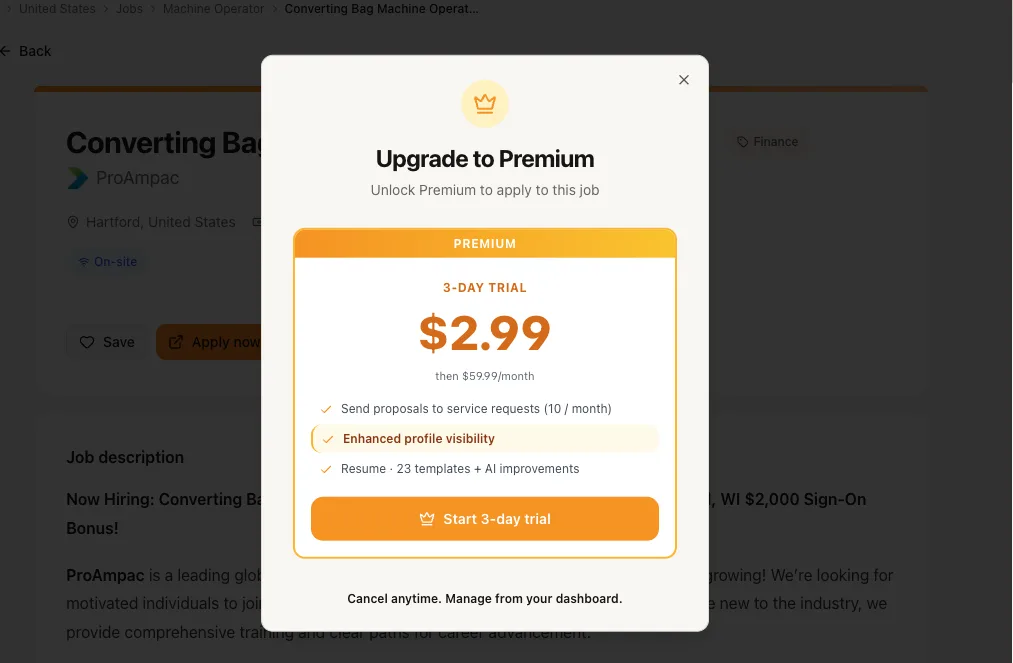
A second Bebee listing, “Converting Bag Machine Operator” at ProAmpac in Hartford, an hourly role advertising a $2,000 sign-on bonus. Click apply and you hit a modal: “Upgrade to Premium to apply to this job.”
Two dollars and ninety-nine cents for a three-day trial, then $59.99 a month. The jobseeker, the person with the least money and the most desperation in this entire transaction, is being charged a subscription to apply to an hourly machine-operator job.
Here is the real kick in the pants. At the time I pulled this job off OpenAI and went to BeBee, this job did not exist on ProAmpac’s corporate career site.
That is what a bad programmatic experiences looks like in practice. Not a cartoon villain. A real brand used as a lure, a ghost or recycled listing, an AI surface providing the distribution, a data-and-payment gate at the end.
Indeed Said The Quiet Part Out Loud This Week
So what does Indeed have to do with all of this? I am glad you asked.
This week an “Important update” landed in agency inboxes from Indeed for Agency.

The framing is corporate and soft: the world of work is evolving, Indeed is adapting its marketplace, and a Help Center article plus agency talking points will roll out ahead of broader employer communication.
Translation: Indeed is about to change the terms again, and it is pre-loading its agency channel with its desired talking points before employers find out.
The article behind the email is titled “Setting Expectations Amidst a Changing Landscape,” and it is the soft-focus version of hard changes that have fundamentally already happened.
- As of March 31, 2026, Indeed stopped giving free organic visibility to jobs that come in through single-source XML or API feeds unless those jobs route through an ATS that supports Indeed Apply.
- Jobs that used to appear in organic search for free are now sponsored-only or effectively invisible unless they arrive through a compliant integration.
The largest job board in the market just made organic reach conditional on going through its systems and how much a company spends.
For the most part, I think this left a lot of us scratching our heads and wondering why Indeed felt like this was something they needed to announce.
Here is my favorite exchange from the week about said head scratching:
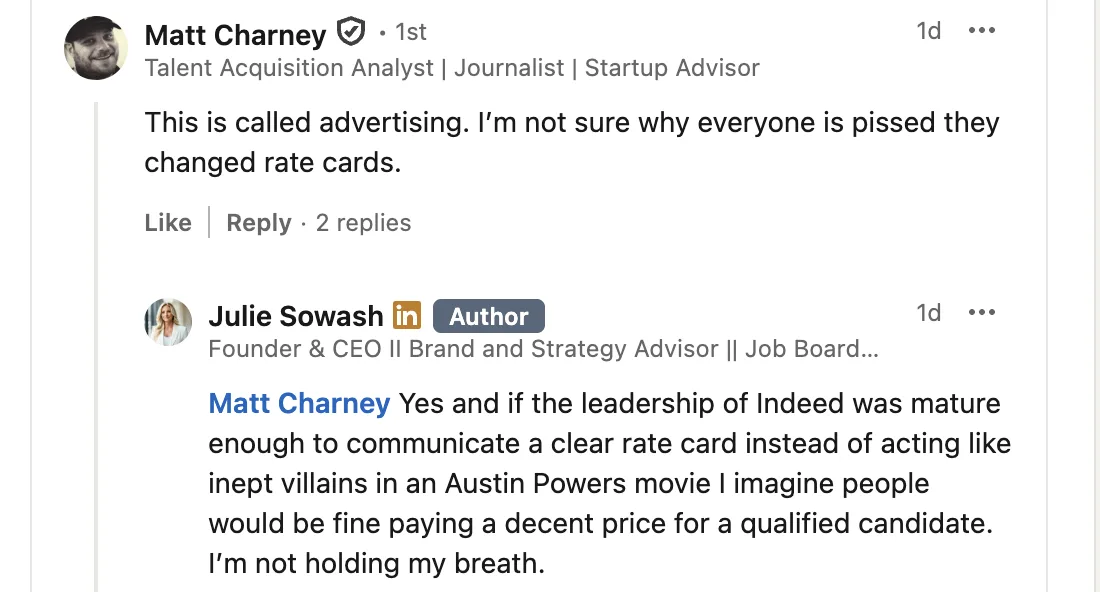
But their is a part worth slowing down on, because Indeed is doing two different things and only one of them is defensible.
The first is a genuine quality move: cutting duplicate roles and limiting refresh reposts that make old jobs look new. That is a direct shot at ghost jobs, and it is good.
The second is the visibility change, and that is where the quality story falls apart. The free posts are not being removed. They are being deprioritized. If the goal were really fraud reduction, you would take the bad listings down, not demote them and leave them up.
ERE made this point cleanly this week: this is the well-worn tech playbook of subsidizing a product to win the market, then monetizing once you have critical mass, the same path Uber, Google search, and Amazon search all walked.
So separate the two. Killing ghost jobs is quality. Demoting free posts while keeping them live is monetization wearing a quality costume. Do not let the first launder the second.
That is the opening. Every employer about to get squeezed on organic visibility is an employer with a reason to ask what else is out there.
Programmatic distribution and independent job boards are the answer to that question, if we can explain ourselves in plain language and show up now.
The door is open. The question is whether we walk through it or keep tripping over our own value proposition.
So What Do We Actually Do
Indeed handed us the opening this week. The question is whether our industry is finally willing to get itself together and walk through it.
This is the part where job boards can actually win. A curated marketplace, real verification, brand protection, choosing programmatic partners wisely, clearly stating what your content rules are, and constant (and I do mean constant) post cleaning from those vendors.
And quit waiting for OpenAI (or Google, or Amazon, et al) to save us or kill us, because it is going to do neither.
Until Next Time,
Julie “The Doc” Sowash
[Want to get Job Board Doctor posts via email? Subscribe here.]
[Got a tip, document or intel you want to share with the Doc? Tell me. Tip so hot you need it to be encrypted? Use Signal.]

Great article
[…] analyst the Job Board Doctor has criticised the trend as part of a broader “job slop” problem, arguing that platforms are prioritising monetisation […]