
While Everyone Waits for September: Why Summer Is Now the Smartest Time to Hire

Executive Summary
HR teams have long planned around one assumption: summer is when hiring slows down. Market signals increasingly suggest the opposite.
Across labour market trends, evolving candidate behaviour, and campaign insights from VONQ’s global programmatic recruitment platform, a clear shift is emerging: employers are bringing hiring activity forward. Candidates are engaging earlier and more intentionally. The result is real momentum – ahead of the September surge, not because of it.
The conditions this creates are measurable: reduced competition for candidate attention, stronger candidate intent, and more favourable recruitment economics. For teams operating with tighter budgets and leaner resources, this is a window worth taking seriously.

Talroo brings clarity to improve new-hire retention
You filled the seat, but not with someone who plans to stay. The candidate made it through your entire interview process while quietly interviewing with other companies that pay 25% more.
When expectations aren't clear up front, retention suffers.
Get clarity up front with Talroo's SmartQualify.
Capturing it, though, requires more than maintaining recruitment activity. It requires the ability to respond continuously to changing candidate behaviour, shifting channel performance, and fluctuating competition levels. This is where programmatic recruitment advertising becomes particularly relevant. Through automation, real-time optimisation, and performance-based investment, organisations can adapt dynamically to market conditions and turn a quiet season into a strategic advantage.
In this edition of The VONQ View, we explore why summer is becoming a competitive lever in recruitment, and how programmatic advertising enables organisations to capture it.
What our platform data is telling us
As a provider of programmatic recruitment technology managing high-volume campaigns across global hiring markets, VONQ has a unique view into seasonal recruitment behaviour through aggregated campaign performance and platform insights across industries, channels, and candidate journeys.
Three clear developments are emerging in summer hiring behaviour:
- Summer hiring activity is increasing
- Candidate behaviour is becoming increasingly mobile-first
- Performance-based recruitment strategies are delivering stronger efficiency during off-peak hiring periods
These shifts are reshaping how organisations should approach Q3 recruitment planning.
Summer is no longer a holding pattern
VONQ’s performance data shows that employers are no longer treating summer as a pause. Key signals from our platform include:
- Earlier timelines: Vacancies launched 4-6 weeks earlier compared to historic September-led hiring cycles (observed since 2023)
- Increased volume: 8-12% increase in roles posted during June and July compared to previous year
- Shifted onboarding: Peak in final offer activity shifted to late August compared to pre-2023 hiring patterns
External labour market data underline this. According to Eurostat1, euro area unemployment declined from 6.3% in July to 6.2% in August, compared with 6.4% during the same period the previous year – equivalent to approximately 170,000 additional people moving into employment during the summer period.
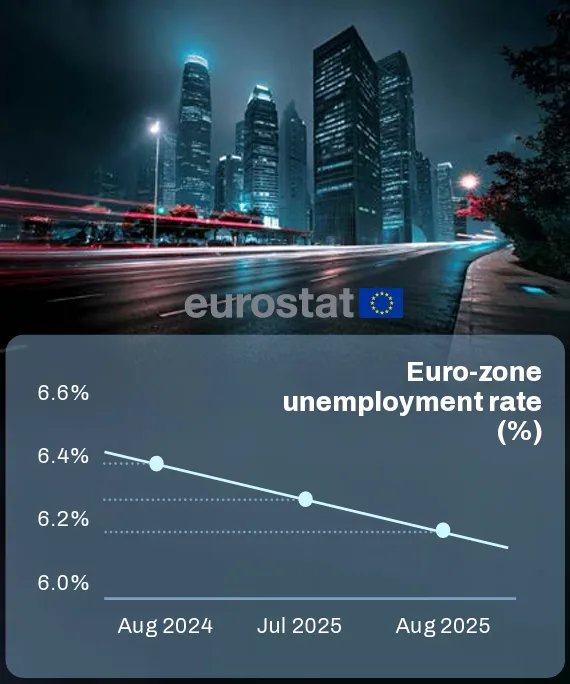 What was once a seasonal hiring curve is increasingly flattening. Instead of concentrated hiring peaks, employers and candidates are maintaining more continuous engagement throughout the year.
The same trend is visible in the United States. According to JOLTS data, job openings declined from approximately 7.4 million in June 2025 to 7.2 million in July, while the hires rate remained stable at 3.3%. This suggests that employers are posting fewer speculative vacancies but continue to fill critical positions at a steady pace, pointing to a more efficient and targeted labour market rather than a seasonal slowdown.
Several forces are driving this – both market and technology driven:


The sectors that aren’t waiting
Summer hiring activity is not evenly distributed across industries. VONQ’s sector-level analysis shows that while some continue to follow traditional seasonal cycles, others maintain – or accelerate – recruitment activity during Q3 in response to operational demand, workforce planning cycles, and changing market conditions.
- Education & Healthcare:
Education peaks in June/July for academic year planning. Healthcare remains at 100% capacity to manage holiday staffing gaps. Healthcare remains at full capacity to manage staffing demand throughout the summer. U.S. labour market data further supports this trend, with the sector adding up to 87,000 job openings in a single summer month, making it one of the strongest drivers of hiring activity during the period. - Construction & Engineering:
Project-driven demand and seasonal operating conditions contribute to an estimated 15% increase in hiring activity. - Logistics & Retail:
Recruitment begins in late July/August to prepare for the “Golden Quarter” (Black Friday/Christmas) ramp-up.
More broadly, hiring reports for the technology sector in 2025 show that specialised roles in AI, Data Science, and Cybersecurity did not follow seasonal lulls. Hiring for these niche roles remained competitive throughout the summer window.
Candidates have moved to mobile. Has your recruitment?
 Studies consistently show that job-seeking activity increasingly migrates to mobile during the summer months – candidates checking LinkedIn and job boards from the beach, the airport, or the park.
| VONQ data shows how this time creates a “Mobile-First” environment: a 15-20% increase in mobile traffic to career sites and aggregators (mainly Indeed and LinkedIn) during the summer compared to Q1/Q2 averages. |
In 2026, an emerging behaviour is amplifying this further. “Micro-applying”, using one-click mobile profiles – combined with save-for-later actions is bridging the gap between passive browsing and active conversion. Candidates who would previously have scrolled past a role are now bookmarking, shortlisting, and completing applications in fragmented moments throughout their day. The friction has dropped. The question is whether employer recruitment infrastructure is keeping pace.
| Read last summer’s report on “Social Recruiting in Summer: Turning Views into Applicants”. |
Good market conditions don’t execute themselves
Candidate engagement remains high during the summer. Mobile behaviour increases. Advertising competition softens. The conditions are genuinely favourable.
At the same time, recruitment teams often operate with reduced capacity, tighter budgets, and limited time for manual optimisation.
Traditional recruitment approaches are not always designed to respond effectively to this combination. .Fixed job postings distribute spend upfront, remain locked into predefined channels, and rely heavily on manual intervention at a time when candidate behaviour and market conditions continue to shift.
Programmatic advertising operates differently.
Rather than distributing recruitment budgets across fixed channels and static job postings, programmatic uses automation, performance data, and real-time decision-making to continuously optimise where, when, and how recruitment media investment is deployed.
By continuously analysing channel performance, candidate engagement, device behaviour, and conversion signals, programmatic technology dynamically reallocates investment toward the audiences and channels delivering the strongest results in real time.
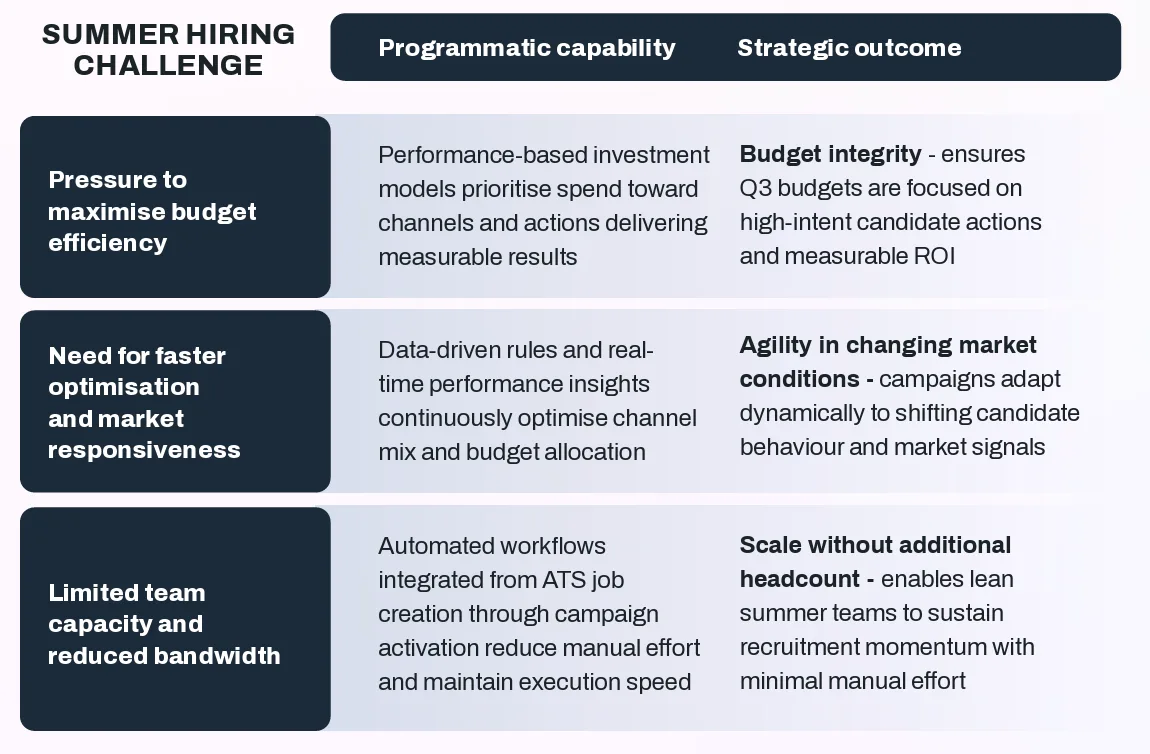
This creates a measurable execution advantage during summer:

The numbers behind the seasonal advantage
Summer market conditions create a seasonal sweet spot where employers can improve both hiring outcomes and acquisition economics.
1. Peak Matching Efficiency
Matching efficiency measures how productively a job market connects vacancies with the right job seekers. In summer, this efficiency peaks due to three distinct factors:
- Reduced Noise: Casual applicants who flood portals during the January rush step back, significantly improving the “signal-to-noise” ratio for recruiters.
- Higher Intentionality: Candidates remaining in the talent pool are highly motivated. When the market appears to cool, the connections made are far more precise.
- Fewer Frictions: With lower total application volumes to wade through, HR teams and algorithmic screening tools identify the “perfect fit” faster.
Evidence from both European and U.S. labour markets suggests that while overall vacancy volumes have moderated, hiring activity has remained comparatively stable, indicating that employers are connecting available roles with active job seekers more efficiently than during the high-volume hiring cycles of previous years.
2. Lower acquisition costs
With VONQs Programmatic solution, employers respond dynamically to changing conditions – creating opportunities to maximize recruitment budgets, particularly between July and mid-August.
| ✅ Lower CPC (Cost Per Click) As traditional advertisers (who may be budget-pacing or on holiday) pull back, the “auction pressure” on job boards drops. This frequently results in a 10-15% decrease in CPC. |
✅ Improved CPA (Cost Per Application) Because programmatic algorithms can shift budget in real-time to high-performing mobile traffic, they bypass the inefficiencies of “static” job postings. Organisations are allocating spend toward higher-intent candidate engagement while competition remains lower. |
Summer is no longer downtime. It is decision time.
Summer recruitment is no longer defined by lower activity – but by different market conditions.
As this report shows, hiring behaviour is becoming more continuous, candidate engagement increasingly mobile-first, and recruitment economics more favourable during the summer period. Employers that adapt to these dynamics can benefit from lower competition, stronger candidate intent, and more efficient acquisition costs.
This creates a window of opportunity that extends beyond filling vacancies.
Lower CPC, improved CPA, and increased mobile engagement mean organisations can build talent pipelines more efficiently while competitors delay action until traditional hiring peaks return. Combined with automation, optimization, and performance-based execution, summer becomes less of a resource challenge and more of a strategic growth lever.
The implication is clear: waiting until September increasingly means entering the market when competition, advertising pressure, and acquisition costs are already rising.
The organisations that win in Q3 and beyond will not necessarily be those spending more – but those recognizing that summer is no longer a pause in recruitment.
The most valuable candidates will not wait for the market to restart. Increasingly, neither should employers.
The same report is also available as a PDF download.
Footnotes
1. Eurostat, Euro Indicators – October 2025.
2- Federal Reserve Board, What Drives Matching Efficiency? A Tale of Composition and Dispersion (2011).
3. VONQ proprietary data and internal analysis.
4. U.S. Bureau of Labor Statistics. Job Openings and Labor Turnover Survey (JOLTS) News Releases, 2025. Available at: JOLTS News Releases
[Want to get Job Board Doctor posts via email? Subscribe here.]
[Got a tip, document or intel you want to share with the Doc? Tell me. Tip so hot you need it to be encrypted? Use Signal.]

Comments (0)