
The Build-vs-Buy Debate Is Dead. The ATS Ecosystem Era Is Here.

The winner ATSs have already made the shift in how they think about product strategy.
For much of the past two decades, product strategy in recruitment technology revolved around a deceptively simple question: should we build this ourselves or buy it from someone else?
Whether the discussion touched on CRM, recruitment marketing, assessments, or AI, the logic was consistent. Strategically important? Add it to the roadmap. Not a priority? Leave it to a specialist vendor.

Talroo brings clarity to improve new-hire retention
You filled the seat, but not with someone who plans to stay. The candidate made it through your entire interview process while quietly interviewing with other companies that pay 25% more.
When expectations aren't clear up front, retention suffers.
Get clarity up front with Talroo's SmartQualify.
That model worked when customer expectations moved at the pace of annual planning cycles. They no longer do.
Today, HR technology providers are operating in an environment where demands are expanding faster than any roadmap can absorb, and the cost of building, especially AI products, is rising faster than most engineering budgets can follow. The traditional build-versus-buy debate isn’t just losing relevance. It’s the wrong frame entirely.
The ATS itself is changing shape under that pressure. It used to be a system of record, a place to store applications and track status. That model is breaking. The ATS is becoming a system of execution, the place where decisions get made, where workflows run, and increasingly, where AI itself operates. Which means the real fight isn’t best-of-breed versus suite anymore. It’s platform versus platform, and the ATS sits at the center of it.
The Feature Pressure Is Real
The expectations placed on ATS platforms today would have been unrecognizable five years ago.
Historically, organizations bought an ATS to manage workflows, applications, and recruiter productivity. Those requirements haven’t disappeared; they’ve become table stakes. But the context recruiting teams operate in has changed fundamentally. Pressure to fill roles faster, leaner teams, tighter budgets, and rising expectations from both candidates and hiring managers have made efficiency a strategic imperative, not just an operational one.
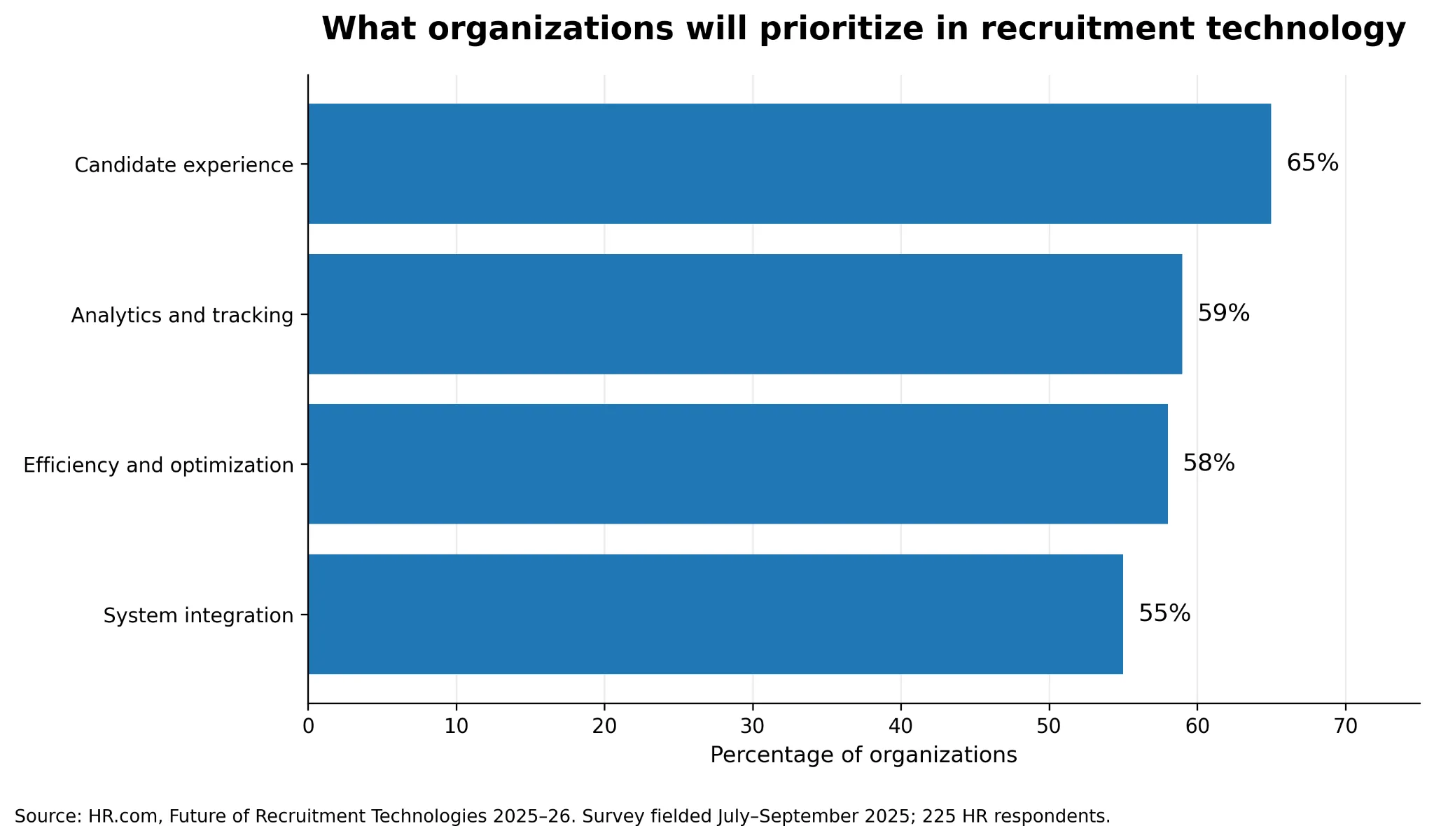
As Madeline Laurano, Founder of Aptitude Research puts it: “Recruiters are asked to do more with less. This challenge has created problems because recruiters have less resources, limited budget, and sometimes less recruiters on their team compared to maybe even a few years ago.”
As a result, today’s buyers want recruitment marketing, AI-assisted screening, skills intelligence, employer branding, and sourcing automation and they expect all of it inside a single connected hiring experience, not scattered across different tools.
AI has accelerated this dramatically. Intelligent automation moved from “innovation initiative” to “baseline expectation” in roughly two years. And the competitive bar has shifted too – ATS providers are no longer being measured only against other ATS providers. They’re being measured against the best software their users encounter anywhere: Salesforce, HubSpot, Slack. Those experiences set the expectation. Recruitment technology is now expected to meet it.
But more capability is not automatically more valuable. Laurano’s own research flags this directly: ATS scope has expanded fast, but not always with intent. Vendors keep building, buyers keep expecting more, and most organizations still lack clarity on what should live inside the ATS versus what should be integrated around it. That confusion is the real cost of the old build-everything instinct, not just the engineering spend behind it.
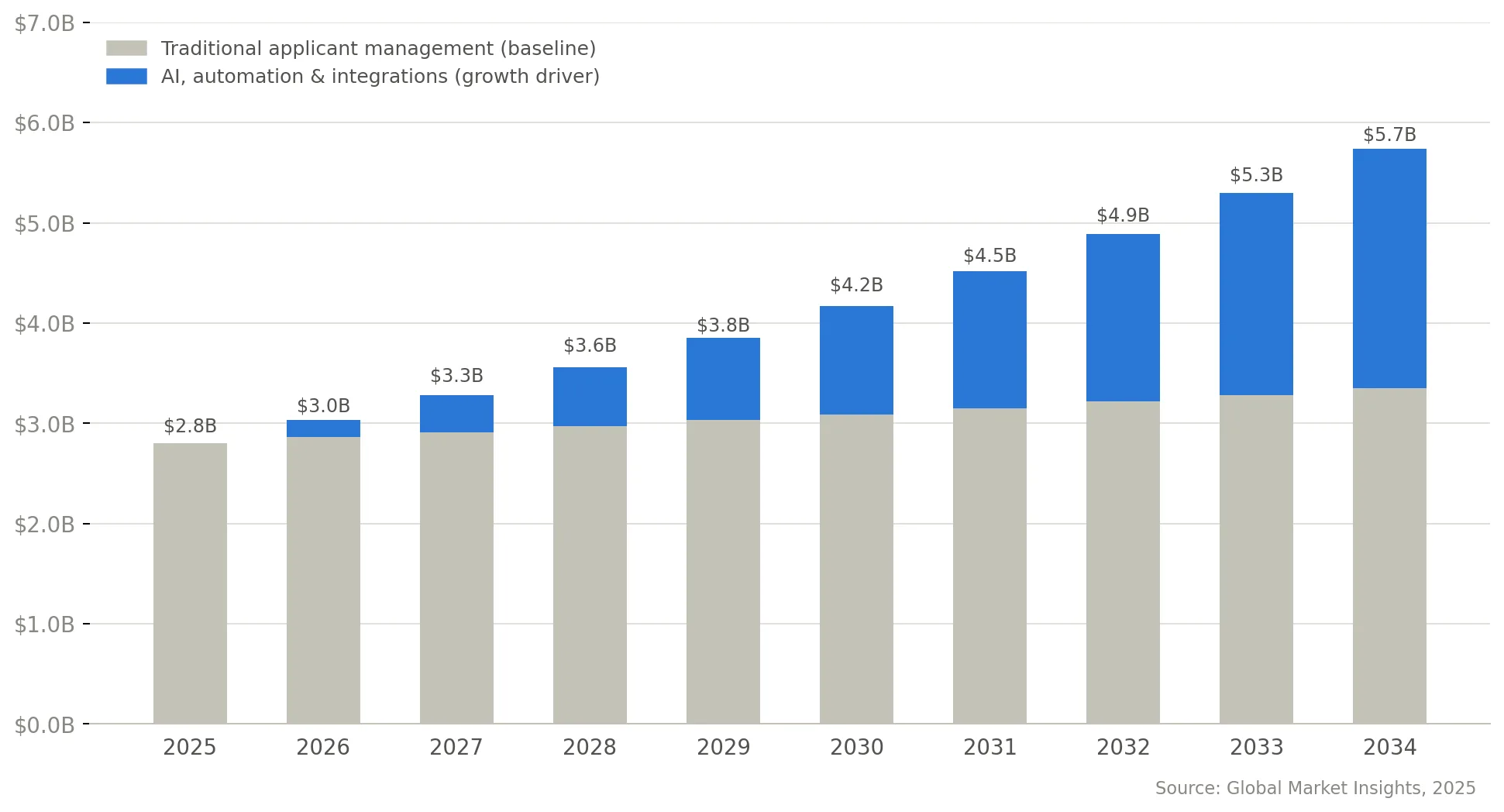
The numbers reflect this. The global ATS market is forecast to grow from $2.8 billion in 2025 to $5.7 billion by 2034 (Global Market Insights, 2025) driven not by traditional applicant management, but by demand for AI, automation, and integrated hiring capabilities.
The Economics of Building Everything Have Broken Down
When customer expectations expand, the instinct is to expand the roadmap. That response is understandable, but it is becoming increasingly unsustainable.
Engineering resources are finite. Product teams are simultaneously modernizing infrastructure, shipping AI features, hardening security, expanding integrations, and maintaining stability. Every new capability competes for the same budget and talent.
The deal data backs this up. WorkTech, which tracks work tech M&A and VC activity globally, found in its Q1 2026 reporting that established platforms are largely buying the AI capabilities that startups were built to provide, not building them from scratch. It’s the same bet made from two different directions: startups building point solutions in the hope of being acquired, platforms acquiring rather than building because the pace of AI development has outrun what any single engineering org can absorb. Build, in other words, is already losing out to buy and partner at the market level, not just in theory.
The cost of innovation isn’t just code anymore. Regulatory pressure is compounding the challenge on both sides of the Atlantic.
In Europe, the EU AI Act places many AI systems used in recruitment and candidate selection into the high-risk category, creating new expectations around documentation, transparency, governance, human oversight, and risk management.
In North America, New York City, California, and Colorado have each enacted laws requiring bias audits, vendor accountability, and impact assessments for automated hiring tools. Every new feature an ATS builds into its AI stack now arrives with a compliance burden attached and that burden is only growing.
For many ATS providers, the challenge is no longer identifying what customers want. It’s determining how to deliver it sustainably.
Other Industries Already Solved This
This isn’t a new problem; it just feels new to recruitment technology.
Salesforce, Shopify, and ServiceNow all reached the same inflection point: customer expectations outpacing what any single product team could build and maintain alone. Their answer wasn’t to hire more engineers. It was to become platforms.
Salesforce built AppExchange; an ecosystem where partners and specialist vendors extend platform functionality. Today it has surpassed 13 million customer installs across 9,000+ solutions (Synebo, 2025), with the partner network projected to generate $272 billion in GDP impact worldwide. Platform value increasingly comes from what the ecosystem delivers, not just what Salesforce builds internally.
The logic is consistent: customers care far less about who built a capability than whether it solves their problem and integrates seamlessly into their workflow. When a partner’s capability is embedded inside the platform, the distinction between “native” and “third-party” largely disappears.
The ATS providers paying attention are asking the same question Salesforce asked a decade ago: not ‘what can we build?’ but ‘what should we enable?'”
What Ecosystem Infrastructure Actually Looks Like
Strategy is one thing. Infrastructure is another.
For ATS providers moving toward an ecosystem model, the practical question is not simply which partners to add. It is how those partner capabilities can be embedded in a way that feels native to the recruiter, commercially valuable to the platform, and sustainable for the product team.
This is where the ecosystem conversation becomes very real.
At VONQ, we have spent more than 19 years working at the intersection of recruitment marketing, job distribution, media performance, and hiring technology. Through deep integrations with 85+ ATS, CRM, and HCM partners globally, we have seen the same pattern repeatedly: recruiters do not want another disconnected tool, another login, or another workflow sitting outside their core system. They want the capabilities they need to be available in the platform where they already work.
That is the thinking behind VONQ’s hiring API (HAPI).
This is for ATS, CRM, and HCM platforms. It enables technology providers to embed recruitment advertising, job distribution, performance-based hiring, and AI-powered candidate screening directly into their own platform experience, rather than building and maintaining those capabilities internally.
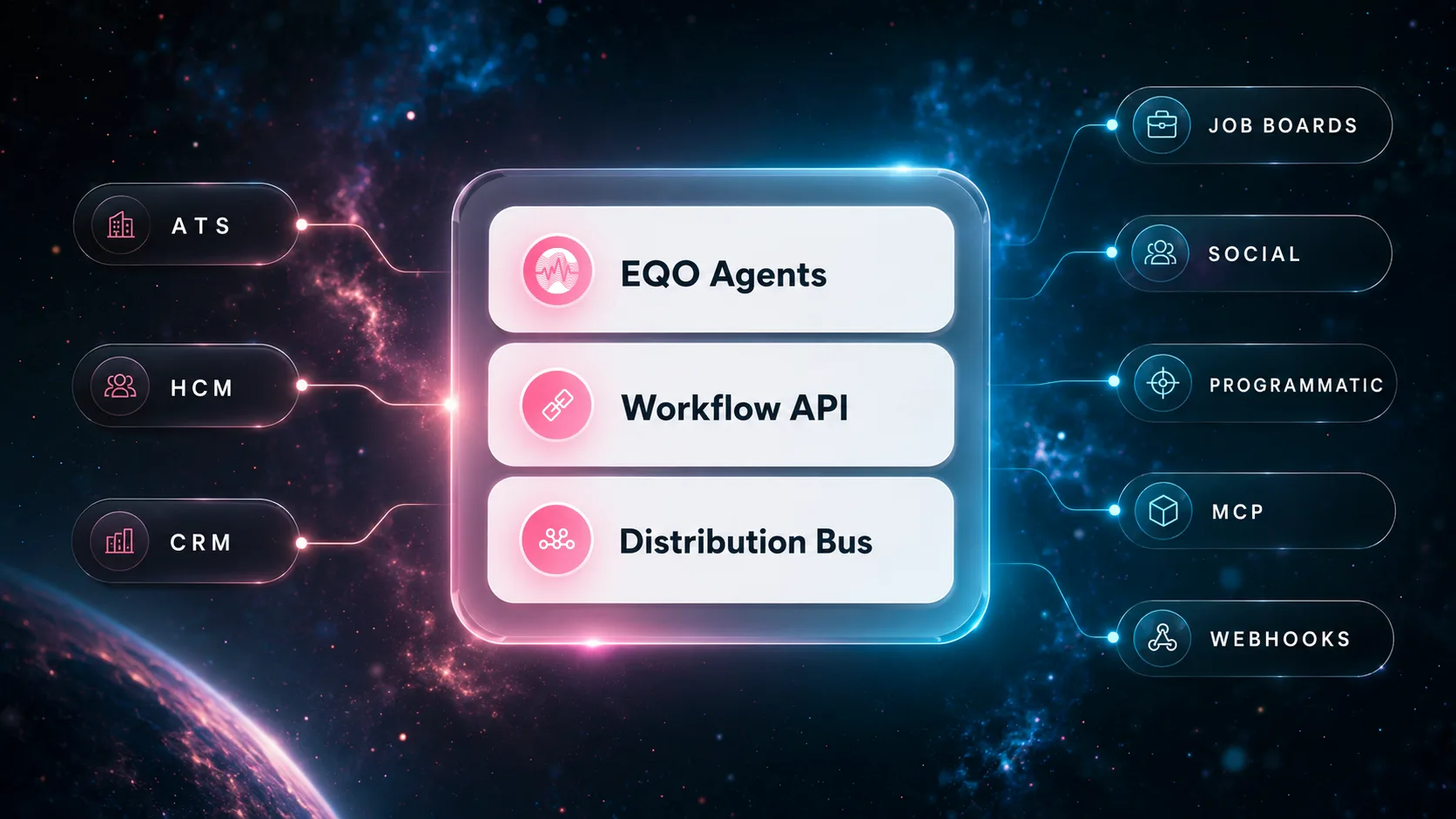
For recruiters, the experience remains simple. They can stay inside their existing workflow while accessing thousands of media channels, launching job campaigns, managing performance, and using AI-powered screening capabilities to identify relevant candidates faster.
For platform providers, the value is different but equally important. HAPI allows them to expand their offering, create new revenue opportunities, and strengthen customer retention without adding every capability to an already crowded product roadmap.
This is also where the clarity problem from earlier gets solved, not avoided. HAPI doesn’t ask an ATS to absorb another undefined feature into an already blurred product scope. It draws a clean line: distribution, screening, and outcome-based hiring sit behind the API, the ATS owns the workflow and the interface. That distinction is exactly what’s missing from a lot of “more capability” expansion happening across the market right now.
This is not just job posting as an add-on. It is ecosystem infrastructure for the top of the hiring funnel.
HAPI partners, including Employ, SmartRecruiters, iCIMS, d.Vinci, Tellent/Recruitee, TalentsConnect, Fountain, and A.Umantis, have embedded VONQ capabilities directly into their platforms. The result is a more connected hiring experience where job distribution, candidate attraction, campaign performance, and screening can happen inside the systems recruiters already trust.
That is what the ecosystem model looks like in practice.Not another standalone tool. Not another disconnected marketplace. Not another feature request added to an already overloaded roadmap.Instead, it is a way for ATS platforms to deliver more value through embedded capabilities that feel native, scale across markets, and help recruiters reach the right candidates faster.
The future of recruitment technology will not be defined by who builds the longest feature list. It will be defined by the platforms that know what to build, what to enable, and how to bring the best capabilities together into one connected hiring experience.
That is where the ATS ecosystem era becomes more than an idea. It becomes infrastructure.
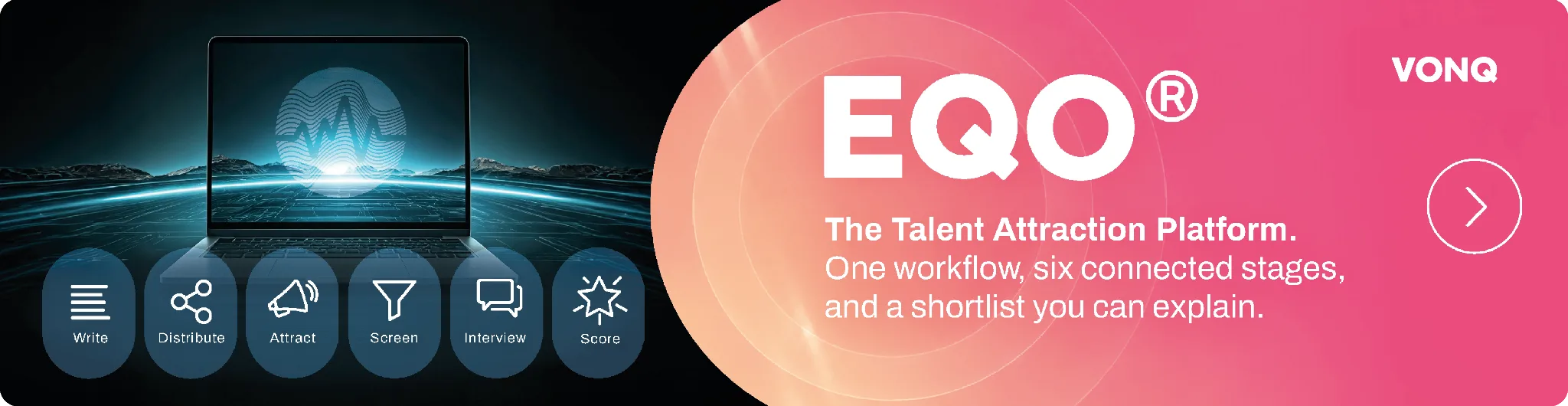
VONQ I One platform. Six connected stages. A shortlist you can explain.
Meet EQO®, VONQ’s Talent Attraction Platform. Instead of disconnected hiring tools, EQO brings together job content creation, distribution, attraction, screening, interviewing and scoring in one continuous, agentic workflow.
- 70% faster time-to-hire
- 75% fewer candidate drop-offs
- 5× Strategic Leader in the Fosway 9-Grid™
Trusted by 350+ enterprise organizations – including Adecco, Danone, DHL, SoftwareOne, and Randstad – EQO runs as a standalone platform or is natively embedded into 85+ ATS and HCM platforms through VONQ’s Hiring API.
Stop managing hiring tools. Start running one workflow.
Bibliography
ATS Market Size & Growth
Global Market Insights / Research and Markets. Applicant Tracking System Market Opportunity, Growth Drivers, Industry Trend Analysis, and Forecast 2025–2034. Research and Markets, 2025. https://www.researchandmarkets.com/reports/6168763/applicant-tracking-system-market-opportunity
Salesforce AppExchange — 13 million installs, 9,000+ solutions
Synebo. AppExchange Trends and Growth Strategies for ISVs. October 2025. https://www.synebo.io/blog/appexchange-trends-and-strategies/
Salesforce ecosystem — $272 billion GDP impact
LLCBuddy. Salesforce AppExchange Apps Statistics 2025. March 2025. https://llcbuddy.com/data/salesforce-appexchange-apps-statistics/
(Originally sourced from Salesforce/IDC partner ecosystem report)
HR.com. Future of Recruitment Technologies 2025–26. Survey conducted July–September 2025 with 225 HR respondents. Published October 2025.
Got a tip, something you just need to get off your chest, or some juicy industry intel? Send it my way. The tip line is always open.
[Want to get Job Board Doctor posts via email? Subscribe here.]

Comments (0)