
The 29-Month Reckoning: White-Collar Job Loss and Gen Z
 Happy Friday, Job Board Doctor friends!
I was listening to Prof G Markets this week, as one does, and a stat host Scott Galloway through out hit me like a brick wall.
White-collar job loss is on a current 29-month bender.
With last week’s jobs numbers report, it seems like a good time to take a look at white-collar job loss, what it means for Gen Z, and the talent technology (including job boards) that serve these groups.
White-Collar job loss: Correction or Implosion?
The headlines tell us the labor market is fine. Last week’s headline the U.S. unemployment rate is holding around 4.3%. Pair that with solid corporate profits and modest but steady GDP growth rate and everything looks a-ok.
Yet, it is not fine, for many communities including professional workers and the generation trying to break into their ranks. The reality: white-collar payrolls have now contracted for 29 consecutive months.
According to Aaron Terrazas, former chief economist at Glassdoor, that is without precedent. “It’s clear that white-collar hiring has slowed and white-collar payrolls have contracted. This is incredibly unusual, going back 70, 80 years,” Terrazas told Quartz.
“The fact is, we have not seen this long of a contraction in white-collar jobs outside of a recession ever before. That has to be kind of ringing some alarm bells.”
The convenient explanation is AI. Companies have leaned hard into that narrative, and the financial press has largely accepted it. But the data tells a more complicated story, and the more defensible read is that this contraction is primarily a hangover from one of the most aggressive and poorly calibrated hiring sprees in modern corporate history.
Fabian Stephany, assistant professor of AI and work at the Oxford Internet Institute, put it plainly to The Street: “I’m really skeptical whether the layoffs that we see currently are really due to true efficiency gains. It’s to some extent firing people for whom there had not been a sustainable long-term perspective, and instead of saying ‘We miscalculated this two, three years ago,’ they can now come to the scapegoating, and that is saying, ‘It’s because of AI, though.'”
That framing matters for how we interpret what comes next. A correction from pandemic-era overhiring is finite. Companies shed the excess, stabilize headcount, and eventually resume normal hiring cycles.
An AI-driven structural elimination of professional work is something else entirely, with a very different set of implications for job boards, recruiters, and the jobseekers we serve.
We are likely living through both dynamics simultaneously, but in my humble opinion, the overhiring correction is still doing most of the work, and conflating the two obscures what is actually happening. Keep in mind, we (me, at least) have not yet identified how to calculate the impact of ongoing trade disputes and more uncertainty created through the U.S.’s war in Iran and the closure of the Strait of Hormuz. Let’s just say: the constant state of flux and uncertainty is not contributing to a stable hiring environment.
What is not in dispute is the scale of the damage, or who is absorbing the worst of it.
The Numbers Behind the Contraction
Between Q1 2023 and Q1 2025, overall job postings for professional roles fell by 35.8%, with declines for software developers, business analysts, and market researchers running at nearly double that rate, according to Revelio Labs. That breadth matters. When cuts cluster in one function or one sector, you can write it off as targeted adjustment. When they span tech, finance, consulting, and business operations simultaneously, you are looking at something structural.
The total number of professional workers in the U.S. fell to 22.6 million in January 2025 from nearly 22.7 million a year earlier, according to the Federal Reserve Bank of St. Louis. One in every four Americans who lost their jobs in 2024 worked in professional and business services, per Newsweek.
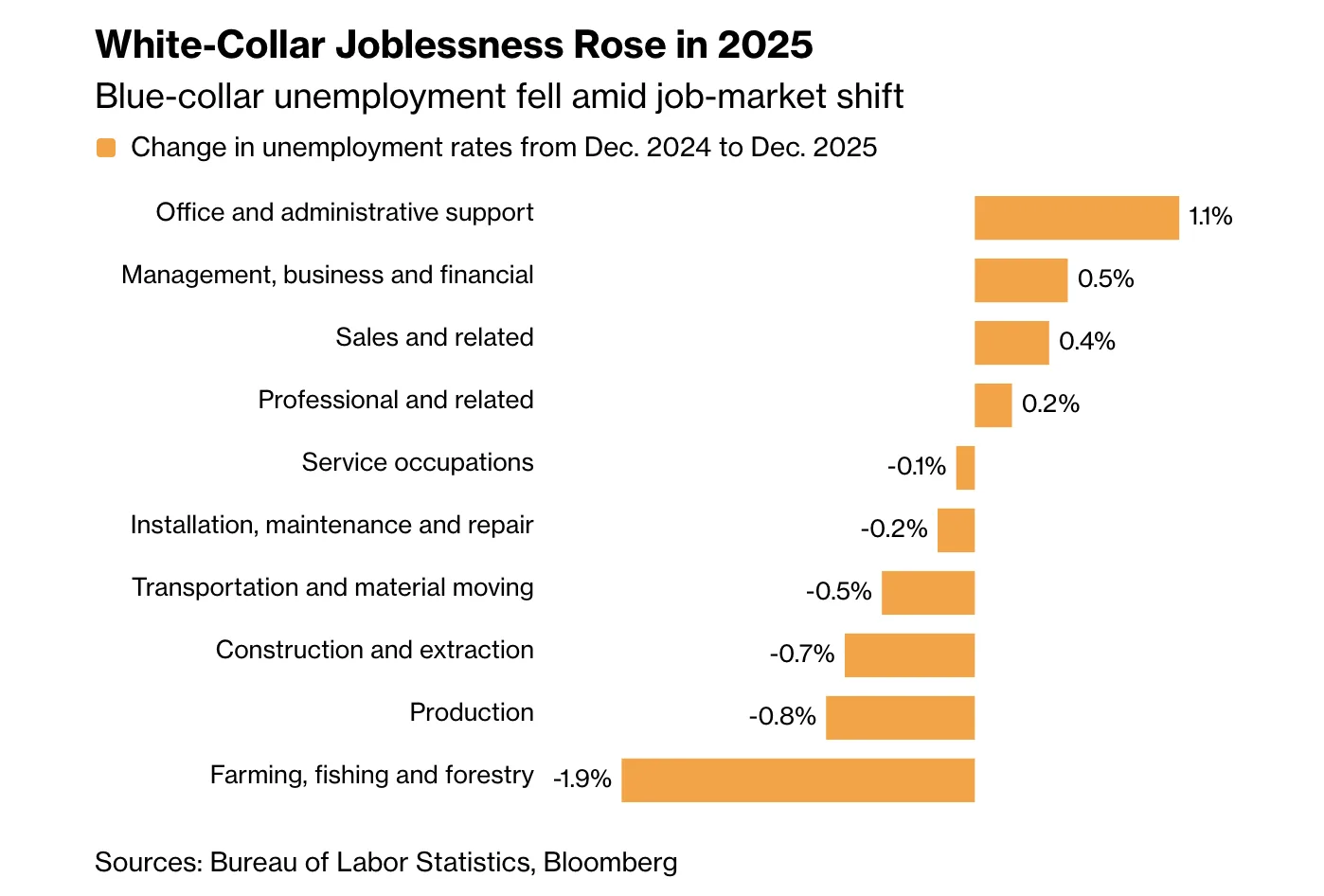
Source: BLS via Bloomberg
The divergence from blue-collar employment is especially sharp. The professional unemployment rate has climbed to 4.2%, up from 3.1% a year earlier, while manufacturing holds steady at 3.7%, according to HR Digest. That inversion is historically unusual. The employment advantage that knowledge workers have held over their blue-collar counterparts for decades is narrowing in real time.
Gen Z IS Getting the Worst of It
Every generation entering the professional market pays their dues. The structural timing here, though, is particularly brutal for Gen Z in a way that goes beyond a prior generations.
In 2025, the share of unemployed Americans who are new workforce entrants hit a 37-year high, peaking at 13.3% in July before settling at 10.6% by February 2026. That figure is still higher than at any point during the Great Recession, according to Fortune.
About 58% of recent Gen Z graduates are still looking for full-time work, compared to just 25% of earlier generations. Only 12% of recent Gen Z grads had something lined up before graduation, making them three times less likely to have an offer ready at commencement than their millennial and Gen X predecessors, per Fortune.
Entry-level job postings have fallen 29 percentage points since January 2024, according to Randstad’s analysis of 126 million job postings globally, reported by the World Economic Forum.
On the employer side, 76% of employers reported hiring the same number or fewer entry-level employees in 2025 than in 2024, citing a tightening labor market, AI adoption, and broader economic pressures, per CNBC.
Finance and information services, the industries that once provided the clearest on-ramp for recent graduates, are shedding an average of 9,000 jobs per month, according to Fortune. These are not peripheral sectors for a cohort of grads who tilted heavily toward business, finance, and technology degrees. These are the sectors they planned their careers around.
The Career Ladder HAS CUrrently Been Pulled Up
The problem is not only that there are fewer jobs. It is that the jobs that remain have changed their requirements in ways that systematically exclude new entrants, and nobody is being particularly honest about that.
Employers are increasingly reserving even “entry-level” roles for candidates with three or more years of experience. Research from the Burning Glass Institute found that unemployment rates for recent college graduates aged 22-27 have climbed to their highest level in decades, and the gap between degree holders and workers with only a high school diploma is now the smallest it has been in 30 years (MyPerfectResume).
For six months in 2025, workers with an occupational associate’s degree in skilled trades posted slightly better employment outcomes than college graduates. That marks the first time college graduates have lost their employment advantage since the federal government began tracking these data in the 1990s, according to Fortune.
Let that sink in.
There is also a gender dimension worth noting. In Q2 2025, 9.1% of Gen Z men were unemployed compared to 7.2% of women, a gap that has persisted since the pandemic. As more women have moved into healthcare and other roles resistant to automation, men remain concentrated in tech and financial services roles being systematically eroded (Fortune).
What This Means for Talent TEchnology and top of funnel
The job board industry has a structural exposure to professional hiring, this is not news to any of us. General boards, niche boards, and graduate recruitment platforms have all been built on an assumption of sustained professional hiring volume. That volume is contracting, and it is contracting in the sectors that historically paid the highest posting CPAs and produced the most engaged candidates.
Professional and business services job openings fell below one million for the first time since April 2020, according to KPMG’s analysis of the January 2026 JOLTS data.
For any board running a volume-based revenue model in professional categories, that is not a market cycle. That is a demand reset.
The candidate side tells another story
Around 20% of professional job seekers have been searching for work for at least 10 to 12 months, with some sending more than 1,700 applications with no results, per Fortune. Candidate volume is high. Candidate frustration is higher.
Boards that are not thinking carefully about what they deliver to job seekers who cannot get traction, not just a listing page but real signal on the gap between their qualifications and what employers are currently requiring, are going to feel that frustration in their metrics.
The WEF’s Future of Jobs Report 2025 projects a net 78 million new roles by 2030, even as 22% of current jobs undergo structural change, with 63% of employers citing skills gaps as their main hiring barrier, per the World Economic Forum. Abundant candidates, persistent vacancies, and a widening skills mismatch sitting in between. That is the central dysfunction of this labor market, and it is also where job boards have always claimed to add value.
The question now is whether the mismatch is too deep for a listing to bridge.
The Platform Implication
A 29-month contraction in professional hiring is not a correction anyone can afford to wait out passively.
For boards serving early-career candidates and recent graduates, the data suggests an urgent product conversation.
- What does a platform deliver when the jobs genuinely are not there?
- What does honest candidate experience look like in a 10-to-12-month search cycle?
- How do niche boards built on professional and knowledge-worker categories think about revenue diversification as hiring stalls in the sectors that have historically driven their volumes?
These are not rhetorical questions. They are the ones your clients, on both sides of the market, are quietly to answer. The boards that help them get there effectively will be better positioned for an ever changing labor market.
Until Next Time,
Julie “The Doc” Sowash
[Want to get Job Board Doctor posts via email? Subscribe here.]
[Got a tip, document or intel you want to share with the Doc? Tell me. Tip so hot you need it to be encrypted? Use Signal.]

Comments (0)