
California, Alabama, West Virginia, and Oregon: 4 Different Metros. Real Hiring Numbers.

Happy Friday, Job Board Doctor friends!
Something caught my eye in last month’s JobMarketPulse monthly data dive, so I asked the team over at Aspen to take a deep dive this month.
I hope it helps provide some insights and spark some ideas to identify some bright spots you can leverage in a less than thrilling labor market.

Talroo brings clarity to improve new-hire retention
You filled the seat, but not with someone who plans to stay. The candidate made it through your entire interview process while quietly interviewing with other companies that pay 25% more.
When expectations aren't clear up front, retention suffers.
Get clarity up front with Talroo's SmartQualify.
Let me know what you think.
Nobody Is Watching These Cities and that is the opportunity.
There is a version of the 2026 labor market story that goes like this: hiring is soft, vacancies are down, employers are cautious, and the best strategy is to wait for the cycle to turn.
That version is not wrong, exactly. It is incomplete in a way that creates a market opportunity for whoever pays closer attention.
Because while the national numbers are doing their slow decline, something interesting is happening in a handful of cities that most job board operators don’t see. Hiring is not just holding up in these places. It is accelerating. Dramatically. For reasons that have nothing to do with the economic cycle and everything to do with where the United States has decided to park its next few decades of industrial ambition.
Four metros. Real numbers. Named employers. And a question at the end that the industry has not adequately answered… yet.
Let’s get into it.
First, Setting the Stage
The national picture heading into mid-2026 is one of consolidation rather than growth. Aspen Tech Labs’ Q1 2026 JobMarketPulse report shows U.S. job postings down 2.0% year over year, with 44 of 51 states posting declines and most major metros tracking the same direction. The pullback is broad but measured; employers are not panicking, they are just not expanding.
The BLS March 2026 data adds a useful caveat: payrolls rebounded to +178K after February’s -133K, but unemployment only held steady because the labor force shrank by 396K. Job creation did not keep the rate flat; a smaller workforce did. Worth keeping in mind when reading any headline that calls the market stable.
Now zoom in. Because within that national picture, four metro areas are posting year-over-year vacancy growth that looks nothing like the trend. The employers driving it are not responding to the economic cycle. They are responding to capital commitments, in defense, AI infrastructure, and logistics, that operate on an entirely different clock.
Those are the markets worth paying attention to right now.
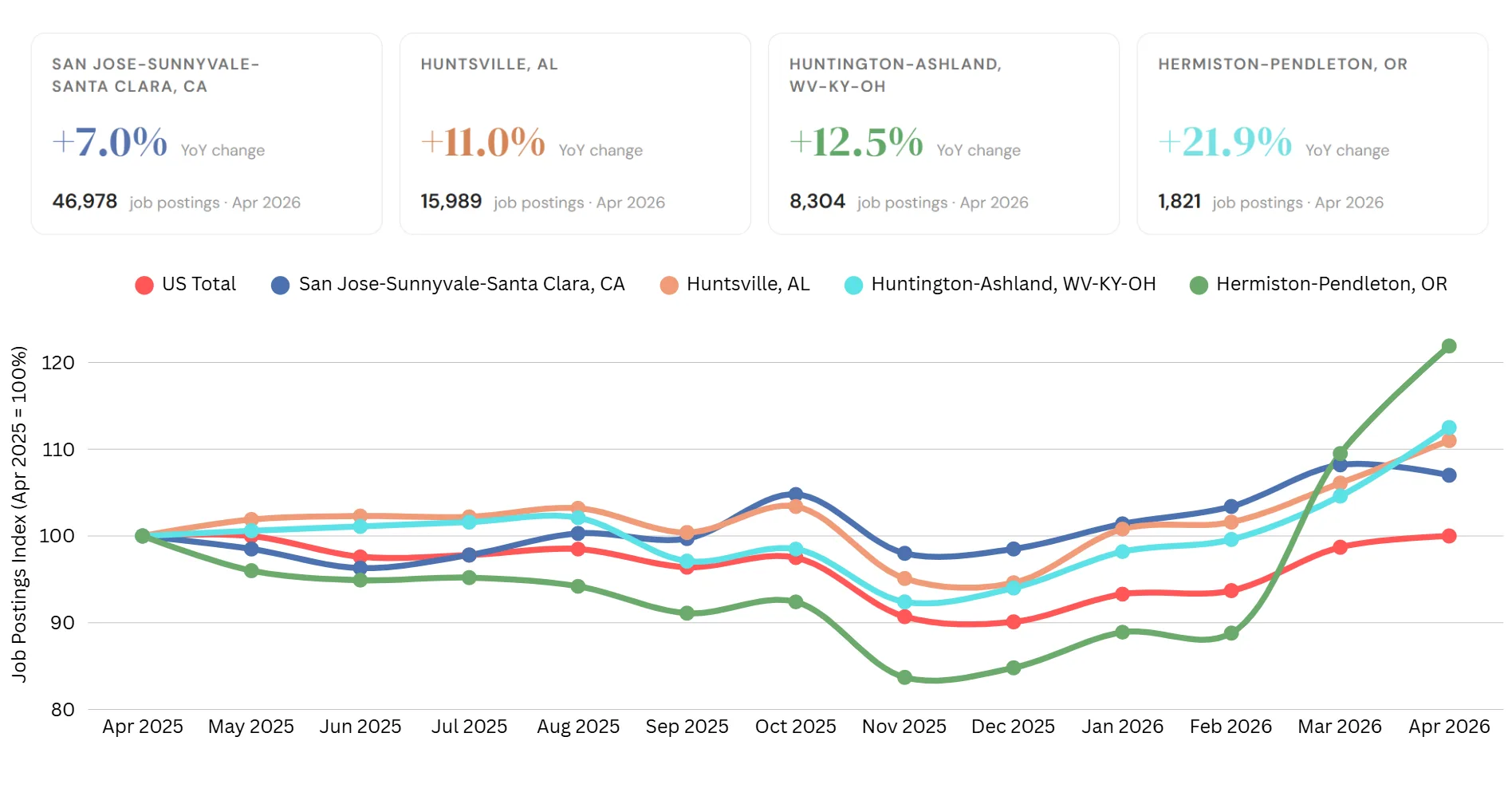
Figure 1: Non-Traditional Hiring Hubs, last 12 months
San Jose, California: The Tech Market Did Not Recover. It Shed Its Skin.
Here is a headline that sounds reassuring: San Jose job postings are up 7% YoY as of April 2026.
Here is what is actually happening underneath it: the tech market in the Bay Area has quietly become a completely different industry.
The names growing fastest in the market are Nvidia (+167%, 1,203 active postings), Applied Materials (+278%, 503 postings), Waymo (+286%, 257 postings), Astera Labs (+326%, 95 postings), and General Motors (+409%, 127 postings). Adobe is up 111% with 422 postings. These are companies building the physical infrastructure that AI runs on, chips, semiconductor equipment, autonomous systems, and next-generation connectivity hardware.
Meanwhile, Meta job postings are down 76%. TikTok is down 35%. Keylent is down 48%.
The consumer internet era of Bay Area hiring is quietly deflating. The AI hardware era is inflating to replace it. And these are not the same jobs, the same candidates, or frankly, the same recruiting challenges. A platform built to connect product managers with Series B startups is operating in a shrinking corner of this market. A platform that understands this market and has been built for it is sitting directly in front of the growth.
San Jose is where that wave is most concentrated. The roles that Nvidia, Applied Materials, and Astera Labs are advertising require a different kind of matching capability and a different kind of candidate pipeline. A platform that has not noticed the rotation has already missed a year of it.
Huntsville, Alabama: Every Single Contractor Is Hiring at Once.
Huntsville is up 11% YoY as of April 2026. Fine. But the number that should stop you in your tracks is not the metro total; it is the employer list:
- Amentum: +545% (143 postings)
- Yorktown Systems Group: +608% (75 postings)
- Lockheed Martin: +211% (141 postings)
- Raytheon Technologies: +189% (68 postings)
- Leidos: +105% (161 postings)
- Astrion: +110% (54 postings)
- L3Harris: +71% (70 postings)
In recruiting, when one big employer in a region is hiring aggressively, you chalk it up to a contract win. When every major employer in a region is hiring aggressively at the same time, something structural is happening. Federal investment is flowing through the entire Redstone Arsenal ecosystem simultaneously, into missile defense, space systems, hypersonics, and a dozen other programs that Huntsville has been home to for generations.
And it just got bigger. In April 2026, U.S. Space Command officially took operational control of its new facility at Redstone Arsenal, marking the start of a phased headquarters relocation that will bring an estimated 1,400 military and civilian positions to the region. The first operational unit stood up on April 15. The permanent headquarters complex breaks ground in 2027. The hiring pipeline that follows a move like that does not wait for the building to open.
According to Rocket City Now, Redstone Arsenal directly employs around 45,500 people on-site and supports a further 100,000 jobs across the wider Tennessee Valley through its contractor and supplier base. Total annual economic impact: $36.2 billion, accounting for 58% of the region’s entire gross regional product. That is not a military base with a jobs program attached to it. That is an economy with a military base at the centre of it.
And it is almost entirely ignored by mainstream job platforms, because hiring here relies on security clearances, aerospace engineering credentials, and government contracting relationships. None of that fits neatly into a keyword search box. None of it generates the kind of high-volume, broad-audience traffic that keeps generalist boards’ metrics looking good. So the market sits there, enormous and underserved, waiting for someone to build for it properly.
Hermiston-Pendleton, Oregon: When One Employer Rewrites the Map.
And then there is this one. Hermiston-Pendleton, Oregon, has the strongest growth of any market in this analysis at +21.9% year over year, and the data behind it is almost uncomfortably simple.
Amazon went from 64 active postings to 427. That is a 575% increase. One employer, one infrastructure expansion decision, one small Oregon metro that was not on anyone’s list twelve months ago, and now has over 400 open roles in fulfillment operations, logistics management, and data center support.
Amazon does this. It is not random. The company deliberately targets secondary and tertiary markets where land is cheap, logistics corridors are accessible, and local governments are enthusiastic about the investment. Amazon has invested in over 1,000 small towns and rural areas across the U.S. since 2010, and the pattern is consistent: one infrastructure wave arrives in a market that nobody was watching, and within a year, the local hiring landscape looks completely different.
Huntington-Ashland, West Virginia
Hermiston-Pendleton is the clearest example of that pattern in the current data. But it is not the only one. Huntington-Ashland, West Virginia, a significantly larger metro, is up 12.5% year over year for a broader set of reasons, one of which follows the same logic. Vertiv, which manufactures power management and cooling systems for data centers, has grown from essentially zero presence in the market to among the top five employers in the metro.
The Data Center Map shows exactly how distributed this infrastructure build-out already is, in Northern Virginia, central Iowa, west Texas, and eastern Oregon. The supply chain hiring that follows it is landing in places that look nothing like traditional tech markets.
The interesting question for job boards is not whether this happens, it clearly does, but how quickly you can detect it and serve it. If your strategy for discovering new markets is waiting for an employer to call you, you are going to be 18 months late every single time. If you are tracking vacancy data at the employer and metro level in real time, both of these markets show up in the numbers long before they show up in the press.
So What Do These Four Cities Actually Have in Common?
Nothing obvious. A Bay Area tech hub, a Deep South defense city, an Appalachian manufacturing market, and a small Oregon logistics corridor do not share demographics, geography, industry history, or culture.
What they share is that each one is being reshaped by a capital commitment large enough and durable enough to override the normal softness in the broader labor market. AI hardware investment. Federal defense spending. Data center infrastructure buildout. E-commerce logistics expansion. These are not cyclical hiring surges that will evaporate when sentiment shifts. They are multi-year, multi-billion-dollar structural programs that will generate employer demand, whether the rest of the economy is cooperating or not.
And yet these markets remain largely untapped by the current generation of job platforms, not because the technology is not there, but because the business model of large generalist boards is built around volume in established markets. None of these cities generates enough aggregate traffic to make them an obvious priority for a platform whose growth strategy is centered on New York, London, and Sydney.
That is exactly what makes them interesting.
The opportunity compounds in ways that go beyond the initial hiring wave. When a market heats up in one sector, it does not stay contained there. Defense contractors hire engineers in Huntsville; those engineers need houses, schools, doctors, and restaurants. Amazon builds a data center campus in eastern Oregon, and suddenly the local healthcare system needs more nurses, the school district needs more teachers, and the town needs more of everything that follows a growing population. One structural investment triggers a much broader economic expansion, and that expansion generates hiring demand across every sector, not just the one that started it.
For job boards, that dynamic matters enormously. A platform that establishes itself in Huntsville or Hermiston-Pendleton at the beginning of a growth cycle does not just capture the defense or logistics postings. It captures the entire labor market as it expands. The network effects that make large platforms dominant in major cities work exactly the same way in secondary markets; they just have not been built there yet.
The CHIPS and Science Act has committed over $61 billion to semiconductor fabrication in Arizona alone, with Ohio and New York each receiving more than $20 billion, anchoring advanced manufacturing in states that were not on the tech industry’s map five years ago. Defense budgets are doubling down on markets like Huntsville. Hyperscale data center construction is spreading into markets that look nothing like traditional tech hubs.
Even in healthcare, Aspen’s JobsIndex data through February 2026 shows Dallas and Miami growing while New York and Boston plateau, the exact same secondary market growth pattern playing out in an entirely different sector.
The hiring map has been redrawn. The question is whether you are working from the new one or the old one.
Note: All employer-level vacancy data is sourced from Aspen Tech Labs’ JobMarketPulse, April 2026. Healthcare vacancy data from Aspen Tech Labs’ JobsIndex, February 2026. Additional labor market context from the U.S. Bureau of Labor Statistics.
As always, tell me what you think.
Until Next Time,
Julie “The Doc” Sowash
[Want to get Job Board Doctor posts via email? Subscribe here.]
[Got a tip, document or intel you want to share with the Doc? Tell me. Tip so hot you need it to be encrypted? Use Signal.]

Comments (0)