
What the Healthcare Job Market Is Actually Doing Right Now

Happy Friday, Job Board Doctor friends! This week the team at Aspen Tech Labs takes a deep dive into the trends and signals in healthcare hiring.
I will see you all next week with some juicy new (🍵) tea.
In February 2026, the U.S. Bureau of Labor Statistics reported that total nonfarm payroll employment declined by 92,000.

Talroo brings clarity to improve new-hire retention
You filled the seat, but not with someone who plans to stay. The candidate made it through your entire interview process while quietly interviewing with other companies that pay 25% more.
When expectations aren't clear up front, retention suffers.
Get clarity up front with Talroo's SmartQualify.
Within that, healthcare employment also fell by 28,000, a notable shift for a sector that has consistently driven job growth.
On the surface, that suggests cooling. But the detail tells a different story.
The decline in healthcare employment was largely driven by strike activity, particularly in physicians’ offices, while hospitals continued to add jobs.
Over the past 12 months, healthcare has added an average of 36,000 jobs per month, reinforcing that the underlying trajectory remains positive.
This is where the gap between employment data and hiring demand becomes important.
BLS data reflects extrapolated survey outcomes. It attempts to capture what has already happened and can be heavily influenced by short-term disruptions. It is essential for understanding the labor market baseline, but it does not always reflect how employers behave in real time.
Using Aspen Tech Labs’ JobMarketPulse data, which tracks job postings from over 275,000 company career sites globally and captures hiring activity at the source, we can examine how demand is evolving across employer types, regions, and roles.
While employment dipped in February, healthcare vacancy levels did not follow the same pattern. Hiring demand has remained consistently elevated, with no comparable drop in open roles.
Healthcare is not cooling as headline employment figures might suggest. Instead, it has moved into a more stable phase, where demand remains high but is no longer accelerating.
That distinction is critical when interpreting what comes next.
Vacancy levels are high, but not moving much
Healthcare continues to support overall job growth, even as hiring demand begins to stabilize. Over the past year, the sector has contributed a significant share of net job creation, meaning overall employment growth would look very different without it.
Much of this demand is tied to long-term demographic trends, particularly an aging population that continues to increase the need for care, regardless of economic cycles, AI disruption, or broader market shifts.
But what does that look like in the data?
Over the past 12 months, from February 2025 to February 2026, healthcare vacancies have remained relatively stable, but the breakdown by employer type provides additional context.
Direct employer postings in Aspen’s JobsIndex continue to account for the larger share of demand and remain broadly stable YoY, up approximately 1.2%. Agency-driven postings show a similar pattern, declining slightly by around 5.7% YoY, but still holding close to 600,000 vacancies.

Figure 1: Healthcare vacancy trend over 12 months (company vs agency)
Both follow a similar pattern of short-term fluctuation without a sustained upward or downward trend. There are short-term fluctuations, including a dip in late summer and a lift toward the start of the year, but levels ultimately return to a familiar range.
This suggests a market where demand remains structurally high, but growth has plateaued, and hiring patterns are becoming more fragmented across channels.
Regional trends are mixed
The geographic picture is not uniform.
Several major healthcare markets, including New York, Boston, and Los Angeles, show year-over-year declines in vacancies, while others, such as Dallas and Miami, have seen increases.
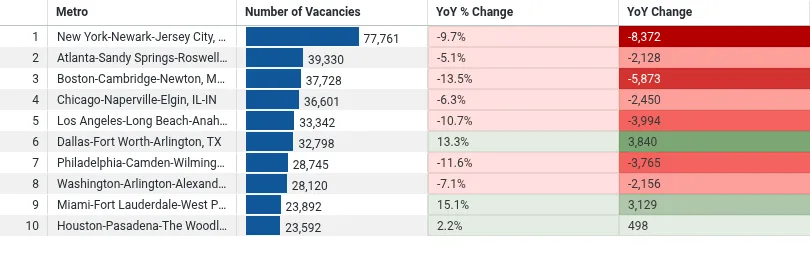
Figure 2: US healthcare vacancy change by top 10 metros
Rather than a single national trend, healthcare hiring is increasingly localized, with growth and decline occurring in parallel across major markets.
Demand is concentrated in a small number of roles
Healthcare demand is not evenly distributed across job types.
A significant share of vacancies continues to be driven by nursing roles, alongside a smaller set of core clinical positions.
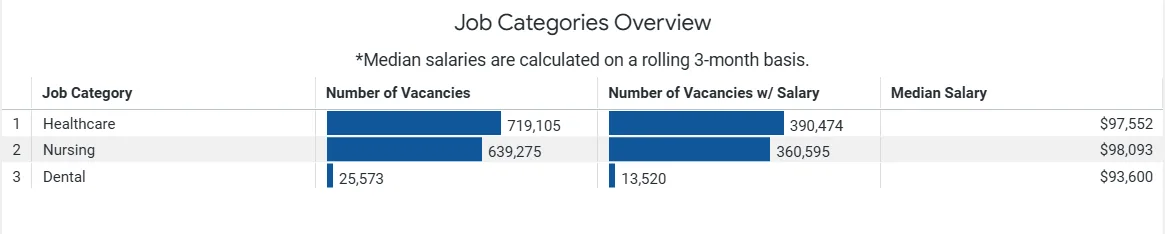
Figure 3: Job categories overview
Recent data shows that individual subcategories are moving in different directions, even when overall demand appears stable.
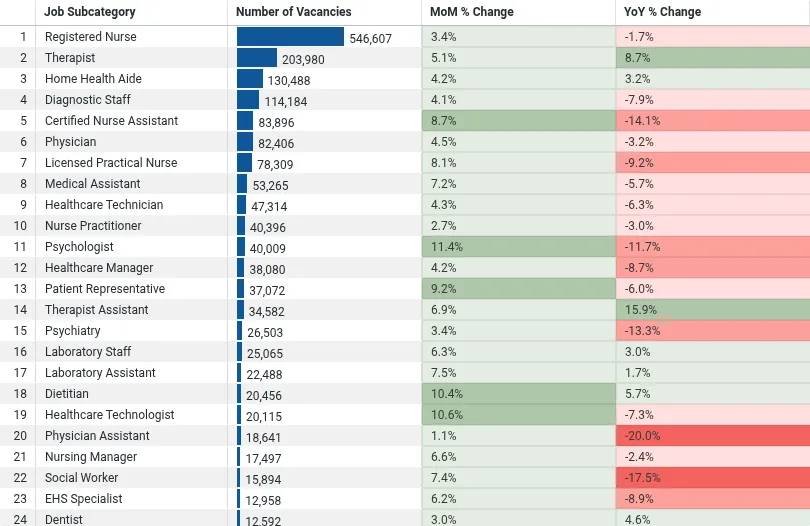
Figure 4: Change in vacancies by subcategory
Year-over-year changes vary across roles, with some, such as therapists and home health aides, showing increases while others continue to decline.
This indicates that while demand is concentrated at a high level, the underlying dynamics differ depending on the specific role.
Taken together, these patterns provide a clearer view of how hiring is evolving across the market.
What the data shows
Healthcare remains one of the most active sectors in the job market.
Vacancies remain high, with limited variation over time, and company hiring accounts for the majority of demand. At the same time, hiring patterns vary across regions, with some major markets declining while others grow.
Demand remains concentrated in a small number of roles, particularly nursing, but subcategory data show that not all roles are moving in the same direction.
Taken together, the data points to a market that is active but uneven, with variation depending on employer type, location, and role.
Data Methodology
The findings in this analysis are based on Aspen Tech Labs’ JobMarketPulse platform, which monitors hiring activity from more than 275,000 direct employer career sites worldwide. This dataset captures a substantial share of live postings and provides near-real-time insight into employer demand.
Wage data is sourced from Aspen Tech Labs’ WagePulse platform, which aggregates and standardizes salary information directly from job postings to provide a consistent view of compensation trends.
All figures reflect information published directly by employers, including salary ranges where available. All data comes from posted job requirements; salary figures should be interpreted as indicators of market trends rather than confirmed offer amounts. Changes reflect real shifts in hiring activity rather than database expansion or methodological updates.
Are you a hiring leader in healthcare? Do you manage healthcare focused TA tech? How does Aspen’s intel compare to what you are seeing? Tell me.
Until Next Time,
Julie “The Doc” Sowash
[Want to get Job Board Doctor posts via email? Subscribe here.]
[Got a tip, document or intel you want to share with the Doc? Tell me. Tip so hot you need it to be encrypted? Use Signal.]

Comments (0)