
The End of “Salary – Competitive, Based on Experience”
 If you’ve spent any time in talent acquisition, you know the dance.
The candidate goes through at least three rounds of interviews. Everyone likes each other. Then compensation comes up, and the number is nowhere close to what they were expecting. Time wasted. Offer rejected, back to the pipeline.
The EU just made that dance illegal.

Talroo brings clarity to improve new-hire retention
You filled the seat, but not with someone who plans to stay. The candidate made it through your entire interview process while quietly interviewing with other companies that pay 25% more.
When expectations aren't clear up front, retention suffers.
Get clarity up front with Talroo's SmartQualify.
The EU Pay Transparency Directive came into force on 7 June 2026. The European Commission has confirmed that the rules now apply regardless of whether individual member states have completed national transposition.
Here’s what it actually means, what the data says about where this is heading, and how we at Aspen Tech Labs are preparing to track it.
What Changed on June 7th
The directive covers four core obligations that TA teams need to understand:
Salary ranges go out before you meet the candidate. Employers must share compensation information with candidates either in the published job vacancy notice, prior to the job interview, or through another channel before an employment contract is concluded. Not in the offer stage. Not after a verbal. Before the process begins, a US company recruiting a developer in Berlin is subject to this. A UK firm hiring in Amsterdam is too. Headquarters location doesn’t matter; the candidate’s location does.
Salary history questions are gone. That “what are you currently earning?” question that’s been used for decades to anchor offers below market. Off the table. Prohibited.
Pay secrecy clauses are unenforceable. You can no longer stop employees from talking about what they earn. Full stop.
Employees can ask what their colleagues make, and you have to answer. Any worker can request their individual pay level and the average pay for comparable roles, broken down by gender. You need to be ready to respond.
Looking a bit further out: companies with 150 or more employees must submit their first gender pay gap report by June 2027; employers with 100 employees will be phased in by 2031. If a gap of 5% or more can’t be explained by objective factors, a formal pay assessment is required. And if a discrimination claim lands, the burden of proof now sits with the employer, not the employee.
The underlying principle, equal pay for equal work, has technically been EU law since the Treaty of Rome in 1957. The gender pay gap across the EU currently stands at 11.1%. This directive is what enforcement finally looks like.
Let’s Be Honest About Where Europe Actually Is
Here’s the uncomfortable part: most EU member states weren’t ready for the deadline. And most job postings still don’t show a salary.
According to the JobMarketPulse UK Q1 2026 report, 55.8% of UK job postings included salary information as of March 2026, a market that moved largely on employer culture alone, with no legal mandate to disclose. That’s a useful benchmark for where EU member states need to get to. The picture across the EU is considerably bleaker, with most major countries showing disclosure rates well below half, and some of the largest markets, Germany and Spain among them, still in the low double digits. Austria, which has required minimum pay disclosure in postings since 2011, remains the regional outlier. EU member states, on the whole, have a long way to go.
On the legislative side, Littler’s post-deadline implementation tracker confirms that Germany had no draft legislation published as of the June 7 deadline, France published a draft but has targeted entry into force for January 2027, and the Netherlands has officially delayed implementation to January 2027. Italy and Ireland, to their credit, drafted laws that go further than the directive, requiring pay disclosure in the posting itself, not just before the interview.
That distinction is more important than it sounds. The directive only technically requires employers to share salary before an interview, not necessarily in the posting. A salary range in a posting is visible to every candidate before they spend a single minute applying. Pre-interview disclosure only helps people who’ve already invested their time in the process. These are two very different levels of transparency.
We expect the number of countries with full national legislation to grow significantly by the end of 2026. But even those that pass laws are likely to give companies transitional periods to adapt. Our honest read: the main effect on actual hiring practices and salary disclosure rates won’t be visible until mid-2027. For some markets, the end of 2027 is the more realistic estimate.
Why TA Teams Should Care Beyond Compliance
The legal obligation is real, but the business case for transparency runs ahead of it.
A 2024/2025 Stepstone survey found that 86% of job seekers across Europe are more likely to apply for a role that includes salary information. Women were more likely to hold this view than men, which tells you something about who currently bears the cost of opacity in the hiring process. Yet despite that candidate appetite, Mercer’s 2026 Global Pay Transparency Survey of over 1,600 multinational organizations found that only 9% of European employers have a full transparency strategy in place. The gap between what candidates want and what employers are doing is still wide.
The same pattern holds in the US. A 2026 Patriot Software survey found that nearly half of job seekers won’t apply to a role without a salary range listed, and 90% say pay transparency directly affects how they feel valued as candidates. That’s not a nice-to-have anymore. It’s a filter candidates apply before you ever see their name.
The pay secrecy prohibition matters for the same reason. Until now, informal pay comparison – colleagues quietly talking – was often the only way unexplained gaps surfaced. Those conversations now have legal backing. If the gaps are there, they’ll come out. Better to find them yourself first.
What We’re Building at Aspen Tech Labs, and What We’ll Report Back
At Aspen Tech Labs, we’re building and refining a salary parser directly into our platform. Here’s how it actually works.
The parser scans raw job description text for two types of signals: salary-related keywords, words like “salary,” “remuneration,” “wage,” and their equivalents across languages, and currency markers, whether that’s a € symbol, CHF, NOK, or any of the other currencies in the markets we cover. It’s built primarily for Europe, but also covers the Americas, South Africa, and Japan.
The tool works across most EU languages, including Greek, Finnish, and Czech. A directive that applies across 27 member states only generates useful data if you can read what employers in all of them are actually posting.
Finding a number with a currency symbol next to it is the easy part. The harder problem is understanding what that number represents. A posting might mention a €50,000 salary, a €5,000 signing bonus, and a €200 monthly transport allowance. All mean something different. The parser validates each amount in context to distinguish genuine compensation from bonuses, allowances, prices, or revenue figures that happen to appear in the same text.
Once a salary is confirmed, it’s normalized into an hourly rate. This makes it possible to compare salaries across roles, sectors, and geographies, regardless of whether the original posting listed an annual salary, a monthly figure, a weekly rate, or an hourly wage. Without normalization, you’re comparing apples, oranges, and currency conversions.
The output is structured, comparable pay data, not just a flag that says “this posting contains a number.”
The US Did This First. It’s Taking Longer Than Anyone Expected.
Europe is not the first to try this, and the US experience is worth studying closely.
Colorado kicked things off by introducing the salary transparency legislation in January 2021. New York City followed in November 2022, California and Washington in January 2023. As of 2026, 18 states plus Washington D.C., have pay transparency mandates, with Massachusetts, Vermont, New Jersey, Illinois, and Minnesota among the most recent additions. Still no federal law.
Pay Transparency in US Job Postings: Q1 2023 vs Q1 2026
Share of active job postings disclosing salary information, by state. LAW badge indicates states with pay transparency legislation.
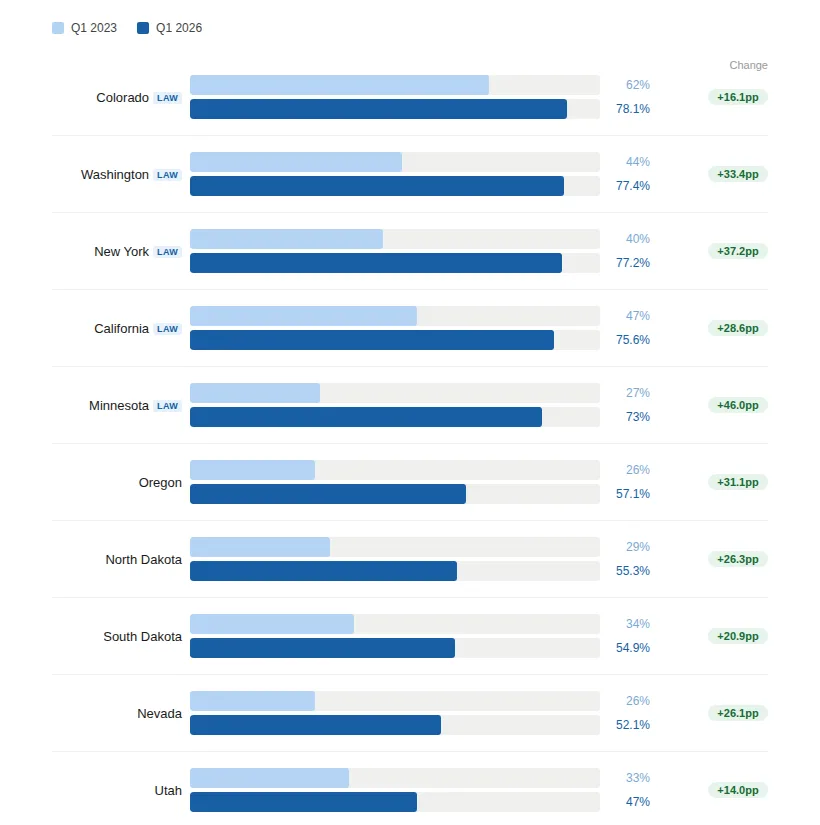
Figure 1: US Salary Transparency by State: Q1 2023 vs Q1 2026
In the JobMarketPulse Q1 2023 report, 27.2% of job postings contained advertised salary information. Above, you can see a sample of states with and without salary transparency legislation, and how it’s changed over the last three years. States with legislation led the way, but even those without saw meaningful gains. This is the curve Europe is now starting to follow. We’ll be tracking the same progression across EU markets as the directive takes hold.
But compliance? Still not fully there. Our own JobMarketPulse Q1 2026 report tracks salary transparency across US job postings in real time, and the numbers are instructive. Transparency crossed 50% nationally for the first time in early 2025, peaked at 55.3% in January 2026, and actually pulled back slightly to 54.2% by March 2026. The gap between states with transparency legislation and those without remains stark: 78% versus 45%. Even after multiple years of salary transparency requirements, compliance is still not universal, with Colorado, Washington, and New York all hovering just below 80%. Colorado and New York City have both issued fines. The problem isn’t that employers don’t know the law. It’s that changing hiring infrastructure across large organizations takes time, and enforcement has been uneven.
The pattern is clear: legislation moves the needle fast, full compliance takes years, and the laggards only move when enforcement actually kicks in. Europe should plan for the same curve.
What to Watch
The directive is live, but its real-world effects will play out gradually. A few things worth tracking:
Disclosure rates in the low-transparency markets. According to Aspen Tech Labs, Germany at 7.2% and Spain at 4.1% are the ones to watch. Whether the directive’s existence alone shifts employer behavior or national laws are the actual catalyst will become clear over the next 12 to 18 months.
The quality of the ranges, not just their presence. A range so wide it tells candidates nothing is technically compliant and practically useless. Disclosure is a start. Useful disclosure is the actual goal.
Gender pay gap reports. First wave due June 2027 from companies with 150+ employees. These will be public, and they will get attention from employees, unions, media, and regulators, particularly where gaps can’t be explained.
Enforcement appetite by member state. Member states set their own penalties. The states that enforce aggressively will see faster movement. The ones that don’t will see slower. Watch where the first fines land.
What We Expect to Find
We don’t think the first wave of data will be pretty.
Based on what the US showed us, the 12 months following legislation tend to produce a visible jump in disclosure rates, and then a long plateau. The early movers comply quickly. The rest wait for enforcement. We expect that by mid-2027, salary disclosure across major EU markets will be meaningfully higher than it is today, but still well short of universal. Some markets will surprise us. Others will disappoint.
What we’re most interested in isn’t just whether salaries are appearing in postings. It’s whether the ranges being disclosed are actually useful, how they vary by sector and geography, and where the gap between what the law requires and what employers are actually doing remains widest. That’s the data that tells TA teams something actionable.
We’ll bring it back here when we have it, though, if you want to talk through the numbers sooner, our data team is easy to reach.
Until Next Time,
Julie “The Doc” Sowash
[Want to get Job Board Doctor posts via email? Subscribe here.]
[Got a tip, document or intel you want to share with the Doc? Tell me. Tip so hot you need it to be encrypted? Use Signal.]

Comments (0)