
Indeed Finally Has a CTO Again. But Where’s the Chief Product Officer?
 Happy Friday, Job Board Doctor friends! Indeed is back on my mind this week so let’s get after it.
After operating without a Chief Technology Officer for more than four years, Indeed has made a significant leadership move appointing Jim Giles as CTO, effective February 16, 2026.
It’s a hire that signals Deko might finally understand that it will take more than his brilliance to build lasting innovation. It also raises questions about what took so long and who is still missing from Indeed’s C-Suite.
A Google Veteran Steps In
 Giles arrives from Google, where he spent over a decade rising through engineering leadership. Most recently he served as Vice President of Engineering overseeing Google Workspace’s collaboration products (Docs, Sheets, Slides, and Drive), tools used by more than a billion people globally.
Perhaps more telling than his operational scope is his strategic track record. At Google, Giles helped lead the company’s transition to an AI-first product strategy and founded the Workspace AI platform, which powered AI development and enabled cross-product integration.
Four-Plus Years Without a CTO
What makes this appointment so notable isn’t just who Indeed hired. It’s how long the seat was empty.
Indeed has operated without a dedicated CTO for over four years, a remarkable gap for a “technology” company that processes millions of job searches monthly and has hundreds of millions of job seeker profiles across 60+ countries.
During that stretch, technical leadership appears to have been distributed across other roles, including the CIO/CSO function held by Anthony Moisant, who oversees platform security, IT, and increasingly, internally championing agentic AI.
But a CIO and a CTO serve fundamentally different purposes. A CIO keeps the lights on, secures the infrastructure, and optimizes internal systems.
A CTO sets the technical vision: deciding how products get built, how the platform evolves, and where the engineering organization places its biggest bets.
For a company whose entire value proposition is its technology platform, that distinction matters enormously.
During part of this four-year vacuum, Indeed publicly claimed it is collecting 320 terabytes of data every single day and that data is available to its AI for learning.
They were still rolling out AI products, deprecating old ones, and rebranding features faster than their own sales teams could keep up.
Oh wait, did I mention a massive integration with OpenAI, where there is no publicly available data sharing agreement?
All without anyone in the C-suite whose sole job was to own the technical strategy.
And what did all that data and all those AI experiments produce? Did they fix hiring?
No.
The DAILY 320 terabytes they have already collected since at least 2024 apparently isn’t enough.
The Missing CPO
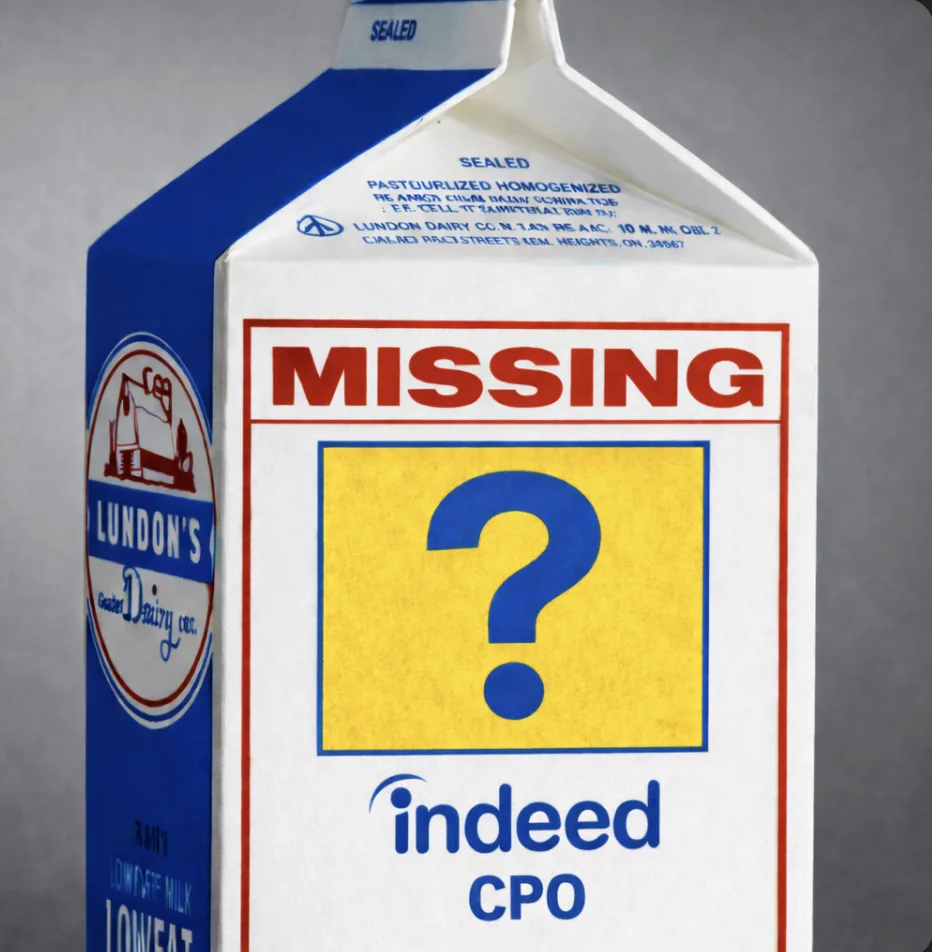
If the CTO gap was conspicuous, there’s another absence in Indeed’s leadership structure that deserves additional scrutiny: there is no Chief Product Officer.
A review of Indeed’s current senior leadership team reveals roles you’d expect at a company of this scale: CEO, CRO, CMO, CIO/CSO, Chief People Officer, General Counsel, SVP of Sales, SVP of Operations.
But no one carries the CPO title, and no one on the leadership page appears to own the product function as their primary mandate.
Competitors and peers in the HR tech space, as well as marketplace companies more broadly, almost universally have a dedicated product executive at the C-level or senior VP level reporting directly to the CEO.
Indeed’s history offers some context. Chris Hyams, the former CEO, originally joined the company in 2010 as VP of Product. When he ascended to the CEO role in 2019, product strategy was effectively absorbed into his purview.
But with Hyams gone and Idekoba (whose background is more rooted in marketplace operations and M&A) now at the helm, the question is: who owns product vision at Indeed today?
It’s possible that product leadership exists below the C-suite level or is being divided among engineering, revenue, and operations leaders.
But the absence of a visible, senior product executive raises a structural question at a moment when Indeed is trying to reinvent itself.
AI-powered hiring agents, smart matching algorithms, and new monetization models all require someone with clear authority over the product roadmap, and critically, someone who can say no to launching half-baked products under confusing names.
Indeed’s Product Problem: A Naming Disaster and a Timeline of Chaos
If the need for a CPO at Indeed has not been clearly evidenced over the past six months alone, allow the Doc to give you a little refresher.
First, a soapbox moment: if you need a CPO for anything at all, it’s just to pick a product name and stick with it. I cannot stress this enough.
Across all the research I’ve done (Indeed’s press releases, product pages, sales materials, industry coverage), the naming landscape is an absolute mess. “Smart” this. “Advanced” that.
Products that launch and disappear. Names that change between the pitch deck and the press release. Features rebranded as products. Products demoted back to features.
It’s serving chaos energy, and it’s the clearest evidence that nobody owns product.
The Product Timeline
2024: Smart Sourcing Launches
AI-powered candidate sourcing from Indeed’s 225M+ resume database. Employer-initiated: you go in, select a job, the system surfaces matched candidates with AI summaries, and you do the outreach. It’s a pull model where the recruiter drives the process.
2024: Pathfinder Announced
AI career pathing tool that analyzes skills, suggests career paths, identifies skills gaps, and recommends learning resources. Conversational interface. Previewed at FutureWorks 2024 by then-CEO Chris Hyams.
Planned for early 2025 iOS launch. Pathfinder was never launched as a standalone product. It appears to have been quietly folded into Career Scout, I think.
Late 2025: Basic AI Candidate Summaries
Included with Indeed Connect. Launched and then put on hold as of January 30, 2026.*
Here’s the actual verbiage that went out to clients:
“As of January 30, 2026, Candidate Summaries are no longer available for new candidates. Any existing summaries will remain visible, but you will not see newly generated summaries moving forward. This change follows reported quality concerns, and the team is currently reviewing feedback and evaluating next steps.”
So a product they were actively selling through Indeed Connect, a product that was part of the value proposition, was pulled less than a month after launch due to quality issues.
That’s not iteration. That’s shipping something that wasn’t ready.
*Current status as of 2.27.26 is unknown to the Doc.
2026: Advanced Screening (Also Called… Smart Screening?)
Advanced Screening is pitched in the Indeed Connect sales deck as the premium tier along side Advanced Sourcing.
It has three components:
- Smart Fit Score: Scores candidates against employer-set criteria (active as of Feb 2026)
- Criteria Refinement: Conversational AI interface for defining and adjusting screening parameters (active)
- License and ID Verification: Third-party credential verification (reportedly on hold, select jobs only)
But the relationship between “Advanced Screening” and “Smart Screening” feels a bit murky.
Smart Screening appears to be the umbrella product name used publicly, while Advanced Screening is the name used in sales materials and the Indeed Connect pitch deck.
Are they the same thing? Is one replacing the other? Is Advanced Screening just Smart Screening with a premium label?
2025-2026: Advanced Sourcing
And here’s the product that nearly broke my brain.
“Advanced Sourcing” does not appear in any Indeed press release, product page, or public announcement I could find. The only place I could find that it appears by name is in the Indeed Connect pitch deck, where it is listed as a separate purchasable AI innovation alongside Advanced Screening, and in the Indeed Connect contract terms, where it’s referenced as a beta product.
So what is it? Based on the pitch deck, Advanced Sourcing represents a fundamental shift from Smart Sourcing.
Here’s the difference:
Smart Sourcing is employer-initiated. You go in, you search, you find candidates, you reach out. It’s a tool.
Advanced Sourcing is Indeed-initiated. Indeed finds candidates who match your qualifications, reaches out to them on your behalf, validates their interest, and delivers them to your ATS as applicants.
These show up tagged as “Sourced application” with notes like “This person applied to automatic outreach by Indeed. Please have a look, they’re available to interview any day this week.”
That’s not a feature upgrade. That’s a different business model. Indeed is no longer just a platform where employers search for talent. It’s positioning itself as an active recruiting agent that sources, contacts, and pre-qualifies candidates on the employer’s behalf.
That’s a direct incursion into what staffing agencies and RPOs do.
Worth noting: the 3x hire-likelihood stat that Indeed uses to sell Advanced Sourcing is actually sourced from Smart Sourcing data, meaning they’re selling a beta product on the performance metrics of a different product.
And to the contract language itself:
“Indeed may offer you access to Beta products (such as, but not limited to, Advanced Sourcing and Advanced Screening). You understand and agree that while Indeed makes commercially reasonable efforts to provide these products, access to these Beta products is subject to change and the Beta Program Terms in the Terms.”
Translation: we’ll sell you access to these products, but we reserve the right to change or pull them at any time.
Forced Integrations Coming to a Head
The product chaos doesn’t exist in a vacuum. It’s happening alongside an increasingly aggressive push to lock employers into Indeed’s ecosystem.
A couple of months ago, I wrote a three-part series on why employers should stop using Indeed in 2026.
The core argument: Indeed is leveraging its market position to force ATS integrations that give it access to your disposition data, every applicant status change, every hiring decision, raw notes included.
The data transfer is opt-in by default, and your ATS has already mapped your disposition statuses to Indeed’s schema whether you asked for it or not.
Chris Hoyt, President of CareerXroads has also been facilitating discussions within the CXR membership about these new Indeed policies and practices.
The concerns from enterprise TA leaders are real and growing: data ownership, compliance risk, and the fundamental question of whether employers should be handing over the lifeblood of their talent operations to a platform that can’t even keep its product names straight.
The Indeed Connect value proposition, the whole “next generation” platform strategy, depends on employers integrating deeply with Indeed’s ecosystem.
But trust is earned, and right now Indeed is asking for more data, more integration, and more spend while simultaneously shipping products that get pulled within weeks and maintaining a product portfolio that requires a decoder ring to navigate.
What This Means Going Forward
Giles’ hiring is a strong signal that Indeed may be getting serious about its technical evolution. His experience building AI platforms at Google scale brings a presence that has been absent from Indeed for nearly half a decade.
But a CTO alone doesn’t close the leadership gap.
Technology answers the question of how. Product answers the question of what and why.
Without a counterpart who owns the product vision with equal authority, even the best CTO risks building impressive infrastructure that lacks strategic product direction.
Indeed needs someone who can walk into a room and say: we have too many products with overlapping names, half of them are in beta, one got pulled for quality issues a month after launch, and we’re selling features under names that don’t match anything on our public website.
With AI reshaping every dimension of the hiring market, Indeed can’t afford ambiguity in its leadership structure or its product portfolio.
Filling the CTO role after four years was overdue. The question now is whether Indeed recognizes that the product leadership gap may be just as critical, and whether Jim Giles’ arrival is the first move in a broader executive buildout or another band-aid fix for Indeed’s deepening lack of direction, focus, and execution.
And as always, you know the drill, tell me what you think, what you know, anything I misstated or got wrong. We all learn together.
Until Next Time,
Julie “The Doc” Sowash
[Want to get Job Board Doctor posts via email? Subscribe here.]
[Got a tip, document or intel you want to share with the Doc? Tell me. Tip so hot you need it to be encrypted? Use Signal.]
Comments (0)