
The Remote Work Reality Check: What Employers Post vs. What Job Seekers Actually See
 Remote work is still a small piece of the U.S. job market, but it isn’t standing still. Remote and hybrid postings are both growing faster than the broader market. So we checked: do the remote jobs employers post match what job seekers actually see when they search for one?
We drew on three sources. JobsIndex tracks what employers are posting. JobMarketPulse gives the total-market comparison. A Google for Jobs dataset, built from remote-search queries, shows which job boards and titles actually surface. Together, they show what employers are posting and what a job seeker actually finds, and those aren’t the same thing.
What Employers Are Actually Posting
Remote postings made up 3.0% of all U.S. job postings over the past 12 months, up 0.4 points from 2.6% a year ago. Hybrid sits at 1.1%, also up 0.4 points, from 0.7% a year ago. Both shares are measured against the full job market, which includes many roles that require in-person work, such as retail positions and hands-on healthcare jobs.

Talroo brings clarity to improve new-hire retention
You filled the seat, but not with someone who plans to stay. The candidate made it through your entire interview process while quietly interviewing with other companies that pay 25% more.
When expectations aren't clear up front, retention suffers.
Get clarity up front with Talroo's SmartQualify.
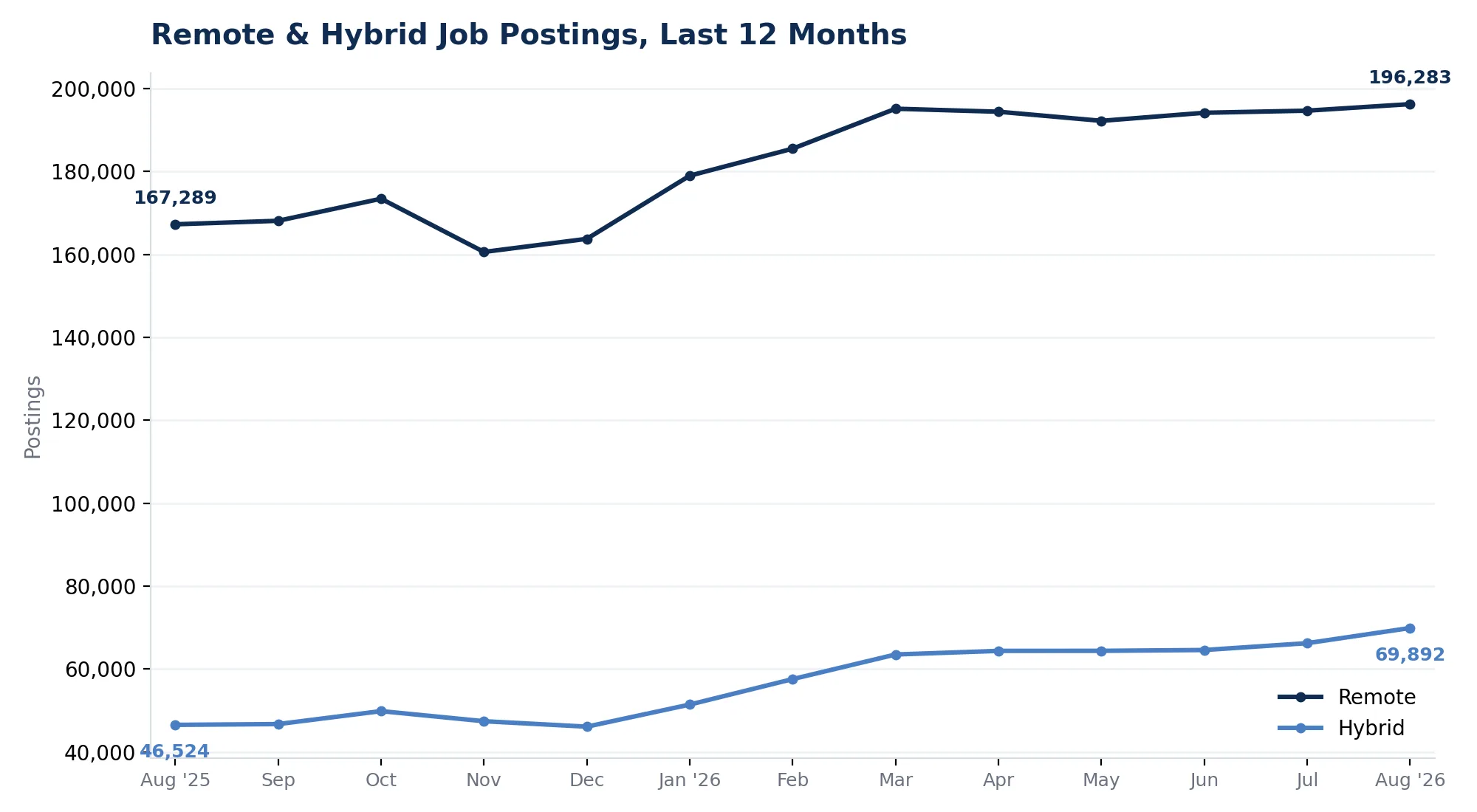
Remote & Hybrid Job Postings, Last 12 Months
Both remote and hybrid job postings grew faster than the broader market. Total U.S. direct employer postings were up 3.8% YoY in August 2026. Remote postings rose from 167,289 to 196,283 over the same window, up about 17%, moving from 2.6% to 3.0% of all U.S. postings. Hybrid grew even faster: from 46,524 to 69,892, up roughly 50%. Both are still a small portion of the market, but both are pulling away from the market’s overall growth rate, not just tracking it.
Where remote actually concentrates:
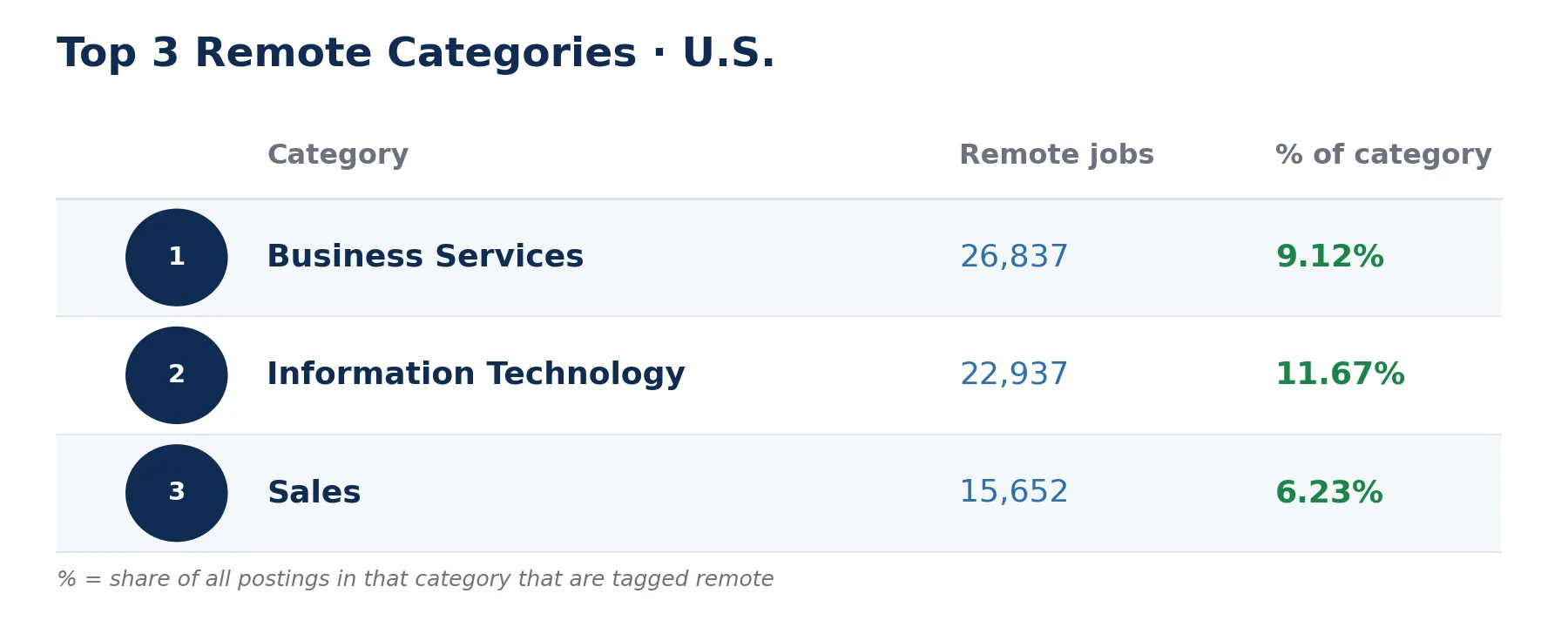
Top 3 Remote Categories in the U.S., as of August 2026.
Business Services carries the most raw remote volume. Information Technology has the highest remote rate of the three; nearly 1 in 8 IT postings is remote. Sales lags both in share. (“% of category” means the percentage of jobs in that category that are remote, not the category’s share of all remote jobs.)
Google For Jobs
Now the search side. Aspen analyzed Google for Jobs button share and title data across a set of remote-specific search queries, the kinds of searches a real job seeker runs (remote IT jobs, remote sales jobs, remote education jobs, and so on), to see which job boards and which roles actually show up.
The first finding is that nobody owns this category. The top five providers by GFJ button share are BeBee, LinkedIn, Talents By Vaia, Monster, and ZipRecruiter. Together, however, they account for just 28.7% of remote-query placements. The chart below shows the top 10; the full dataset tracks 29 providers, which together add up to about 68% of the total share. The remaining third is spread across hundreds of smaller providers.
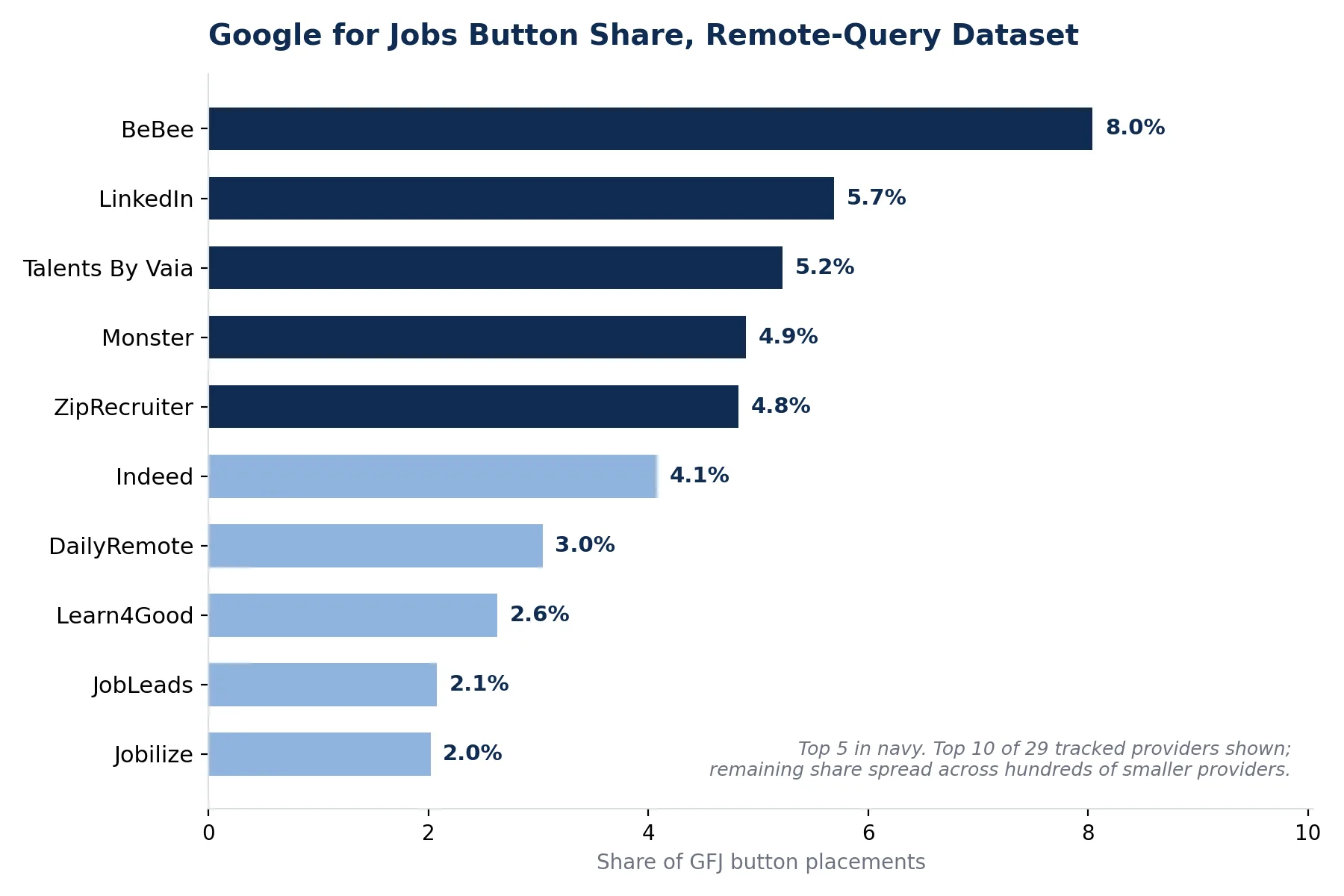
Google for Jobs Button Share, Remote-Query Dataset
Within that fragmented landscape, BeBee also moves ahead of a familiar leader. LinkedIn has historically ranked above BeBee in Aspen’s broader Google for Jobs tracking, but for these remote-specific searches, BeBee captures 8.0% of button share compared with LinkedIn’s 5.7%. That difference shows how provider visibility can change when job seekers narrow their search to remote roles.
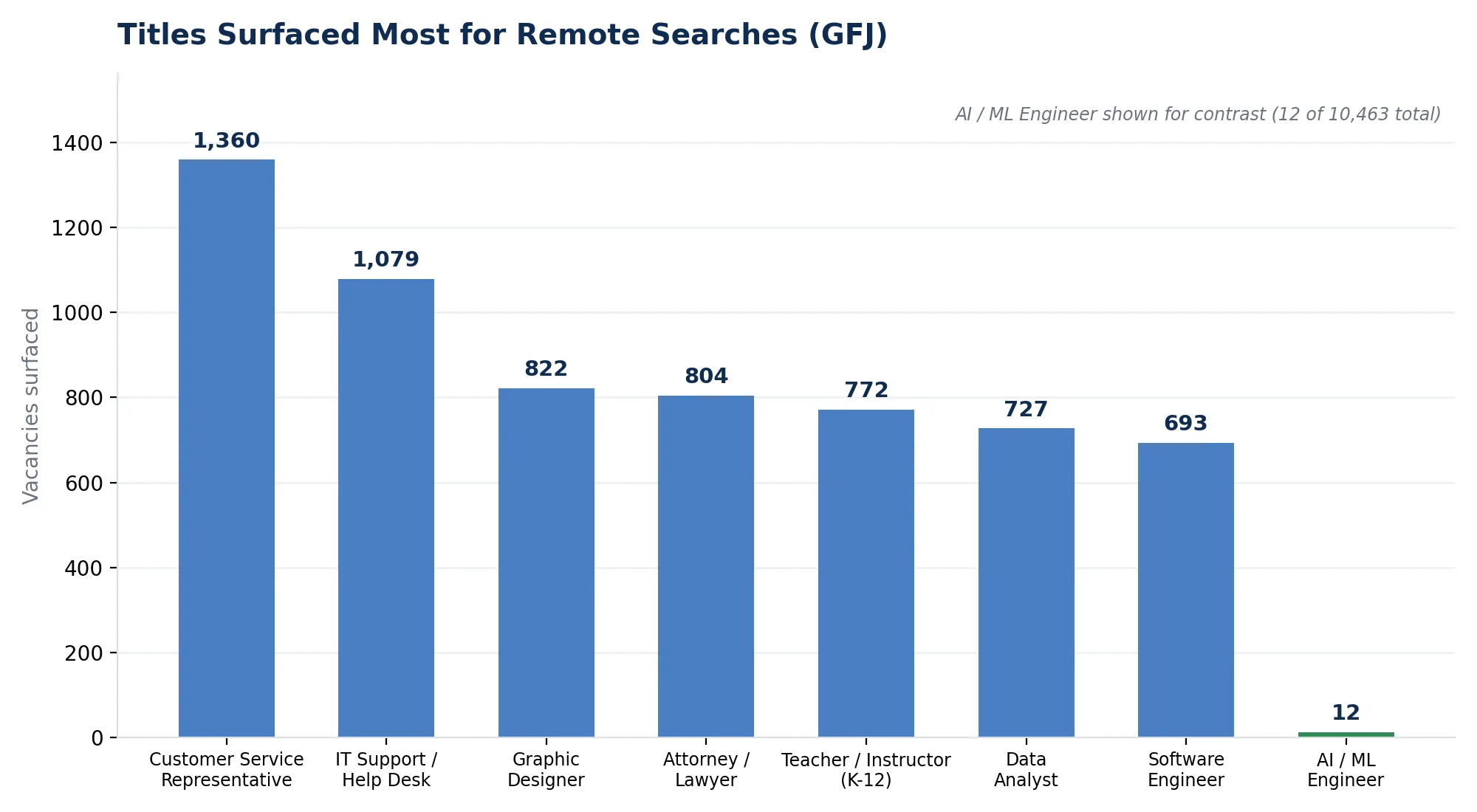
Titles Surfaced Most for Remote Searches (GFJ)
Customer service and IT support leading isn’t a surprise; those are high-volume, low-barrier categories with a large, constant flow of people searching for them. What’s more telling is the AI/ML Engineer line: 12 vacancies surfaced across the whole dataset, despite AI hiring being the most talked-about story in the broader jobs conversation this year. Two things explain that gap, and neither is about job boards deliberately deprioritizing the role. First, employers post far fewer AI/ML engineering roles than customer service or call center roles, so there’s less raw volume to surface. Second, the search behavior around these roles is different: a senior AI/ML engineer is more likely to search for a specific title, such as “remote machine learning engineer,” while customer service or retail candidates are more likely to use broader searches such as “remote jobs.” That means a meaningful share of AI/ML search demand may sit outside broad job-search traffic, while high-volume categories like customer service generate far more clicks and CPC-driven traffic. Teachers/tutors showing up prominently reflects the same dynamic in reverse: a large, steady volume of people searching for jobs in those fields using relatively broad terms.
Where the Two Pictures Diverge
The employer data and Google for Jobs results offer different views of remote hiring. Job postings from employer career sites show what employers are hiring for, regardless of whether those jobs appear prominently in search. The GFJ dataset captures which job boards and titles surface for a defined set of remote-specific queries. One measures posting activity; the other measures visibility within those searches.
Search terms also shape that picture. Queries like “remote jobs” and “remote IT jobs” may surface a different mix of roles than searches for specific titles, such as “remote machine learning engineer.” That means a role’s visibility in these results partly depends on how people search for it. But it’s not only that: employers also post meaningfully fewer AI/ML engineering roles to begin with, so there is less raw volume in the market for such roles.
For job board operators, the clearest finding is fragmentation. The top five providers account for just 28.7% of remote-query placements, while roughly a third is spread across hundreds of smaller providers. That suggests there may be room for smaller or specialized boards to gain visibility around particular roles. Looking at individual search queries could help them identify where their listings already surface and where there may be opportunities to improve.
What the Data Shows
Remote work in 2026 is still a small slice of the market, 3.0% of all U.S. postings, but it isn’t standing still. Remote postings grew about 17% YoY, and hybrid grew about 50%, both comfortably outpacing the broader market’s 3.8% growth. IT has the highest remote rate of any category, and Business Services carries the most raw remote volume. What shows up when a job seeker searches for a remote role on Google looks different: heavy on customer service and help desk listings, with a surprising amount of legal and teacher/tutor content mixed in, and barely any AI roles. The mix reflects what surfaces for the remote searches we tracked, and may look different when job seekers search for more specific titles. No single job board dominates these results, and roughly a third of placements are spread across hundreds of smaller providers, suggesting room for specialized boards to build visibility.
Data Methodology
This analysis draws on two Aspen Tech Labs datasets. Remote and hybrid posting figures are sourced from JobsIndex, which tracks postings directly from employer career sites; figures reflect trailing 12-month data through August 2026 and are limited to direct employer postings (recruitment agency postings excluded). Google for Jobs figures are drawn from a separate dataset tracking button share and job title mix across a defined set of remote-specific search queries (for example, “remote IT jobs,” “remote sales jobs”); share reflects each provider’s proportion of GFJ button placements within that query set, not overall traffic or job volume, and title groupings combine related listing titles by function. Figures reflect information published directly by employers and by job boards; changes reflect real shifts in posting and placement activity rather than methodology changes.

Comments (0)