
The New Reality: Regulation by Litigation
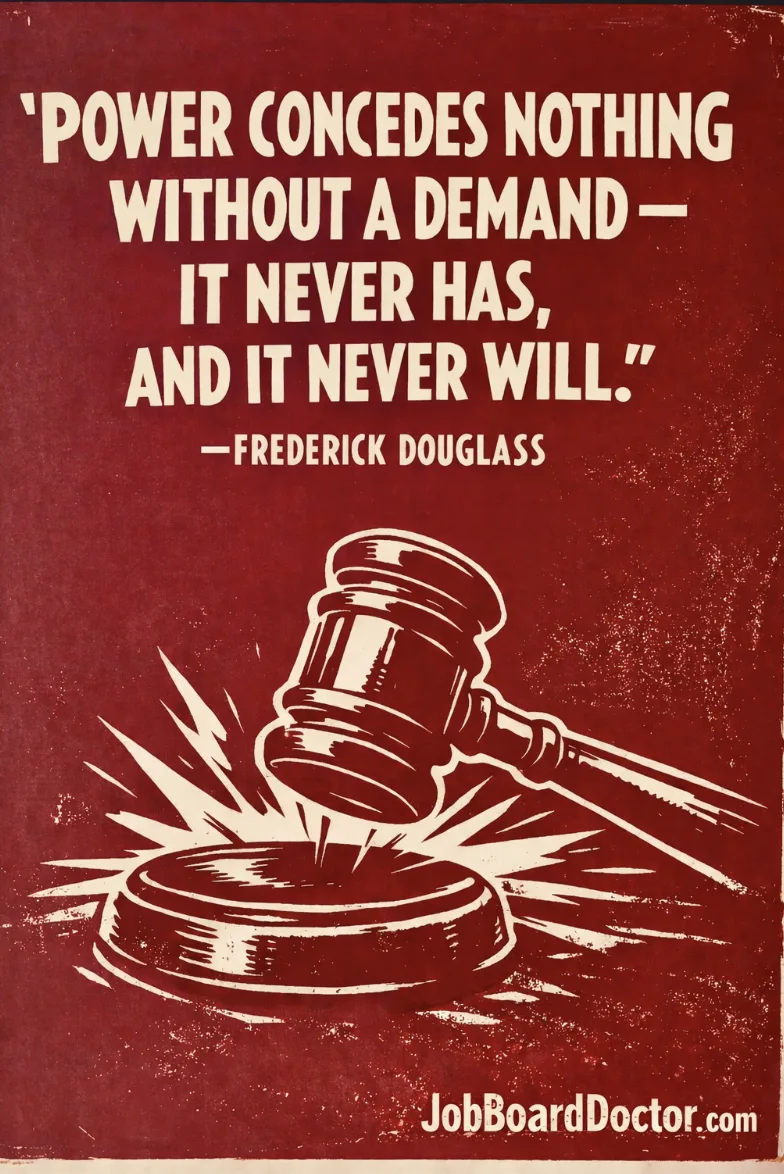 Why the Eightfold Lawsuit Should Concern Every Employer and Vendor in TA Tech
Happy Friday, Job Board Doctor friends! Earlier this week I had the pleasure of joining a panel discussion on the Eightfold AI class action lawsuit and what it means for our industry.
The discussion presented by Warden.ai was hosted by Martyn Redstone, Head of Responsible AI & Industry Engagement, and included Jeff Pole, CEO and Co-Founder of Warden.ai and the inscrutable Hung Lee of Recruiting Brainfood fame.

I found it to be a valuable discussion and invite you to watch the replay and tell me what you think. Of course, I have some thoughts on what I shared there I want to expand on with you all.
“Activist Litigation”
Over the past week or so, I have heard somethings that need to be addressed head on and it did not just start with the Eightfold class action.
Some TA tech leaders are telling vendors not to worry about the these AI in hiring lawsuits. Here is a dismissal shared on LinkedIn regarding the Mobley v Workday and it is eye-catching.
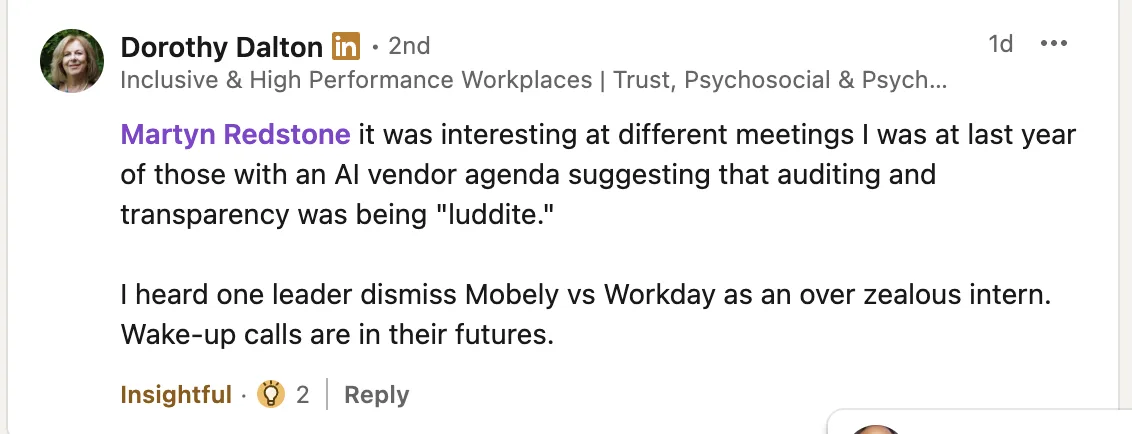
Arrogant much? Also, Dorothy Dalton do not be afraid to name names.
The dismissal I heard which made my head spin was this is “activist litigation”, a pejorative meant to delegitimize the case based on the law firms involved, specifically Outten & Golden LLP and the non-profit Towards Justice, rather than engaging with the substance of the claims.
This Framing Is Both Historically Ignorant And Strategically Dangerous
Plaintiffs have a right to request the court hear their complaint. The Federal Consumer Reporting Act (FCRA) has specific requirements.
Either Eightfold is complying or it isn’t.
The reputation of the plaintiffs’ counsel doesn’t change what the law says.
And for the record, Jenny Yang, the partner leading the case at Outten & Golden, is the former Chair of the U.S. Equal Employment Opportunity Commission (EEOC). I have met her personally and heard her speak on many occasions.
She is exactly the kind of legal firepower you bring when you intend to set precedent.
Litigation Has Led Where Legislation Fails To
The United States has a long, well-documented history of litigation being the mechanism to force systemic change when the other branches of government fail to act. This is especially true when it comes to workers’ rights and protection of vulnerable classes of people.
We can trace this directly through the history of the U.S. labor movement.
The courts legalized unions. The courts enabled collective bargaining. The courts upheld the minimum wage. The courts enforced health and safety standards.
The landmark 1937 Supreme Court decision in NLRB v. Jones & Laughlin Steel Corp. is a perfect example. Jones & Laughlin fired ten workers for trying to unionize. The company refused to comply with the National Labor Relations Board, arguing the Wagner Act was unconstitutional.
The Supreme Court upheld Congress’s authority to protect workers’ rights to organize and bargain collectively. This decision fundamentally reshaped American labor law.
Congress Has Had Its Chance. It Failed.
Over the last two Congresses, lawmakers have introduced a flood of AI related bills. The Brennan Center for Justice tracked over 150 AI bills introduced during the 118th Congress alone.
The 119th Congress has continued at a similar pace. Most of these bills proposed comprehensive oversight of AI systems, including their use in employment decisions.
Yet, not one meaningful AI regulation bill has passed into law.
The 118th Congress passed zero AI bills. The 119th has managed exactly one, the TAKE IT DOWN Act, which deals with deepfakes, not employment.
As the Center for American Progress noted, this congressional inaction is part of a broader history of failure to regulate technology. Leaving users largely unprotected and pushing states to fill the void.
In fact, rather than regulating AI, Congress nearly did the opposite. Earlier versions of the One Big Beautiful Bill Act included a provision for a ten-year moratorium on state AI regulation. This provision focused on effectively blocking the statehouses actually trying to protect workers from AI harms. The Senate rejected that provision 99-1 in July 2025, but House leadership has repeatedly attempted to revive it.
Let that sink in. Congress will not pass AI protections, but it nearly passed a law preventing states from enacting AI protections.
The Executive Branch Has Gutted Enforcement
While Congress languishes, the executive branch has been actively dismantling the enforcement infrastructure that protects workers.
On January 21, 2025, President Trump signed the executive order “Ending Illegal Discrimination and Restoring Merit-Based Opportunity,” which revoked Executive Order 11246. EO 11246 was a foundational civil rights directive signed by President Lyndon Johnson in 1965 that required federal contractors to maintain affirmative action programs and prohibited employment discrimination. That’s 60 years of worker protections, gone with the stroke of a pen. (Holland & Knight)
The order also fundamentally reversed the mission of the Office of Federal Contract Compliance Programs (OFCCP). The OFCCP is not only prohibited from requiring affirmative action by federal contractors. In fact, it must now actively prevent contractors from implementing such programs.
Friends, it did not (and will not) stop there.
On May 12, 2025, the Consumer Financial Protection Bureau (CFPB) announced the withdrawal of the critical 2024 circular on “Background Dossiers and Algorithmic Scores for Hiring, Promotion, and Other Employment Decisions.”
The very guidance that warned employers that AI-driven hiring tools must comply with the FCRA. That guidance is the foundation of the Eightfold complaint. The Trump administration rescinded it.
The EEOC removed its own AI-related guidance from its website on January 27, 2025, just days into the new administration. According to K&L Gates, “This guidance, published in May 2023, addressed how existing federal anti-discrimination law may apply to employers’ use of AI when hiring, firing, or promoting employees.”
Enter the Courts
So here we sit. Congress will not legislate. The executive branch is dismantling enforcement. The entities created to protect workers are being defunded, redirected, or muzzled.
This is exactly the environment that creates regulation by litigation.
This is precisely what the Eightfold lawsuit represents. Plaintiff’s attorneys are looking at where they can utilize existing law to provide protections in the Wild West of AI hiring.
They do not need new legislation. The FCRA already exists.
The question is whether its protections extend to AI-generated candidate scores and dossiers. That is a question for a judge, not the fingers crossed shit talkers in our industry.
As I wrote in my analysis of the case two weeks ago, this is on its face an FCRA complaint. It absolutely is.
But if this case moves forward it will be the opening of Pandora’s box of discovery.
But IF (and it is still a big if) a court orders Eightfold to open its books, to show how the data is gathered, what is being inferred from that data, and how those inferences impact a candidate’s 0-5 score, this becomes the roadmap.
A roadmap for every (potential) plaintiff’s attorney in the country.
Don’t forget, Eightfold’s own privacy policy admits to collecting “inferences drawn…to create a profile about a consumer reflecting the consumer’s preferences, characteristics, predispositions, behavior, attitudes, intelligence, abilities, and aptitudes.”
Their patent application describes generating “Personality Insights” including whether someone is a “team player, introvert, extrovert.”
The FCRA covers reports bearing on “character, general reputation, personal characteristics, or mode of living.” Eightfold’s own marketing uses strikingly similar language. (Outten & Golden press release; Fast Company)
Why “Activist Litigation” Is Exactly Right – Just Not How They Mean It
Here’s my message to the TA tech leaders telling vendors to relax: You are wrong and your framing reveals more about your position than you realize.
Yes, this is activist litigation. In the same way the cases that legalized unions were activist litigation. In the same way the lawsuits that established workplace safety standards were activist litigation. In the same way every major expansion of worker protections in American history was driven by lawyers who saw a gap between what the law promised and what was actually happening to people.
The word “activist” is only a pejorative if you are on the side that benefits from inaction.
This won’t be the last lawsuit. This is a test case, and regardless of its outcome, it will signal to attorneys nationwide where the pressure points are. The discovery process alone, if the case proceeds, may generate intelligence to fuel the next wave of cases. And the next. And the next.
Employers and vendors should be deeply concerned. Not just about Eightfold’s exposure, but about their own. If you’re using AI tools in hiring and you don’t know exactly how candidate data is being collected, what inferences are being drawn, and whether candidates have the ability to see and dispute that information – you have a problem and “activist litigators” aren’t going to wait for you to figure it out.
What Comes Next
We are entering an era where the courts will increasingly fill the regulatory vacuum created by congressional inaction and executive branch rollbacks.
State attorneys general are already stepping up. The Democratic Attorneys General Association recently hired former CFPB Director Rohit Chopra to advise on consumer protection enforcement. States like New York, California, and Illinois are moving forward with their own AI regulations. (American Banker)
For those of you in talent acquisition, audit your AI vendors now and continuously.
Understand what data they collect, how they use it, and what disclosures they provide to candidates.
Do not wait for the next lawsuit to name your company as a co-defendant. Yes, the plaintiffs in the Eightfold case filed against the vendor, but as employment attorneys have already noted, it’s easy to foresee employers being drawn into this battle as well.
Just like in Mobley.
And for those dismissing this as “activist litigation” – I would encourage you to pick up a history book. The activists have a pretty good track record.
Until Next Time,
Julie “The Doc” Sowash
[Want to get Job Board Doctor posts via email? Subscribe here.]
[Got a tip, document or intel you want to share with the Doc? Tell me. Tip so hot you need it to be encrypted? Use Signal.]
Comments (0)