
Understanding the Real State of the Job Market
 Guest post: Michael Woodrow, President at Aspen Technology Labs, Inc.
How real-time employer data reveals a truer picture of hiring activity in 2025.
The gap between what official labor data reports and what is actually happening in the job market has never been wider. Traditional benchmarks like government surveys are losing credibility as response rates fall and revisions increase. In the United States, the Bureau of Labor Statistics now captures data from only about 43% of surveyed employers, down from more than 60% a decade ago. The United Kingdom’s response rate is closer to 20%. With smaller samples and heavier modeling, much of what is published each month is partial or outdated.
While government labor statistics have long been seen as the foundation for understanding employment trends, they are no longer the only source shaping the conversation. Today, private data providers play an increasingly important role in filling the gaps left by declining survey response rates and delayed reports. These providers use different data collection methods, some aggregating job postings from job boards, others from both job boards and employers directly, which can lead to variations in how trends appear across datasets.

Talroo brings clarity to improve new-hire retention
You filled the seat, but not with someone who plans to stay. The candidate made it through your entire interview process while quietly interviewing with other companies that pay 25% more.
When expectations aren't clear up front, retention suffers.
Get clarity up front with Talroo's SmartQualify.
Aspen Tech Labs’ (Aspen) data is based solely on direct employer sources and company career sites, giving a clear, real-time view of actual planned hiring activity worldwide. By focusing exclusively on organic employer postings, we can provide early indicators of labor market shifts and offer a cleaner, more immediate view of how hiring activity is actually evolving, not months after the fact, but as it happens. Our dataset currently tracks more than 9.8 million active job postings from over 200,000 employers across 193 countries, refreshed daily.
NOTE: All figures refer to data collected in early October 2025, unless otherwise noted.
What’s Happening in the Job Market Right Now?
Across major economies, hiring has slowed but remains steady. In the United States, Aspen Tech Labs currently tracks about 5.7 million active job postings, representing openings from more than 149,000 unique employers. While this does not encompass every job posting in the U.S. market, it provides a robust, significant, and representative sample of employer activity, much broader than traditional sources such as the JOLTS survey, which typically draws from surveys sent to approximately 21,000 companies. Based on Aspen’s dataset of 149,000 employers, active postings in the U.S. are down 4.2% year over year, a mild improvement from the 4.5% decline observed in 2024. (Figure 1).

Figure 1: U.S. Job Posting Trend YoY, as of the beginning of October 2025
The United Kingdom shows stronger signs of stabilization, with Aspen-monitored postings down 2% compared with a 14.4% drop at the same time last year (Figure 2). Roughly one-third of all UK vacancies are sourced through recruitment agencies. Direct employer postings are down slightly, while agency listings are up. However, the month-over-month trend tells a different story: employer postings increased by 2.5%, while agency postings dipped by 0.3%. This reversal may indicate that employers are gradually regaining confidence and beginning to post directly again, rather than relying solely on third-party recruiters. Overall, hiring activity in the UK remains below pre-2023 levels, but the market is clearly stabilizing.
In continental Europe, the picture is mixed. Germany’s postings are down 7.3%, a sharper decline than a year ago, while France has fallen only 1.2%, suggesting stagnation rather than contraction. Overall, the slowdown is measured, not dramatic, and hiring activity remains widespread across industries.
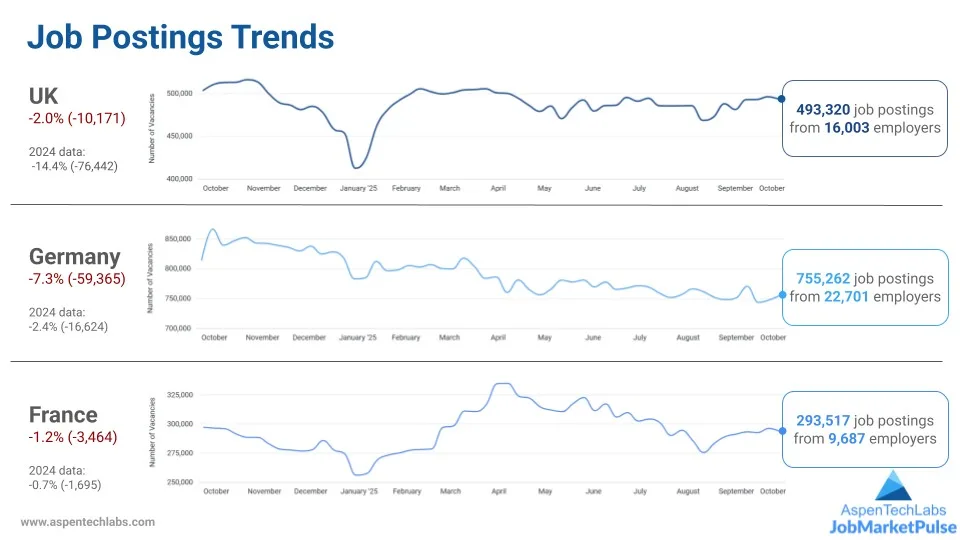
Figure 2: Multi-country line chart showing Aspen-monitored job posting trends in the UK, Germany, and France from 2024 to 2025
Transparency and Transformation
One of the most visible structural shifts in the market is the rise of salary transparency. In the United States, as of the beginning of October 2025, 50.2% of job ads now include pay information (Figure 3), up from 43% same time in 2024 and 30% in 2023. The European Union’s Pay Transparency Directive, which EU member states must implement by June 7, 2026, will make pay disclosure mandatory across member states. Combined with growing candidate expectations, this shift is setting a new standard for openness in hiring.

Figure 3: Salary transparency chart comparing the US, UK, and France
Hiring among large employers is steady but deliberate. Publicly listed companies are maintaining near-normal activity, though with a sharper focus on strategic roles. S&P 500 firms are operating at about 95.9 percent of last year’s level, a decline of roughly 4.1 percent year over year. STOXX Europe 600 companies are at 95.2 percent, down about 4.8 percent (Figure 4). These figures reflect a moderate softening in corporate hiring, consistent with the broader decline in job postings seen across the United States and Europe. Rather than signaling contraction, this shift points to a more measured approach. Companies are being selective, focusing on roles tied to innovation, automation, and efficiency, particularly within manufacturing, engineering, and technology areas that continue to attract steady investment despite slower overall growth.

Figure 4: Heatmap of where STOXX Europe 600 Companies are hiring
The Acceleration of Tech and AI Roles
Interestingly, TA Tech and recruitment technology roles are up 16%, showing that companies are focusing on how they hire, not just how many people they hire. Traditional IT roles have declined slightly, reflecting a shift toward automation, analytics, and AI-driven work.
Technology-related hiring tells an even clearer story of transformation. Globally, AI-related postings have increased 46% YoY. The UK leads Europe with 54.5% growth, followed by Germany at 14.5% and France at 9.07% (Figure 5).TA Tech roles and recruitment technology roles are up 16%, showing that companies are focusing on how they hire, not just how many people they hire. Traditional IT roles have declined slightly, reflecting a shift toward automation, analytics, and AI-driven work.

Figure 5: Chart showing the change in AI-related hiring posts
Hiring Signals and Early Indicators
It’s equally important to understand what’s happening at the company level, who is hiring right now, how quickly hiring is changing, and what that activity might signal. By analyzing job posting behavior daily, at the company and country level, Aspen helps its customers identify organizations showing consistent growth in open roles over the past 30, 60, or 90 days. These hiring signals often act as early indicators of strategic movement, such as expansions, new market entries, product launches, or internal reorganizations. When companies accelerate hiring, it usually reflects a broader story of investment and confidence.
Recent data highlights several firms demonstrating this upward momentum, including Marks & Spencer, Bouygues, Orano, BMW Group, and Vinci Energies, each showing sustained increases in job postings over recent months. While macro-level trends help us understand the overall direction of the labor market, company-level signals provide a real-time pulse of where opportunities are emerging. They bridge the gap between official data and on-the-ground activity, helping analysts, job boards, and businesses anticipate change before it reaches the headlines.

Figure 6: Hiring Signal chart showing rising job posting changes
A Market Redefining Itself
The labor market in 2025 is neither booming nor breaking. It is recalibrating. Hiring volumes are lower than last year but remain broad-based. Pay transparency is moving from trend to standard. Large companies are hiring more carefully, focusing on value rather than volume. And technology-driven roles, especially those tied to AI and recruitment systems, are leading the next phase of workforce transformation.
Real-time, direct-from-employer job vacancy data cuts through the noise, showing that, behind the headlines of slowdowns and revisions, companies are still hiring, innovating, and adapting. The story of today’s labor market is not one of decline, but of change, and clarity comes from watching the data unfold in real time.
This analysis is powered by Aspen Tech Labs, which tracks real-time job posting activity directly from employer career sites and recruiters. By sourcing data at its origin, Aspen delivers a consistent and transparent view of global hiring behavior free from lag, duplication, or modeling. To see how this intelligence can support your organization’s strategy, reach out to schedule a demo.
[Want to get Job Board Doctor posts via email? Subscribe here.]
[Got a tip, document or intel you want to share with the Doc? Tell me.]

This entire article is premised on this claim: 1 job posting on an employer’s website is equivalent to 1 hire.
Fact-check rating: More holes than a completed punch card.
Truth: For any posting, employers may hire 0, 1, or many people.
Truth: Employers often hire people without an online posting.
Equating job postings with actual hiring is a huge step. Think of all the non-posted jobs: farm work/low-skilled work, family businesses, self-employed, using recruiters/third part sites, under the table, campus recruitment, direct/personal recruitment, etc.
Now think of all the postings that don’t result in hiring: postings for compliance, duplicates, testing the market, data gathering, resume banking, business reorganization, lack of quality candidates, intentional data manipulation, etc.
Aspen Hill Tech is marketing the results of data scrapping. We can use the data as one indicator of hiring, but it’s borderline fraudulent to claim that it accurately reflects actual hiring. It’s useful only when combined with reporting from payroll companies, government data (in the US, labor statistics and unemployment), and other economic indicators like inflation, consumer and business spending, etc.