
Guardian Jobs is Closing.

Guardian Jobs closing was the week’s biggest job board story, and the official explanation doesn’t tell the whole story. This week I trace the revenue trail from the 2008 peak to last week’s announcement.
Happy Friday Job Board Doctor friends. September is here, the Brits have left the Algarve and returned home after the August holiday.
Unfortunately for the Job Board industry watchers, they came home to some stunning news.

Talroo brings clarity to improve new-hire retention
You filled the seat, but not with someone who plans to stay. The candidate made it through your entire interview process while quietly interviewing with other companies that pay 25% more.
When expectations aren't clear up front, retention suffers.
Get clarity up front with Talroo's SmartQualify.
On September 2, the Guardian announced it is closing Guardian Jobs. Recruiters were told the platform begins winding down operations September 4, per Press Gazette who I credit for excellent reporting on the news.
The site is still live and delivering committed campaigns, with no announced shutdown date. The statement came from Imogen Fox, the Guardian’s global chief advertising officer, and the stated reason was a fundamental shift in the UK recruitment landscape, with vacancies at their lowest level in five years.
Truly, I did not see this one coming. This was not a zombie board coasting on domain authority. At the time of the announcement, the site carried nearly 15,000 live listings across media, education, government, charity, social care, and the arts, with employers including Conde Nast, Hearst UK, Reach, and Future still buying, per Press Gazette.
This was one of the most credible destination boards in the UK, attached to one of the most trusted media brands in the world, serving a loyal purpose-sector audience.
HISTORY OF GUARDIAN JOBS
The Guardian launched one of the UK’s first online recruitment sites in 1996. Guardian.co.uk/jobs went live in 2001 and was pulling 460,000 unique monthly users by 2004, per Press Gazette.
Before that, recruitment classified was one of the engines of the paper itself. The Guardian ran dedicated print supplements built on job ads: Media on Mondays, Education on Tuesdays, Society on Wednesdays. Those job ads did not just support a job board. They funded the Guardian’s journalism efforts.
THE REVENUE STORY
I pulled Guardian Media Group’s investor reports, and the trail they leave is more revealing than any single number.
Start at the peak. In the FY2008 (ending CY Q1 2008), Guardian News & Media posted turnover (revenue for Americans) of £261.9m, up from £245.7m the year before
The movement from print recruitment advertising revenues had begun to decline, but were offset by a 49% increase in digital recruitment revenues. The move to digital advertising was ramping, not just for job ads.
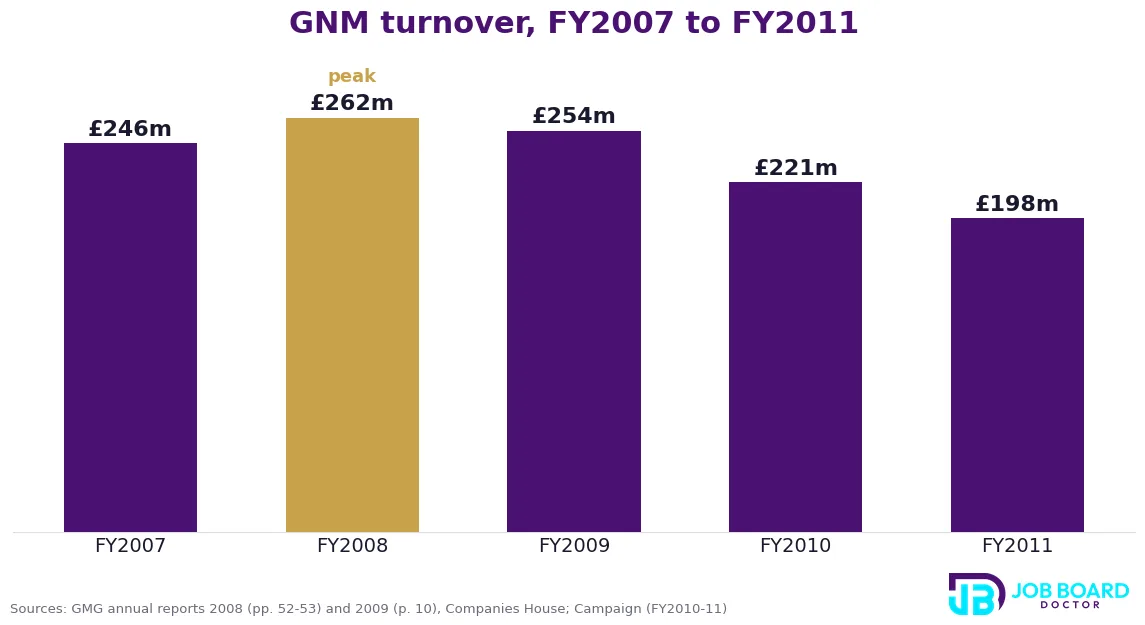
By April 2011, GNM revenue was down to £198.2m from £221.0m, and GMG chief executive Andrew Miller attributed the drop specifically to a sharp decline in recruitment advertising, driven by the recession and deep public sector spending cuts, per Campaign.
A GNM source said the Guardian was hit harder than any other national paper by the loss of public sector recruitment ads. That concentration detail matters: Guardian Jobs was built on public sector, education, charity, and social care hiring, and when austerity cut those budgets, this board absorbed the hit ahead of the general market.
The same year, the Guardian killed the printed job-ad supplements, saying recruitment advertisers now wanted employer branding and passive-seeker reach rather than listings.
After 2011, recruitment stops appearing as a named driver in GMG results coverage. It gets absorbed into an advertising line that was itself shrinking around it.
Advertising fell from 38% of Guardian revenue in 2016 to 24% in 2024, per editor-in-chief Katharine Viner’s comments reported by Press Gazette.

In GMG’s 2024/25 annual report, the only mention of Guardian Jobs revenue is a note showing it sits inside “other revenue,” lumped in with content licensing, events, and philanthropic funding, per Press Gazette.
That was GMG’s best revenue year in memory: £275.9m in total revenue, with digital reader revenue up 21.7% to £107.3m, per the group’s 2024/25 results.
Even though reading a P/L isn’t not the most enjoyable way to spend a Thursday evening, accounting disclosures are chock full of critical signal data.
Guardian Jobs went from named revenue driver, to blamed loss driver, to a merged line, to “other,” to closed.
VACANCIES AS THE CAUSE
The job market in the UK is more than tough for job seekers right now. The public statement about why Guardian Jobs is closing pointed to the vacancy rates (job openings in the UK), and the underlying data point is real.
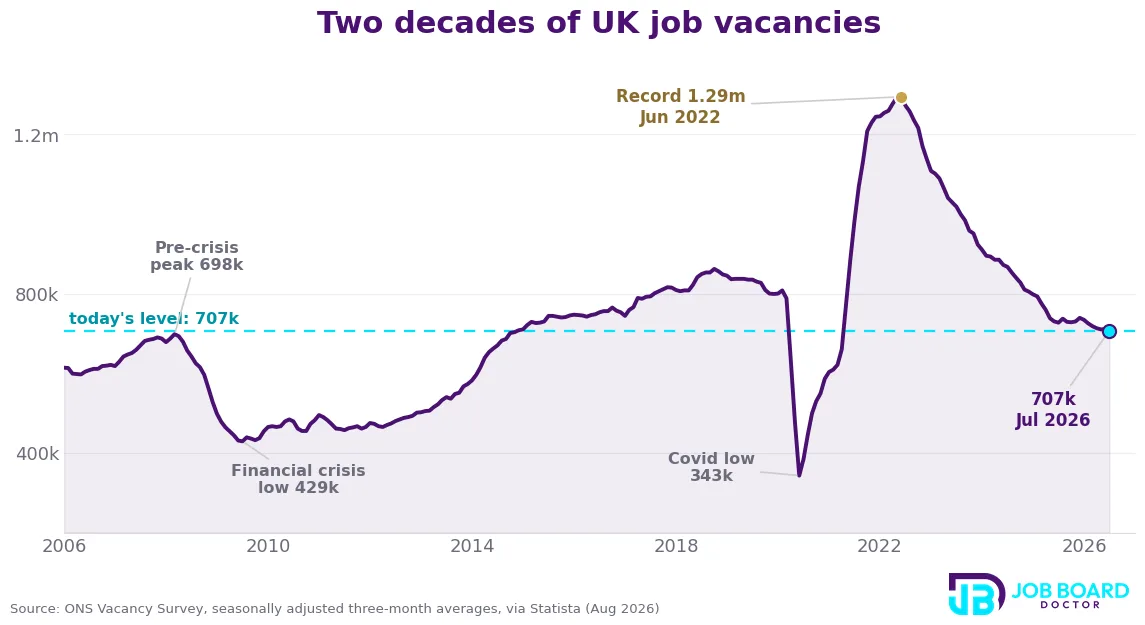
In fact, the Office of National Statistics (ONS) reported 707,000 vacancies in the UK between May and July 2026, the lowest number excluding the pandemic since late 2014, down 2.7% year over year.
Now put that next to the publisher side. Recent Association of Online Publishers and Deloitte surveys of 13 digital publishers found recruitment revenue falling year over year by more than 90% in two quarters last year, per Press Gazette.
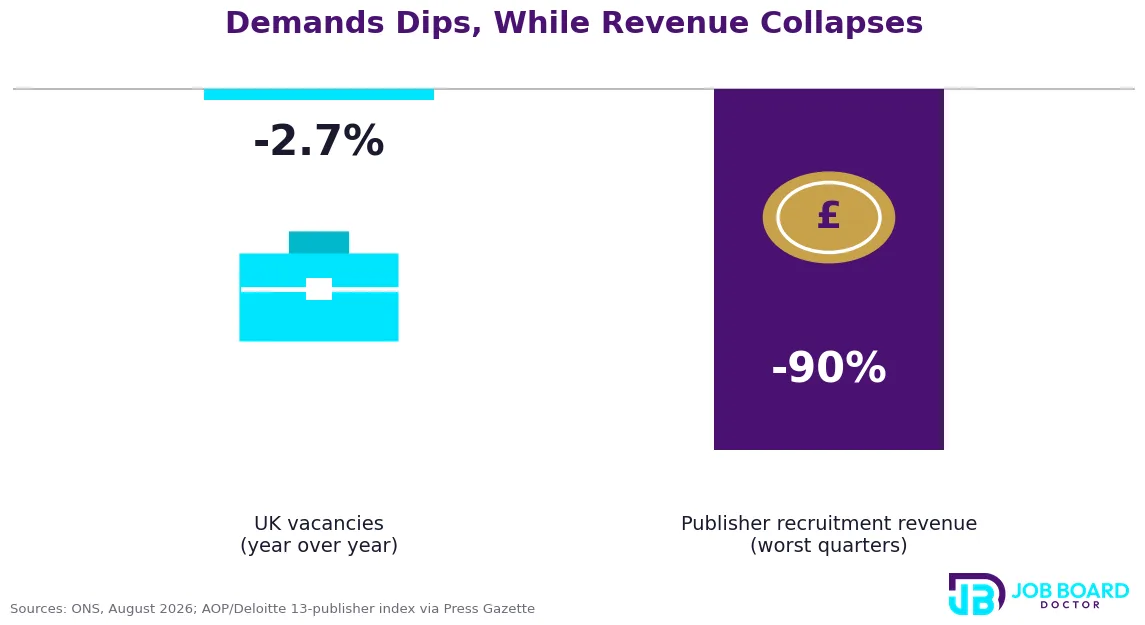
A 2.7% decline in demand does not produce a 90% decline in revenue. A structural rerouting of recruitment spend does.
The vacancy rut is when the last margin disappeared. It is not why the business died.
GMG’s own 2009 accounts named the structural pressure, and the Guardian described the mechanism again in 2011 when it said advertisers wanted reach and branding rather than listings. It just took fifteen more years for the model to finish going where those statements pointed.
Worth saying plainly: this closure happened inside a group posting record revenue, backed by a £1.25bn endowment, per Press Gazette. GMG did not close Guardian Jobs because it could not afford to run it. It closed it because a destination job board no longer earned its place in the portfolio, even with a trusted brand, a defined niche, and 15,000 live listings.
THE LOSS IS REAL
Guardian Jobs was one of the few UK boards where charity, education, social care, and public sector candidates could search without wading through arbitrage inventory. Those job seekers do not stop existing when the board does. They get pushed onto aggregators and platforms optimized for volume, where a hospice fundraising role competes for attention with everything else on the internet.
The infrastructure serving purpose-driven candidates just got thinner, and nobody announced a replacement. And beyond the mechanics, it is worth pausing that Guardian Jobs is now simply gone. For thirty years, Guardian Jobs was where a generation of teachers, social workers, charity fundraisers, journalists, and public servants found the work that became their careers.
Whole professional lives in this industry were spent building it, selling it, and running it well, and the people who did that work deserved a better ending than a paragraph about market conditions.
If Guardian Jobs was part of your story, as an employer, a recruiter, a candidate, or one of the people behind it, this is a hard week, and we are all feeling it, in some small way, with you.
Institutions like this one do not come back once they are gone. The least the rest of us can do is mark the loss properly, and remember that behind every wind-down notice is a team getting the worst news of their year.
[Want to get Job Board Doctor posts via email? Subscribe here.]

Comments (0)